
India installed a record 44.6 GW of new solar capacity in FY2026, an 87% jump over the previous year, with ground-mounted projects alone accounting for 34.8 GW of that total, according to JMK Research. Behind almost every one of those ground-mounted megawatts sits a document that decided whether the project got built or quietly died: a solar farm business plan. If you own land, have capital to deploy, or simply want a stable 25-year income stream, this guide walks you through exactly what that plan needs to contain in 2026.
You will get real capital cost numbers per MW, land and grid rules that decide feasibility, the licences you must arrange, the revenue and payback maths lenders actually check, and a practical route for anyone building a solar farm business plan in India for the first time. We will also cover a new small business plan on solar farm development at 500 kW to 2 MW scale, which is where most first-time promoters now start.
What a Solar Farm Business Is and Why It Works in 2026
A solar farm, also called a solar park or ground-mounted solar power plant, is a utility-style installation that generates electricity for sale rather than for self-consumption. You install panels on open land, connect to the distribution or transmission grid, and sell every unit you generate under a long-term contract. That single revenue model is what makes the business bankable, and it is what your entire solar farm business plan has to protect.
India’s Solar Boom Has Made Room for New Entrants
As of 31 March 2026, India’s installed solar capacity reached 150.26 GW, including 110.43 GW of utility-scale plants, and the country now ranks third globally in renewable capacity, as confirmed by the Ministry of New and Renewable Energy. The national target of 500 GW of non-fossil capacity by 2030 means roughly another 200 GW has to be built in four years. State discoms, commercial buyers and open-access aggregators are all short of contracted green power, which is why a well-prepared solar farm business plan finds an offtake buyer far more easily today than it did five years ago.
What Your Solar Farm Actually Sells
Your product is a kilowatt-hour, and you have four realistic ways to sell it. You can win a state or central auction and sign a 25-year power purchase agreement with a discom. You can sell to a commercial or industrial buyer through open access at a tariff higher than the discom rate. You can supply a captive group company and save on their electricity bill. Or you can lease your land to a developer and take a fixed rent without operating anything. Each route changes your risk, your capital need and your returns, so your solar farm business plan must commit to one before anything else.
Solar Farm Business Plan in India: The Core Numbers You Must Get Right
Every solar farm business plan in India stands or falls on four numbers: cost per MW, land per MW, units generated per MW, and the tariff you will receive. Get these four right and the rest of your solar farm business plan is detail. Get them wrong and no amount of formatting will save the project.
Capital Cost per MW in 2026
A turnkey ground-mounted solar plant in India costs roughly Rs 3.5 crore to Rs 4 crore per MW in 2026, before land purchase and before battery storage. Adding a battery energy storage system pushes that to Rs 4 crore to Rs 5 crore per MW. Modules remain the single largest line item at around 45% of capital cost, followed by inverters, mounting structures and grid evacuation infrastructure. The image below breaks the number down so your solar farm business plan carries a defensible cost sheet rather than a round figure.
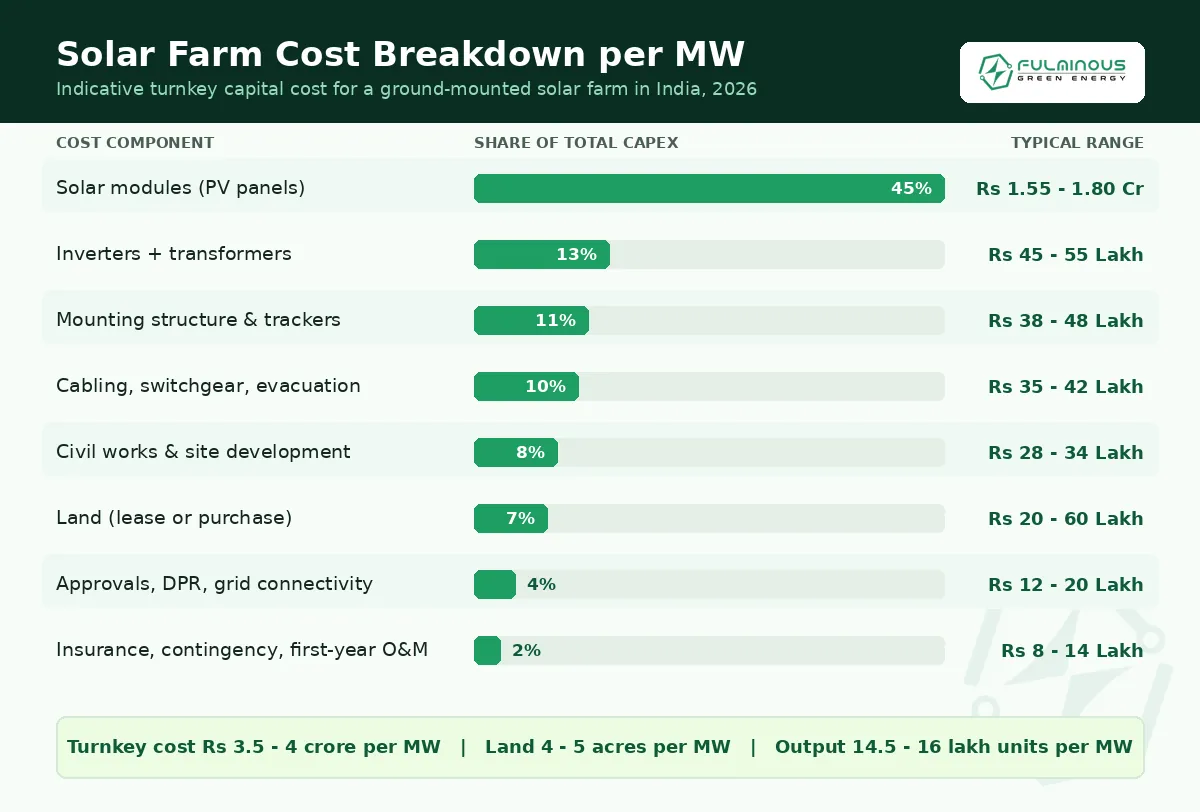
Capital cost breakdown per MW used in a typical solar farm business plan, India 2026.
| Cost Component | Share of Capex | Typical Cost per MW |
|---|---|---|
| Solar modules | 45% | Rs 1.55 to Rs 1.80 crore |
| Inverters and transformers | 13% | Rs 45 to Rs 55 lakh |
| Mounting structure and trackers | 11% | Rs 38 to Rs 48 lakh |
| Cabling, switchgear and evacuation | 10% | Rs 35 to Rs 42 lakh |
| Civil works and site development | 8% | Rs 28 to Rs 34 lakh |
| Land (lease or purchase) | 7% | Rs 20 to Rs 60 lakh |
| Approvals, DPR and connectivity | 4% | Rs 12 to Rs 20 lakh |
| Insurance, contingency and first-year O&M | 2% | Rs 8 to Rs 14 lakh |
Land Requirement, Soil and Grid Distance
Plan for 4 to 5 acres of usable land per MW for a fixed-tilt plant, and closer to 6 acres per MW if you use single-axis trackers. Three site conditions matter more to a solar farm business plan than the land price itself. First, the land must be classified correctly in revenue records as barren, fallow, cultivable wasteland or non-agricultural, because wrong classification is the most common reason applications get rejected. Second, the nearest 33/11 kV substation should be within about 5 km of cable route, not road distance, since evacuation cost rises sharply beyond that. Third, the site needs firm soil, no flooding history and year-round vehicle access for construction and cleaning crews.
Generation and Tariff Assumptions
A well-built plant in Rajasthan, Gujarat or Madhya Pradesh generates about 14.5 lakh to 16 lakh units per MW per year, while lower-irradiance states deliver 12.5 lakh to 14 lakh units. Use a 0.5% annual degradation factor across the 25-year life. On tariff, PM-KUSUM Component A auctions in 2026 have been settling in the range of Rs 2.80 to Rs 3.40 per unit depending on the state, while open-access sales to commercial buyers usually fetch more once discom charges are netted off. Never build your solar farm business plan on the highest tariff you have heard about; build it on the state-specific rate discovered in the most recent auction.
Not sure whether your land and grid connection actually qualify? Fulminous Green Energy runs free pre-feasibility checks on site classification, irradiance and substation distance before you spend a rupee on a DPR.
How to Write a Solar Energy Farm Business Plan Section by Section
A bank, a state nodal agency and a private investor all read the same solar farm business plan differently. A complete solar energy farm business plan satisfies all three by covering eight sections in a fixed order, with numbers that reconcile across every page.
The Eight Sections Lenders Expect
- Executive summary. One page of your solar farm business plan covering capacity, location, capital cost, offtake route, expected IRR and how much equity you are bringing.
- Promoter and entity profile. Company, LLP, farmer producer organisation or cooperative details, along with relevant experience and net worth.
- Market and offtake analysis. State demand, recent auction tariffs, the discom’s payment record and your chosen buyer.
- Technical plan. Module type and wattage, inverter configuration, plot layout, tilt angle, evacuation design and expected plant load factor.
- Land and approvals. Title documents, revenue classification, conversion status, connectivity approval and every statutory clearance you need.
- Implementation schedule. A month-by-month timeline from land tie-up to commissioning, usually 12 to 18 months in total.
- Financial model. Capex, debt and equity split, 25-year cash flow, debt service coverage ratio, IRR, payback and a sensitivity table.
- Risk assessment. Tariff risk, curtailment, discom payment delays, module degradation, weather events and how you have mitigated each one.
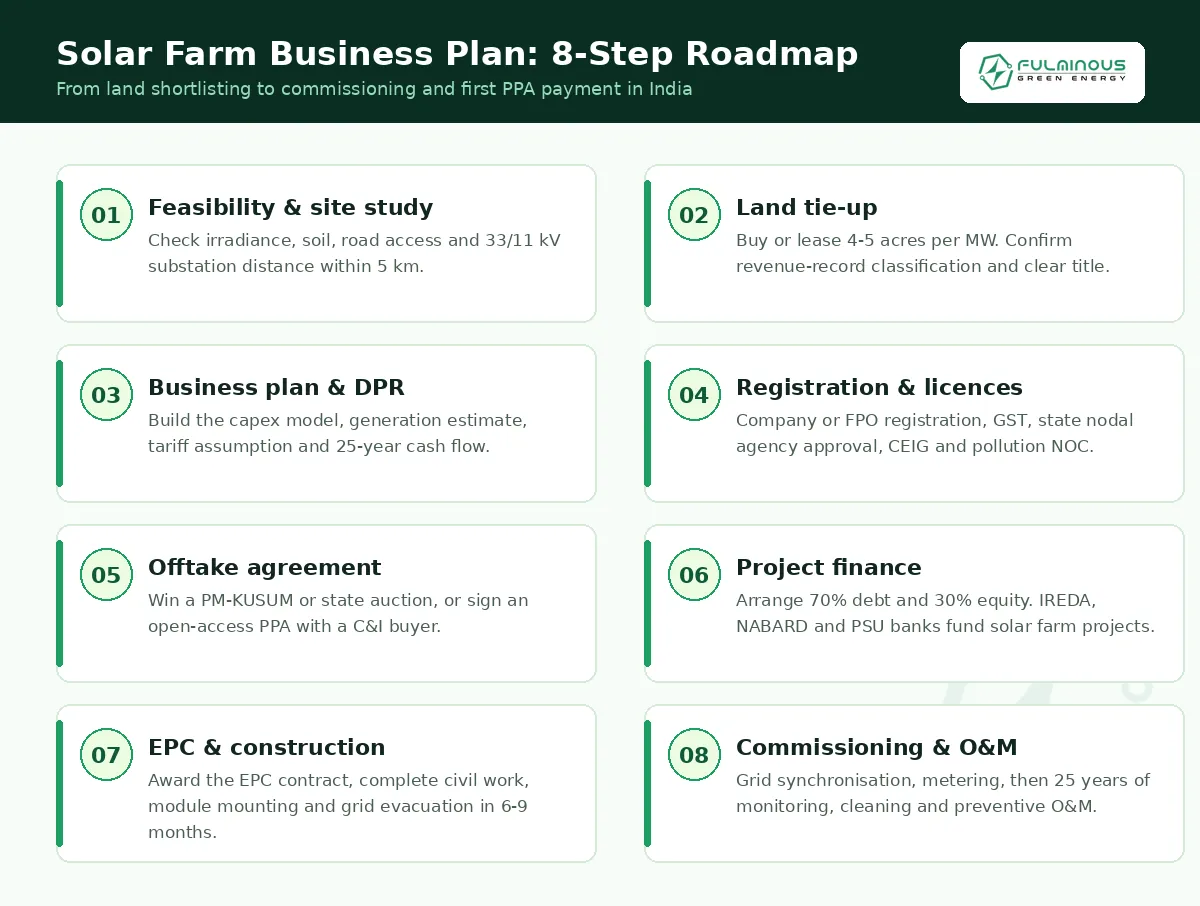
The eight execution steps that sit behind every approved solar farm business plan in India.
The Financial Model Is the Section That Gets Audited
Most rejected proposals fail in this part of the solar farm business plan, not on technical design. Your model should show a debt service coverage ratio of at least 1.3 in every year, a project IRR of 14% to 18% over 25 years, and an equity IRR that stays positive even if the tariff falls 10% or generation underperforms by 8%. Add a sensitivity grid to the solar farm business plan that flexes tariff, capex and plant load factor together, because that single table is what a credit committee looks at first. If you want a quick reality check before you build the full model, the solar ROI calculator gives you an indicative payback in minutes.
Fulminous Green Energy has grown into one of the best solar EPC companies in Jaipur by handling exactly this stage for its clients, not just the hardware that comes later. The team prepares bankable detailed project reports, runs site feasibility studies across Rajasthan, designs the evacuation layout, executes turnkey installation and then manages long-term operations and maintenance. For a promoter who is entering solar for the first time, having a single EPC partner carry the project from feasibility to commissioning removes the coordination risk that usually causes cost overruns.
Revenue, ROI and Payback in a Solar Farm Business Plan
Once your cost and generation assumptions are locked, the revenue side is straightforward arithmetic. Multiply annual units by tariff, subtract operations and maintenance, insurance and interest, and you have your annual free cash flow. What surprises most first-time promoters writing a solar farm business plan is how stable that number is compared with any trading or manufacturing business.
What a Solar Farm Earns per MW
At 14.6 lakh units per MW per year and a tariff of Rs 3.00 per unit, one megawatt generates about Rs 44 lakh of gross revenue annually. Operations and maintenance typically costs Rs 5 lakh to Rs 8 lakh per MW per year, covering module cleaning, inverter servicing, security, insurance and remote monitoring. With 70% debt at current lending rates, most projects turn cash-positive from the first full year of operation and repay the loan comfortably inside the tenure.
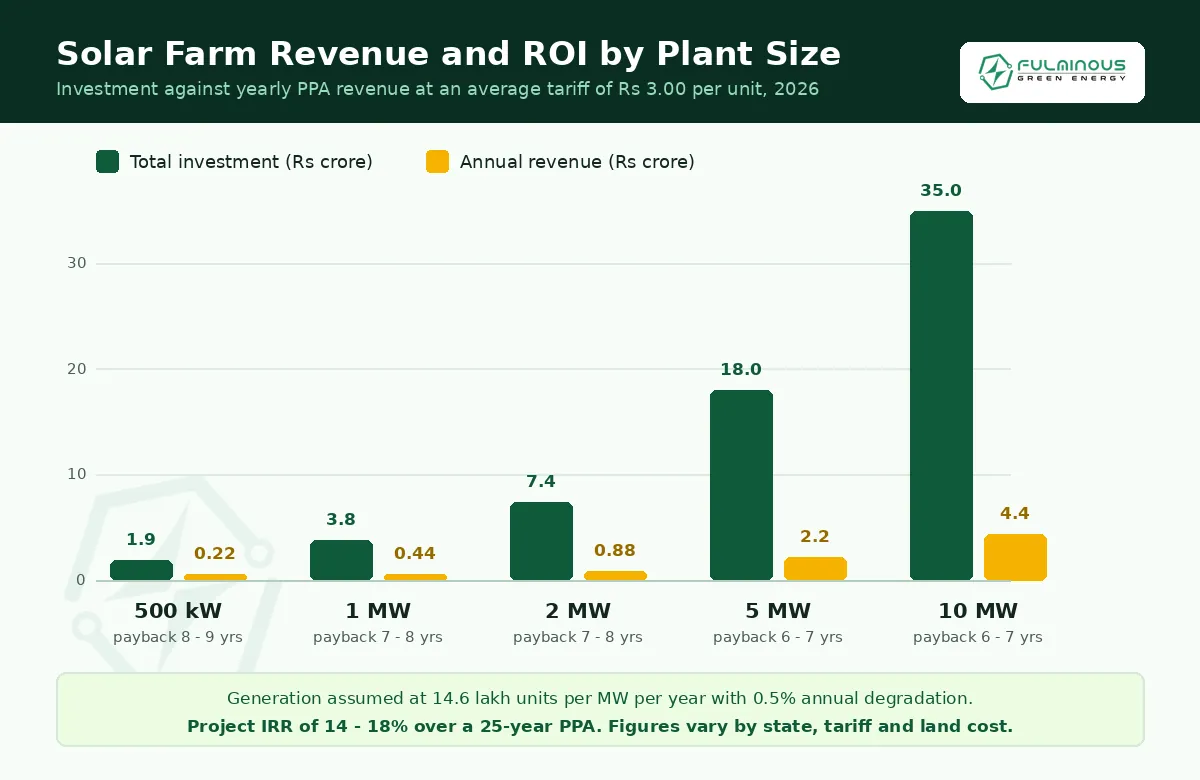
Investment against annual revenue and payback period by plant size, 2026 assumptions.
| Plant Size | Land Needed | Total Investment | Annual Revenue | Payback |
|---|---|---|---|---|
| 500 kW | 2 to 2.5 acres | Rs 1.8 to 2.0 crore | Rs 20 to 24 lakh | 8 to 9 years |
| 1 MW | 4 to 5 acres | Rs 3.5 to 4.0 crore | Rs 42 to 46 lakh | 7 to 8 years |
| 2 MW | 8 to 10 acres | Rs 7.0 to 7.6 crore | Rs 84 to 92 lakh | 7 to 8 years |
| 5 MW | 20 to 25 acres | Rs 17 to 19 crore | Rs 2.1 to 2.3 crore | 6 to 7 years |
| 10 MW | 40 to 50 acres | Rs 33 to 37 crore | Rs 4.2 to 4.6 crore | 6 to 7 years |
Scale clearly improves the returns in a solar farm business plan. Fixed costs such as approvals, evacuation infrastructure and site security do not rise in proportion to capacity, which is why per-MW cost falls as you move from 1 MW to 10 MW. If you are weighing larger capacities, our detailed cost pages for a 2 MW solar power plant, a 5 MW solar power plant and a 10 MW solar power plant give state-wise breakdowns you can drop straight into your model.
Want a bankable financial model built on your actual site data? Fulminous Green Energy prepares detailed project reports and 25-year cash flow models that lenders and state nodal agencies accept.
New Small Business Plan on Solar Farm Projects: Starting at 500 kW to 2 MW
You do not need 50 acres and Rs 40 crore to enter this sector with a solar farm business plan. A new small business plan on solar farm development at 500 kW to 2 MW is now the most common entry point in India, largely because PM-KUSUM Component A was designed exactly for that band and because smaller plants connect at 11 kV or 33 kV without heavy transmission work.
Why Small Solar Farms Make Sense Right Now
- Land requirement stays between 2 and 10 acres, which many farming families and small landowners already hold.
- Equity requirement drops to roughly Rs 55 lakh to Rs 1.2 crore for a 500 kW to 1 MW plant at a 70:30 debt-equity ratio.
- Approvals move faster because decentralised plants below 2 MW face lighter connectivity scrutiny than utility-scale parks.
- Construction finishes in 4 to 6 months rather than the 9 to 12 months a larger park needs.
- You can scale in phases, adding a second megawatt once the first one is generating and servicing its loan.
The PM-KUSUM Component A Route for Landowners
Under Component A of the PM-KUSUM solar scheme, farmers, cooperatives, panchayats and farmer producer organisations can install decentralised plants of 500 kW to 2 MW on barren or fallow land and sell the power to the local discom under a 25-year agreement. Land must sit within about 5 km of an eligible 33/11 kV substation. If you would rather not build anything, leasing the same land to a developer typically earns Rs 60,000 to Rs 1,00,000 per acre per year with an escalation clause, and carries no capital risk at all. Self-installation earns far more but needs the full Rs 3.5 crore to Rs 4 crore per MW investment and an appetite for operational responsibility.
All cost, tariff and subsidy figures here reflect publicly available 2026 data and vary by state, land price, module technology and the auction round in which your project is discovered. Always confirm current numbers with your state nodal agency before finalising your plan.
Licences and Approvals Every Solar Farm Business Plan Must Cover
Approvals are where solar farm business plan timelines slip. Listing them early, with realistic durations against each, is one of the clearest signals to a lender that your solar farm business plan was written by someone who has actually built something.
Documents and Clearances You Will Need
- Company, LLP, cooperative or FPO registration certificate along with PAN and GST registration.
- Land ownership or lease deed, revenue record extract confirming classification, and non-agricultural conversion where the state requires it.
- Connectivity and evacuation approval from the state transmission utility or discom.
- Registration with the state nodal agency and, where applicable, empanelment under PM-KUSUM or the state solar policy.
- Chief Electrical Inspector approval for the plant and switchyard before energisation.
- Pollution control board consent, fire safety clearance and, for larger parks, environmental screening.
- Signed power purchase agreement or open-access approval with the buying entity.
How Long Approvals Realistically Take
Expect 12 to 18 months from application to your first revenue. Technical scrutiny of your proposal takes 30 to 60 days, an auction round takes another 60 to 120 days, construction runs 6 to 9 months for a small plant, and grid synchronisation with metering adds a further 30 to 45 days. Build these durations into your cash flow, because interest during construction is a real cost that many first drafts forget entirely.
Funding a Solar Farm Business Plan: Loans, Subsidies and Investors
Most Indian solar farms are financed on a 70:30 debt-to-equity structure. On a 1 MW project that means about Rs 2.6 crore of debt and Rs 1.1 crore of your own money. Understanding which lender fits the profile in your solar farm business plan saves months.
Where the Money Comes From
IREDA lends specifically to renewable energy projects and is usually the first stop for a standalone solar farm. NABARD offers concessional refinance for farmer producer organisations and cooperatives under PM-KUSUM. Public sector banks and NBFCs fund projects backed by a signed discom power purchase agreement, and several now treat solar term loans as priority sector lending. Private equity and family offices enter at 5 MW and above, typically expecting a project IRR above 15%.
Subsidies and Policy Support Worth Claiming
Utility-scale developers inside a designated park can access central financial assistance of up to Rs 20 lakh per MW or 30% of project cost, whichever is lower, under the Solar Parks and Ultra Mega Solar Power Projects scheme run by the Ministry of New and Renewable Energy. States add their own incentives such as electricity duty exemption, stamp duty waivers on land purchase and banking facilities for open-access power. Our guides to the commercial solar park scheme and the National Green Hydrogen and green energy mission explain which of these you can stack together.
Planning a commercial or industrial scale plant instead? See real project pricing on our commercial solar installation cost in India page, then talk to our engineers about your site.
Risks and Mistakes That Break a Solar Farm Business Plan
Solar generation is predictable. A solar farm business plan is not automatically safe, and the difference almost always comes down to a handful of avoidable errors. Address each of these directly in your risk section rather than hoping the reader skips it.
- Assuming a tariff that no longer exists. Use the latest discovered rate in your state, not a national headline number from an old auction.
- Ignoring discom payment delays. Some state utilities pay 60 to 120 days late. Model a working capital buffer of at least three months of revenue.
- Underestimating evacuation cost. A substation 12 km away instead of 4 km can add Rs 40 lakh or more per MW to your budget.
- Skipping the land title check. Encumbrances, unclear inheritance and wrong revenue classification stall more projects than any technical issue.
- Choosing the cheapest EPC contractor. Poor structure design and weak cabling show up as generation loss for 25 years, which costs far more than the money saved upfront.
- Treating operations and maintenance as optional. Soiling alone can cut output by 8% to 15% in dusty regions, so a proper solar system maintenance contract protects your entire revenue line.
Build the Plan Around a Partner Who Will Still Be There in Year 10
A 25-year asset needs a 25-year relationship, which is why the EPC decision in your solar farm business plan deserves as much attention as the financial model. Recognised among the best solar EPC companies in Jaipur, Fulminous Green Energy delivers end-to-end renewable projects for residential, commercial, industrial and enterprise clients, covering feasibility studies, system design, procurement, installation, grid commissioning and long-term performance management. That continuity matters most in the years after commissioning, when generation data, warranty claims and preventive servicing decide whether your plant actually delivers the returns your plan promised.
Frequently Asked Questions About Solar Farm Business Plan
How much investment is needed for a solar farm in India?
A solar farm in India needs roughly Rs 3.5 crore to Rs 4 crore per MW as turnkey capital cost in 2026, excluding land purchase. With a 70:30 debt-equity structure, your own equity contribution works out to about Rs 1.05 crore to Rs 1.2 crore per MW for a standard ground-mounted project.
How much land is required for a 1 MW solar farm?
A 1 MW ground-mounted solar farm needs about 4 to 5 acres of usable land with fixed-tilt structures, and closer to 6 acres if you use single-axis trackers. The land should be barren, fallow or non-agricultural in revenue records and lie within roughly 5 km of a 33/11 kV substation.
Is a solar farm business profitable in India?
Yes. A well-sited solar farm typically delivers a project IRR of 14% to 18% across a 25-year power purchase agreement, with payback between 6 and 9 years depending on plant size and tariff. Revenue is contracted and predictable, which makes returns far more stable than most trading businesses.
How do I start a small solar farm business?
Start with a 500 kW to 2 MW plant under PM-KUSUM Component A. Confirm your land classification and substation distance, register an entity, prepare a detailed project report, apply through your state nodal agency, win the auction, then arrange 70% debt financing and appoint an experienced EPC contractor.
How much can I earn by leasing land for a solar farm?
Landowners leasing to solar developers typically earn Rs 60,000 to Rs 1,00,000 per acre per year on 25-year agreements, usually with a 5% escalation every two years. Leasing requires no capital and carries no operational risk, though it earns considerably less than building and running the plant yourself.
Turning Your Solar Farm Business Plan Into a Working Project
A solar farm business plan is not a formality you produce for a bank. It is the decision record that fixes your capacity, your site, your offtake buyer and your capital structure before you commit money you cannot easily recover. Anchor it on verified 2026 numbers, a tariff discovered in your own state, land whose title and classification you have personally checked, and a construction timeline that includes the approval months most first drafts leave out.
If you are ready to move from spreadsheet to site, Fulminous Green Energy works with landowners, farmer producer organisations, businesses and investors across Rajasthan and beyond on the full journey from feasibility study to commissioned plant. Ready to build your solar farm the right way? Contact Fulminous Green Energy today for a free consultation on your land, your capacity and your expected returns.
Have land and want to know exactly what it can earn? Get a site-specific capacity estimate, cost sheet and payback projection from the Fulminous Green Energy team at no cost.
Related Solar Guides
Keep reading — these guides from Fulminous Green Energy go deeper on costs, subsidies and installation.