
A rooftop system that is never cleaned can lose 25% to 40% of its yearly output, and almost none of that loss shows up as a fault code or a broken part. It simply disappears from your electricity bill savings, month after month. That is why solar panel maintenance is the single cheapest thing you can do to protect a system you already paid lakhs for.
India crossed 164 GW of installed solar capacity by the end of July 2026, and rooftop solar alone now sits at 14.8 GW after the PM Surya Ghar Muft Bijli Yojana crossed 50 lakh homes. Millions of families are living with a power plant on their roof for the first time, and most of them were handed a warranty card and very little practical guidance on solar panel maintenance.
This guide fixes that. You will learn exactly what solar panel maintenance involves, how often each task needs doing, what it costs in India in 2026, how to clean panels without voiding your warranty, the warning signs that mean you should call a technician today, and how good upkeep quietly adds years of returns to your investment.
Solar panel maintenance in 2026: cleaning schedules, costs and checklists for Indian rooftops.
What Solar Panel Maintenance Actually Involves
Most people hear the phrase and picture someone with a bucket and a cloth. Real solar panel maintenance is much broader than that. It is a structured routine that keeps the glass clear, the wiring safe, the mounting rigid, and the inverter healthy, so that every unit of sunlight that hits your roof turns into usable electricity.
Solar has no moving parts, which is why it is often described as maintenance free. That description is misleading. A better way to think about it is low maintenance, not zero maintenance. The tasks in a solar panel maintenance routine are simple, but skipping them for years is what turns a 25-year asset into a 12-year one.
The Three Layers of Solar Panel Maintenance
Every good solar panel maintenance plan works on three layers, and each one protects a different part of your system:
- Preventive maintenance: scheduled cleaning, visual inspections, bolt tightening and inverter servicing done on a calendar, whether or not anything looks wrong.
- Predictive maintenance: reading generation data, comparing string voltages and running thermal scans to catch a problem while it is still small.
- Corrective maintenance: the actual repairs, such as replacing a failed optimiser, a chewed DC cable, a corroded clamp or an aging inverter.
Homeowners who only ever do corrective work end up paying the most. Preventive and predictive solar panel maintenance costs a few thousand rupees a year. A failed inverter caught late, after it has already run your array at reduced output for eight months, costs far more than that in lost generation alone.
Why Rooftop Solar Maintenance in India Needs Its Own Playbook
Guidance written for Europe or the United States does not transfer cleanly to Indian rooftops. Our conditions are harsher in three specific ways, and each one changes your solar panel maintenance schedule.
First, dust levels are high across most of North and West India, especially from March to June, and construction activity in growing cities makes it worse. Second, module temperatures regularly cross 65 degrees Celsius in summer, and panel output drops by roughly 0.3% to 0.4% for every degree above the 25 degree test standard. Third, the monsoon brings algae, moss, bird activity and water ingress risk that simply does not exist in drier climates.
As a result, a rooftop in Jaipur or Delhi needs more frequent solar panel maintenance than the same hardware in a mild coastal town. Location, not brand, is usually the biggest variable in how often your solar panel maintenance should happen.
Why Solar Panel Maintenance Matters More Than You Think
The financial case for solar panel maintenance is not subtle once you put numbers to it. Your system was sized around a daily generation figure that quietly takes regular solar panel maintenance for granted, and your payback period was calculated from that same figure. Every percentage point you lose to dust, shading or a degraded connection stretches your payback further out.
Dust and Soiling: The Silent Output Killer
Soiling is the technical term for anything that blocks light from reaching the cells: dust, pollen, bird droppings, cement powder, leaves and sticky industrial residue. Research published by the IEA Photovoltaic Power Systems Programme estimates that soiling accounts for roughly 4% to 7% of all solar energy losses worldwide, but in dusty Indian conditions the figure on a rooftop with no solar panel maintenance climbs much higher.
Field data from Indian residential systems shows generation dropping by about 3% to 7% after a single uncleaned month, 10% to 18% by three months, and 25% to 40% after a full year without cleaning. Commercial rooftops with flatter arrays often fare worse, because low tilt angles let dust settle instead of sliding off. Regular solar panel maintenance recovers almost all of that loss for a very small spend.
Degradation, Warranties and the 25-Year Question
Even a perfectly clean panel slowly loses output. Modern modules degrade at roughly 0.4% to 0.5% per year, which is why most manufacturers guarantee around 80% to 87% of rated output at year 25. Panels do not stop working at 25 years; they simply drop below the guaranteed threshold and keep producing for years afterwards.
Here is the part that catches people out. Almost every product warranty requires proof that the system was maintained according to the manufacturer’s instructions. If a module fails and you cannot show a single service record, you may be arguing your claim from a very weak position. Documented solar panel maintenance is, in effect, your warranty insurance policy.
Not sure whether your system is performing the way it should? Fulminous Green Energy runs a free rooftop performance health check and tells you exactly where your output is leaking.
Your Complete Solar Panel Maintenance Checklist
The easiest way to stay on top of solar panel maintenance is to stop treating it as one big annual job and split it by frequency. Some solar panel maintenance tasks take five minutes and need no skill at all. Others involve live DC voltage and must only be handled by a certified technician.
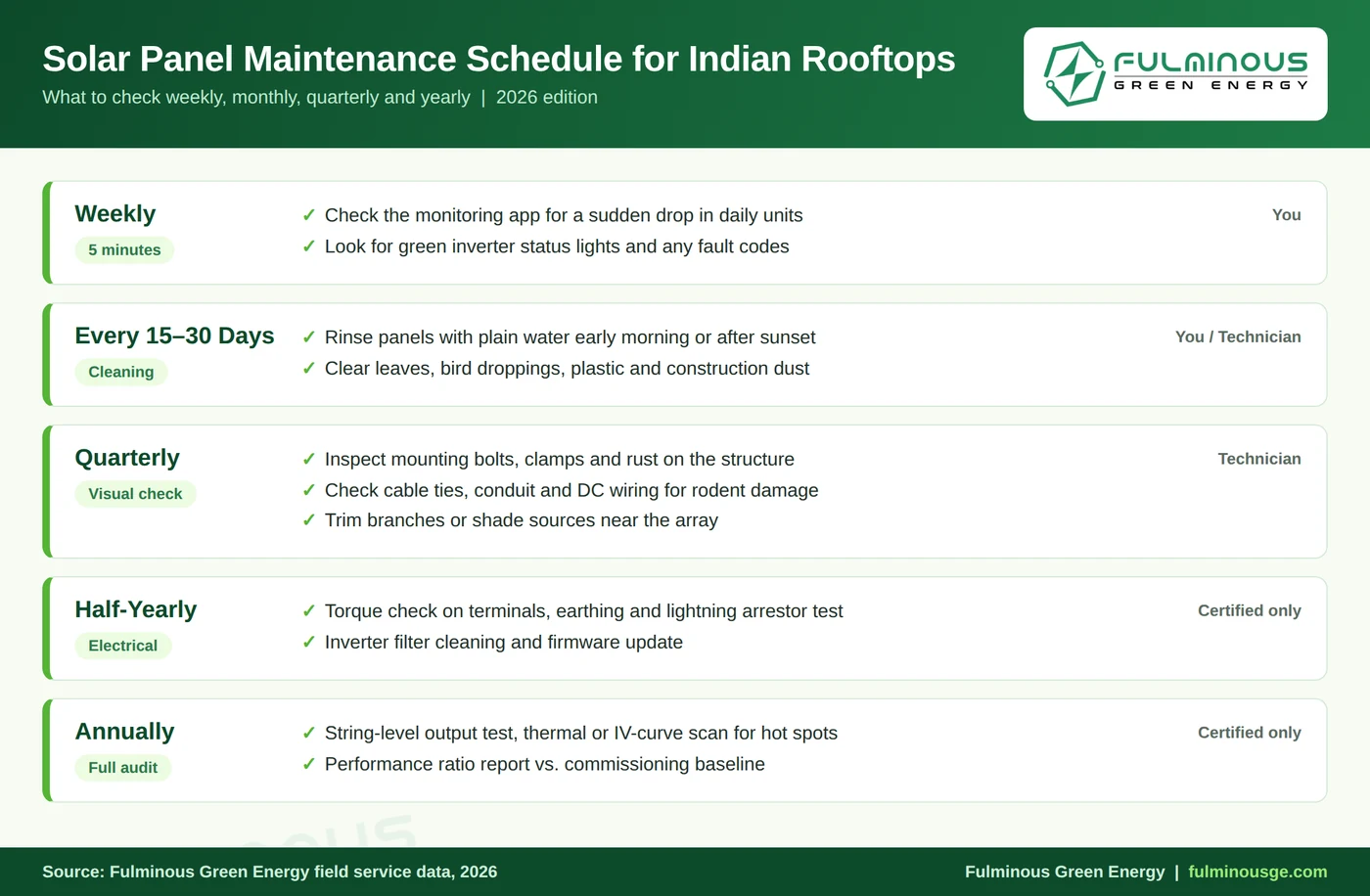
A practical solar panel maintenance schedule, from five-minute weekly checks to the full annual audit.
Weekly and Monthly Checks You Can Do Yourself
These take almost no time and catch the majority of real problems early. Make them a habit and your professional solar panel maintenance visits become confirmations rather than rescues.
- Read your monitoring app once a week. Compare this week’s daily units against the same week last month. A sudden 15% drop on clear days means something has changed.
- Glance at the inverter. A steady green light is normal. Any red, amber or blinking fault indicator deserves a photograph and a phone call.
- Look at the array from the ground or a window. Bird droppings, a fallen branch, a plastic bag or a new water tank shadow are all visible without climbing anywhere.
- Rinse the panels every 15 to 30 days. Plain water, early morning or after sunset, is enough in most months. This one habit does more for output than anything else in solar panel maintenance.
Quarterly and Half-Yearly Professional Solar Panel Maintenance
Once a quarter, the physical structure becomes the focus of your solar panel maintenance. Mounting bolts loosen with thermal expansion, galvanised clamps rust near coastal air, cable ties become brittle in UV, and rodents love the shaded space under an array. A technician checks all of this in under an hour.
Every six months, the electrical side needs a proper look. Terminal torque, earthing resistance, lightning arrestor condition, inverter cooling fins and firmware version are all part of a competent solar panel maintenance visit. None of these are DIY tasks, because a rooftop DC string can carry 600 volts or more even when your house supply is switched off.
The Annual Solar System Audit
Once a year, ask for a full performance audit rather than a routine visit. A proper audit includes string-level output testing, a thermal or IV-curve scan to find hot spots and micro-cracks, an insulation resistance test, and a written performance ratio comparison against your commissioning baseline.
This annual report is what turns solar panel maintenance from a chore into an asset management exercise. Three years of audits tell you whether your array is degrading normally, whether one string is quietly underperforming, and whether your inverter is heading toward replacement. Our solar system maintenance service covers all of these checks under a single annual plan.
Solar Panel Cleaning and Maintenance: How to Do It Safely
Cleaning is the part of solar panel maintenance most owners want to handle themselves, and for a single-storey home with an accessible roof, that is reasonable. The method matters more than the effort in this part of solar panel maintenance, because the wrong technique can permanently damage the anti-reflective coating on the glass.
The Right Way to Clean Solar Panels
Follow this sequence and you will get the full benefit with none of the risk:
- Choose the time carefully. Clean early in the morning or after sunset. Cold water on hot glass can cause thermal shock and micro-cracks.
- Start with a dry sweep. Remove loose leaves and grit with a soft brush before adding water, so you are not dragging abrasive particles across the surface.
- Use plain or filtered water. Hard water leaves mineral streaks that block light almost as effectively as dust. Deionised water is ideal where available.
- Work with a soft brush or squeegee on an extension pole. Staying on the ground is safer and avoids putting body weight on the modules.
- For stubborn residue, use a mild soap solution. A drop of dish soap in a bucket of water is enough for bird droppings or tree sap.
- Finish with a plain water rinse so no soap film is left behind to attract fresh dust.
Mistakes That Void Warranties and Damage Panels
The list of things not to do is short but important. Never use a high-pressure jet, which can force water past the frame seals into the junction box. Never use abrasive pads, scouring powder, thinner, acid or ammonia-based glass cleaners. Never walk on the modules, and never clean at midday in peak summer.
Also resist the urge to clean too often. Over-cleaning wastes water and slowly wears the coating, which is why matching frequency to your local dust level is a core principle of sensible solar panel maintenance. If you would rather hand the job over entirely, our breakdown of solar panel cleaning cost shows what professional per-visit and annual rates look like in 2026.
Prefer not to climb onto your roof? Our trained technicians clean, inspect and report on your system in a single visit, using warranty-safe methods and equipment.
Solar Panel Maintenance Cost in India in 2026
Budgeting is where most homeowners want hard numbers on solar panel maintenance, so here they are. As a rule of thumb, plan for 1% to 2% of your original system cost per year for routine solar panel maintenance on a grid-tied rooftop system. For a typical 5 kW home installation, that works out to a few thousand rupees annually.
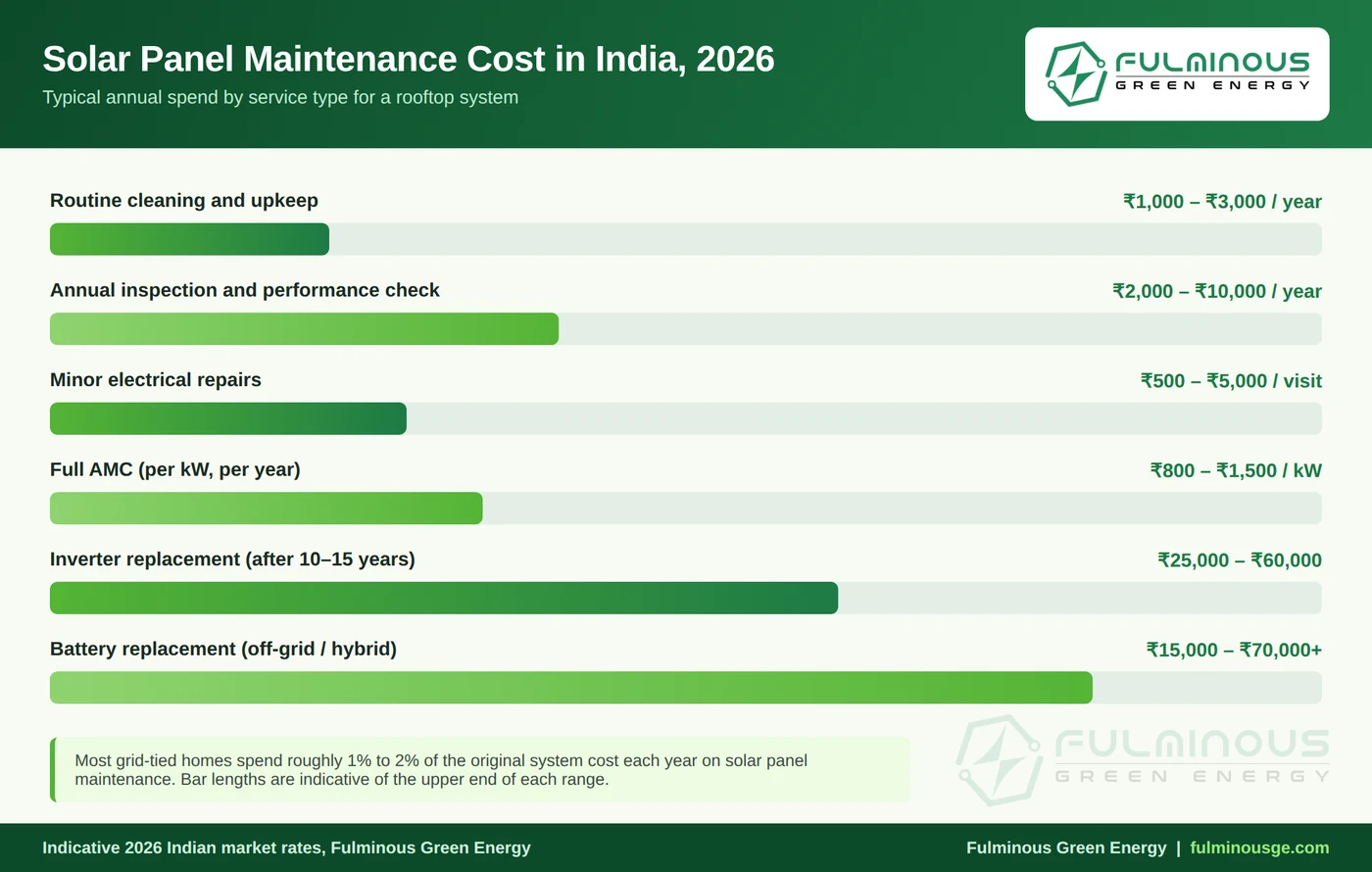
Indicative solar panel maintenance cost in India for 2026, broken down by service type.
| Maintenance Item | Frequency | Who Should Do It | Indicative Cost (2026) |
|---|---|---|---|
| Panel cleaning (per visit) | Every 15 to 30 days | Owner or technician | Free (DIY) to ₹500 per visit |
| Routine cleaning and upkeep (annual) | Ongoing | Technician | ₹1,000 to ₹3,000 per year |
| Annual inspection and performance audit | Once a year | Certified technician | ₹2,000 to ₹10,000 per year |
| Minor electrical repairs | As needed | Certified technician | ₹500 to ₹5,000 per visit |
| Full annual maintenance contract | Yearly plan | Service provider | ₹800 to ₹1,500 per kW per year |
| Inverter replacement | Once in 10 to 15 years | Certified technician | ₹25,000 to ₹60,000 |
| Battery replacement (off-grid or hybrid) | Once in 5 to 10 years | Certified technician | ₹15,000 to ₹70,000 and above |
What a Residential Annual Maintenance Contract Includes
An annual maintenance contract, or AMC, bundles your solar panel maintenance into a fixed yearly fee, generally ₹800 to ₹1,500 per kW per year. A 5 kW home therefore sits in the ₹4,000 to ₹7,500 band for a comprehensive plan, which typically covers scheduled cleaning visits, two or more inspections, minor consumables, priority breakdown response and a written annual report.
Read the solar panel maintenance scope carefully before signing. A cheap contract that only covers cleaning is not the same product as a comprehensive plan that includes electrical testing and labour on repairs. The gap between the two usually shows up in year three, not year one.
Commercial and Industrial Solar Panel Maintenance Budgets
Above 20 kW, the economics change. Commercial operators treat solar panel maintenance as an operations line item rather than an occasional expense, because a 100 kW plant running 12% below its clean-panel potential can quietly lose ₹10,000 to ₹12,000 of revenue every month. Contracts at this scale usually include 20 or more cleaning visits a year, remote monitoring with alerts, guaranteed response times and sometimes a generation guarantee.
Large plants increasingly use semi-automatic or robotic cleaning systems, which cut water use dramatically and make weekly cleaning practical in dusty industrial belts. If you are planning a business rooftop, our guide to commercial solar installation cost in India shows how maintenance fits into your total cost of ownership from day one.
Seasonal Solar Panel Maintenance Through the Indian Year
India does not have one climate, it has several in sequence. Adjusting your solar panel maintenance routine by season is what separates a system that holds 95% of its expected output from one that limps along at 75%.
Summer: Heat, Dust and Peak Load
From March to June, dust accumulation peaks and so does module temperature, making this the busiest season for solar panel maintenance. Increase cleaning to once every 10 to 15 days if you live near a highway, a construction site or open farmland. Check that airflow behind the modules is not blocked by stored items or a new water tank, because the gap under the array is what keeps panels cool.
Also confirm your inverter is not installed in direct sun. Inverters throttle their output when they overheat, and a shaded, well-ventilated location can be worth several percent of summer generation on its own.
Monsoon: Sealing, Drainage and Algae
Rain does part of your cleaning for you, but the monsoon brings its own solar panel maintenance jobs. Before the first showers, inspect cable glands, junction box seals and conduit joints for gaps where water could enter. Check that the roof drains freely and that no water pools under the mounting structure.
After heavy rain, look for green algae or moss along the lower edge of the panels, which is common in humid regions and blocks light on exactly the row of cells that limits the whole string. Also check the earthing connection, since monsoon is peak season for lightning-related surges.
Winter and Post-Diwali Fog Season
North Indian winters bring a sticky mix of fog, smog and festival smoke that bonds to glass far more stubbornly than dry dust. Panels usually need a proper wet clean rather than a rinse during this period. Days are shorter and the sun angle is lower, so shading from parapets, trees and neighbouring buildings that never mattered in June can suddenly cut into your production between 9 am and 11 am.
Warning Signs Your Solar System Needs Maintenance Now
Some symptoms mean you should not wait for the next scheduled visit. Treat any of the following as a reason to book solar panel maintenance immediately:
- Generation is down 15% or more on clear days compared with the same month last year, with no new shading to explain it.
- The inverter shows a fault code, keeps restarting, or displays an isolation or earth fault warning.
- Visible damage: a cracked or clouded module, a snail-trail pattern, brown discolouration around a cell, or a bubbled backsheet.
- Discoloured, warm or burnt-smelling connectors at the junction box or combiner, which is a genuine fire risk and needs same-day attention.
- Loose or rattling mounting structure after a storm, or visible rust at the clamps and rails.
- Your net metering bill stops improving even though your consumption pattern has not changed.
One string performing below the others is the classic early warning of a failing module or connection. This is exactly why data-led solar panel maintenance beats visual inspection alone: the numbers show a problem weeks before your eyes can.
Seeing any of these warning signs on your rooftop? Do not wait for the next billing cycle. Our certified team can inspect, diagnose and repair your system quickly.
DIY vs Professional Solar Panel Maintenance Services
There is a sensible split in solar panel maintenance between what you should handle yourself and what belongs to a professional. Getting that line right keeps you safe, keeps your warranty intact and keeps your solar panel maintenance affordable.
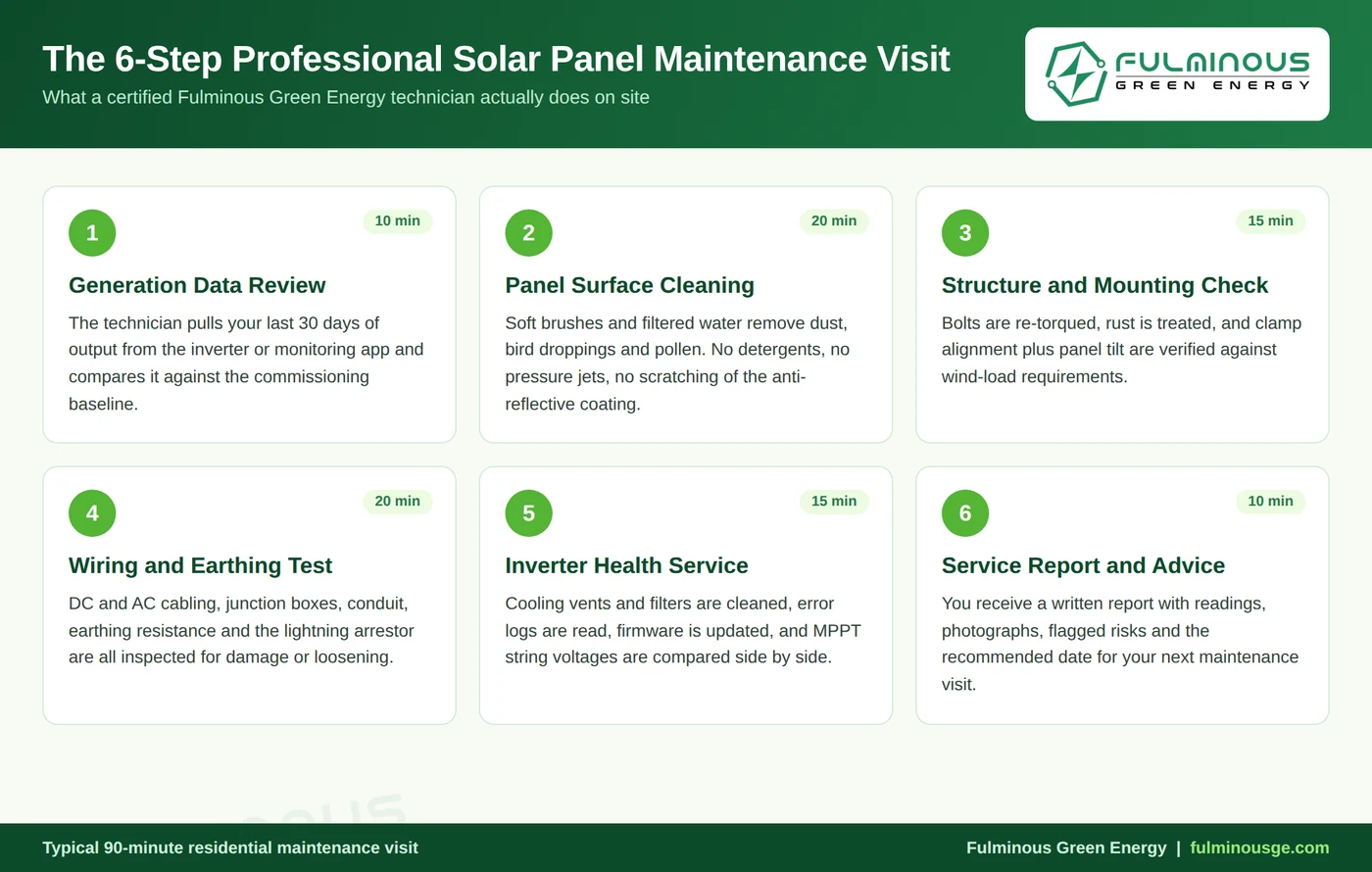
What a professional solar panel maintenance visit actually covers, step by step.
What You Can Safely Do Yourself
Monitoring output, rinsing accessible panels with water, clearing leaves and debris, keeping vegetation trimmed, and doing a visual check from a safe vantage point are all reasonable DIY tasks. They need no tools beyond a soft brush, an extension pole and a bucket, and they cover the largest single cause of output loss.
Buying decent cleaning equipment for the first time costs around ₹10,000 to ₹15,000, which is worth comparing against several years of professional visits before you commit. For a single-storey home in a low-dust area, DIY plus one annual professional audit is often the most cost-effective solar panel maintenance strategy.
What Must Be Left to a Certified Technician
Anything involving live DC circuits, terminal torque, earthing, insulation resistance, module replacement, roof-edge work or inverter internals belongs to a trained professional with proper safety equipment and insurance. Rooftop falls and DC arc faults are the two genuine hazards in this work, and neither is worth saving a few thousand rupees over.
| Aspect | DIY Maintenance | Professional AMC |
|---|---|---|
| Annual cost | ₹10,000 to ₹15,000 one-time equipment | ₹800 to ₹1,500 per kW per year |
| Cleaning quality | Good on accessible, low-tilt roofs | Consistent on any roof type or height |
| Electrical testing | Not possible or safe | Included, with instruments |
| Fault detection | Visual and app-based only | Thermal scan, string test, IV curve |
| Warranty documentation | None | Written service records |
| Safety and insurance | Your own risk | Covered by the service provider |
If you live in or around the city, booking a qualified solar technician in Jaipur for the technical half of the work while you handle routine cleaning yourself is a practical middle path that keeps your annual spend low.
How Solar Panel Maintenance Protects Your ROI
Every rupee spent on solar panel maintenance should be judged against the generation it protects, not against the invoice. Once you frame it that way, the decision becomes obvious.
A 2026 Rooftop Case Study
Consider two identical 5 kW rooftop systems installed in Jaipur in 2024, both rated for roughly 7,500 units a year. The first household followed a simple routine: a fortnightly rinse, a quarterly technician visit and one annual audit, at a total cost of about ₹6,000 a year. The second household did nothing after commissioning.
By mid-2026, the maintained system was still generating within 4% of its original baseline. The neglected system had lost close to 22% of its output to soiling, a partially shaded string and a dirty inverter filter. At ₹8 per unit, that gap is roughly 1,350 units and about ₹10,800 of value lost in a single year, against a ₹6,000 solar panel maintenance spend that would have prevented almost all of it.
Extend that arithmetic across a 25-year system life and the value of consistent solar panel maintenance runs into lakhs. You can model your own numbers with our solar ROI calculator and see how a small annual maintenance budget shortens your payback period rather than lengthening it.
Maintenance, Subsidy and Net Metering Compliance
There is a compliance angle too. Systems installed under national schemes are expected to remain in working order, and your discom connection agreement assumes a safe, correctly earthed installation. Ministry guidance published by the Ministry of New and Renewable Energy requires empanelled vendors to provide defined maintenance support after commissioning, so check what your installer already owes you before paying anyone else.
According to the Press Information Bureau, nearly 19 lakh households under PM Surya Ghar are now reporting zero electricity bills, and over 12 lakh earned a combined ₹421 crore from surplus power exports in a single financial year. Those numbers only hold if the systems behind them keep producing, which is ultimately what solar panel maintenance buys you. If you are still planning your installation, start with our overview of residential solar solutions and ask about the maintenance plan before you sign anything.
Ask every installer one question before you buy: what exactly does your post-installation solar panel maintenance cover, for how many years, and what does it cost after that period ends? The answer tells you a great deal about how they will treat you in year four.
Frequently Asked Questions About Solar Panel Maintenance
These are the questions Indian homeowners and business owners ask most often before setting up a solar panel maintenance routine in 2026.
How often should solar panel maintenance be done?
Clean your panels every 15 to 30 days in most Indian cities, and more often in high-dust areas. Add a professional inspection every three to six months and one full performance audit each year. Commercial plants generally need 20 or more cleaning visits annually.
What is the average solar panel maintenance cost in India?
Budget roughly 1% to 2% of your system cost per year. Routine upkeep runs ₹1,000 to ₹3,000 annually, an annual inspection ₹2,000 to ₹10,000, and a full annual maintenance contract ₹800 to ₹1,500 per kW per year for most residential rooftops.
Can I clean my solar panels myself?
Yes, if your roof is safely accessible. Use plain water, a soft brush on an extension pole, and clean early morning or after sunset. Avoid pressure washers, abrasive pads and chemical cleaners, and never walk on the modules or clean during peak afternoon heat.
How long do solar panels last with proper maintenance?
Quality panels last 25 to 30 years or more, degrading about 0.4% to 0.5% per year. Most warranties guarantee 80% to 87% output at year 25. Inverters usually need replacement once at the 10 to 15 year mark, which is the main mid-life maintenance cost.
Does skipping solar panel maintenance void my warranty?
It can. Most manufacturers require the system to be maintained as specified, and claims are far harder to defend without service records. Improper cleaning, such as pressure washing or using chemicals, can also void coverage on an otherwise healthy module.
Make Solar Panel Maintenance a Habit, Not an Emergency
Solar panel maintenance is not complicated, expensive or time-consuming. It is a fortnightly rinse, a weekly glance at an app, a quarterly professional check and one honest annual audit. Done consistently, that routine keeps your array within a few percentage points of the output you were promised on the day it was commissioned.
Skip it, and the loss is invisible until you notice your bills creeping back up. Dust does not announce itself, a loose terminal does not send a text message, and a slowly failing inverter can run for months at reduced output without ever showing a fault. Regular solar panel maintenance is simply the difference between owning a power plant and owning a roof decoration.
Fulminous Green Energy maintains residential, commercial and industrial solar systems across Rajasthan and beyond, with certified technicians, warranty-safe cleaning methods, documented service reports and annual maintenance plans sized to your exact capacity. Whether you have a 3 kW rooftop or a multi-megawatt plant, we will tell you honestly what your system needs and what it should cost.
Ready to protect the investment already sitting on your roof? Talk to Fulminous Green Energy today about a solar panel maintenance plan built around your system, your roof and your local dust conditions.
Related Solar Guides
Keep reading — these guides from Fulminous Green Energy go deeper on costs, subsidies and installation.