
India added a record 44 GW of solar capacity in FY2026, and more than 34,000 registered vendors are now selling and installing rooftop systems under the PM Surya Ghar Yojana alone, according to the Ministry of New and Renewable Energy’s own scheme data. If you have ever wondered whether you could get a share of that business, the first real question is simple: what is the actual solar panel dealership cost, and can an ordinary entrepreneur afford to get in? This guide breaks down the true solar panel dealership cost for every major brand in India, from Adani Solar and Tata Power Solar to Waaree and Loom Solar, along with the documents you need, the space you need, and the profit margin you can realistically expect in 2026.
You will learn exactly how much a solar franchise cost varies by brand and business size, what the real solar panel dealership cost in India looks like once you add inventory and working capital on top of the dealership fee, and how to become a solar panel dealer step by step. We will also answer the profit question directly: is a solar panel dealership profitable, and which solar dealership is best for your budget and city.
Why the Solar Panel Dealership Business Is Booming in 2026
Before you compare the solar panel dealership cost across brands, it helps to understand why so many people are asking this question right now. Rooftop solar in India has moved from a niche purchase to a mainstream household decision, and the dealer network behind that shift is growing just as fast as the installations themselves.
Government Push Is Creating Real Demand
The PM Surya Ghar Muft Bijli Yojana has crossed 5 million (50.06 lakh) households with rooftop solar installations and 14.8 GW of cumulative commissioned capacity as of August 2026, with installation pace accelerating from around 5,000 systems a day in October 2025 to roughly 16,300 a day by July 2026, a more than threefold jump in nine months, as reported by pv magazine India. Every one of those installations was sold, financed, and often installed by a local dealer, distributor, or channel partner, not directly by the manufacturer. That is the real opportunity behind entering this business: demand is already there, and brands need feet on the ground in every district to capture it.
India’s Solar Market Is Still Growing at Double Digits
India installed a record 44 GW of new solar capacity in FY2026, according to JMK Research, and the broader industry continues to expand at a compound annual growth rate of over 20%, supported by a national target of 500 GW of renewable capacity by 2030 set by the Ministry of New and Renewable Energy. Falling installation costs, rising electricity tariffs, and stronger subsidy support under schemes such as PM Surya Ghar Yojana and the PM-KUSUM solar scheme are pulling growth into smaller towns and rural markets that barely had solar dealers five years ago. That expansion into Tier 2 and Tier 3 cities is exactly where entry costs become most relevant, since they are typically lower than in metro markets while demand is rising just as quickly.
Thinking about entering the solar business but not sure where to start? Fulminous Green Energy works with installers, technicians, and channel partners across Rajasthan. Talk to our team before you commit to a dealership.
Talk to Our TeamHow Much Does a Solar Panel Dealership Cost in India?
There is no single number that answers “how much does a solar franchise cost,” because the solar panel dealership cost depends heavily on which brand you choose, the scale of the business you want to run, and whether you are opening a small retail counter or a full-service distributorship with installation crews. That said, most dealership cost structures in India fall into three broad tiers.
The Three Tiers of Solar Panel Dealership Cost
At the entry level, a basic dealership with a brand like Loom Solar can start with as little as a few thousand rupees in registration and stock, making it accessible to almost anyone with a small shop or storage space. In the middle tier, brands such as Tata Power Solar and Adani Solar typically require a solar panel dealership cost of ₹10 lakh to ₹30 lakh, covering the dealership fee, initial inventory, and a proper showroom or warehouse. At the top end, a full authorised dealership with a large national brand like Waaree can involve a total upfront commitment of ₹40 lakh to ₹50 lakh once you include setup, working capital, and security deposit.
What’s Typically Included in the Dealership Fee
The dealership fee itself is usually the smallest part of the total investment. It typically covers your right to use the brand name, access to the manufacturer’s dealer portal and marketing materials, and in many cases a few days of technical and sales training. On top of that fee, you should budget separately for initial inventory (panels, inverters, batteries, and mounting structures), storage or showroom space, GST registration and other legal costs, staff salaries, and working capital to cover the gap between paying suppliers and collecting from customers.
| Cost Component | Typical Range (₹) | Notes |
|---|---|---|
| Dealership / registration fee | ₹1,000 to ₹5,00,000 | Varies enormously by brand; Loom Solar’s basic tier starts near ₹1,000, Adani Solar can reach ₹2 to ₹5 lakh |
| Initial inventory / stock | ₹10,000 to ₹20,00,000+ | Scales with how many panels, inverters and batteries you commit to stocking upfront |
| Showroom or warehouse setup | ₹50,000 to ₹20,00,000 | Depends on whether it is a small counter or a full 300 to 800 sq.ft showroom |
| Legal, licensing and GST | ₹20,000 to ₹60,000 | Shop and establishment registration, GST certificate, basic compliance |
| Working capital (monthly) | ₹1,00,000 to ₹4,00,000 | Covers staff, rent and operating expenses until sales stabilise |
Solar Panel Dealership Cost by Brand: 2026 Comparison
Because this cost varies so much brand to brand, the most useful way to plan your budget is to compare the major players side by side. Below is a brand-by-brand cost breakdown for the four names most people ask about.
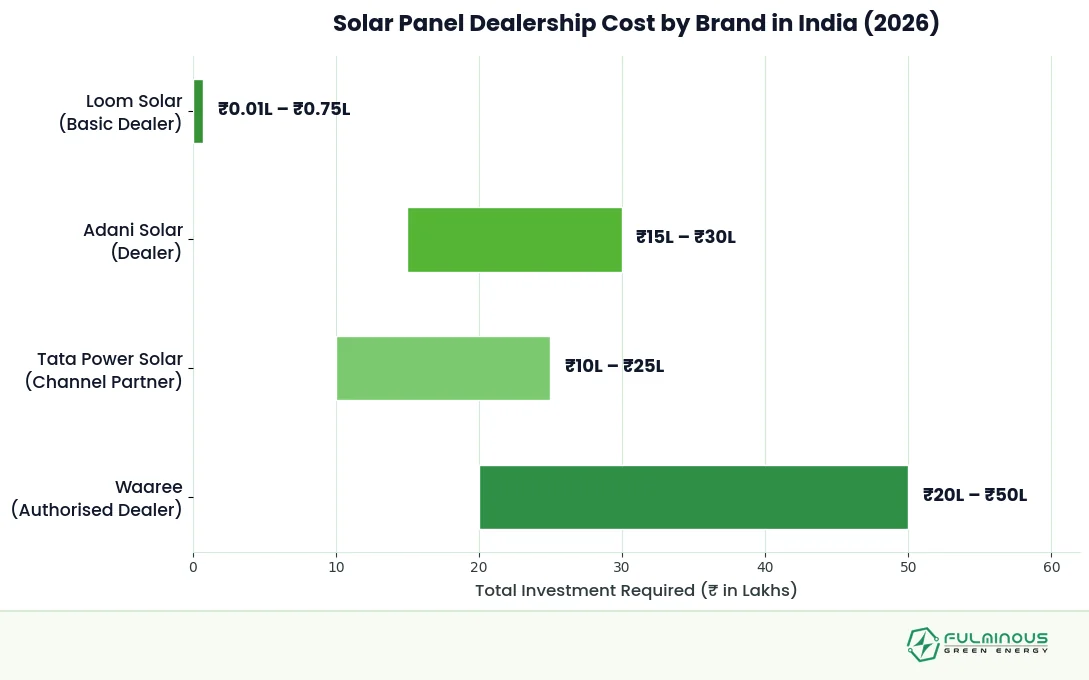
Indicative solar panel dealership cost by brand in India, 2026 (total investment range in ₹ lakhs).
Adani Solar Dealership Cost
Adani Solar dealership cost typically falls between ₹15 lakh and ₹30 lakh in total investment, scaled by the size of operation you plan to run. A small dealer setup generally needs ₹15 to ₹20 lakh, a medium distributor needs ₹20 to ₹30 lakh, and larger regional distributors can invest ₹30 lakh or more. Within that figure, the dealership fee itself is usually ₹2 to ₹5 lakh, with the rest going toward initial inventory, a small warehouse of 200 to 800 sq.ft, and legal and licensing costs. Gross margins on an Adani Solar dealership generally run 12% to 25%, and most dealers report a monthly net profit of ₹60,000 to ₹3,00,000 once the business is established, with a break-even period of 9 to 18 months.
Tata Solar Franchise Cost
Tata Power Solar operates less like a classic franchise and more through an authorised dealer, channel partner, and installer network, so the Tata solar franchise cost varies by which tier you enter at. A small dealer can start with roughly ₹2 to ₹10 lakh, a channel partner setup typically needs ₹10 to ₹25 lakh, and a full-service solar business with EPC capability can require ₹25 lakh to ₹1 crore or more. Profit margins differ by product line: panels alone typically earn 8% to 12%, inverters and accessories 12% to 20%, and installation or EPC services 20% to 30%, which is why many successful Tata Power Solar partners push hard into installation revenue rather than relying on hardware margins alone. Expected annual ROI sits around 20% to 40%, with a break-even period of 12 to 24 months.
Waaree Solar Dealership Cost
Waaree Solar dealership cost is on the higher end of the spectrum because the brand runs a fuller authorised-dealer format. Expect an initial investment of around ₹20 lakh for setup and interiors, plus a recommended ₹30 lakh in working capital, bringing the total upfront commitment to approximately ₹50 lakh once you include the security deposit. The good news is that Waaree runs a zero-royalty model, so you are not paying an ongoing percentage of revenue back to the brand. You will need a minimum of 300 sq.ft of retail space, and Waaree provides five days of formal training as part of onboarding. Gross margins fall in the same 12% to 25% range as other major brands, and dealership agreements typically run 3 to 5 years on a non-exclusive territory basis.
Loom Solar Franchise Cost
Loom Solar franchise cost is by far the most accessible entry point discussed in this guide, which is a major reason the brand has become popular with first-time entrepreneurs. A basic dealership needs only around ₹25,000 in initial stock purchase plus a ₹1,000 registration fee. Stepping up to a distributorship raises the registration fee to ₹10,000 with a minimum stock purchase of ₹10,000, while becoming an international distributor requires a ₹75,000 registration fee and stock purchased according to demand. Loom Solar dealers can expect an approximate 15% profit margin, and the only paperwork required is shop and establishment registration along with a GST certificate, no special licences needed. Decisions on applications are typically returned within 7 to 10 days.
Every figure above reflects publicly available dealer and franchise information as of 2026 and can change based on your city, negotiated terms, and current brand promotions. Always confirm current solar panel dealership cost figures directly with the brand’s franchise or dealer relations team before signing any agreement.
How to Become a Solar Panel Dealer in India
Once you have a rough sense of the investment you can afford, the process of actually becoming a dealer follows a fairly consistent path across brands, with small variations in documentation and timelines.
Eligibility Criteria and Documents Required
Most brands do not publish rigid eligibility criteria, but in practice you will need a registered business entity (proprietorship, partnership, LLP, or private limited company), a GST certificate, and proof of the retail or warehouse space you plan to operate from. Having prior experience in electrical goods, hardware, or a related trade is not mandatory but is viewed favourably during evaluation. Before you apply anywhere, gather the following:
- Business registration documents (proprietorship, partnership deed, or company incorporation certificate).
- GST registration certificate and PAN card of the business and proprietor.
- Proof of retail, showroom, or warehouse space (rent agreement or ownership documents).
- Bank statements or financial proof showing your available investment capacity.
- Shop and establishment registration, where applicable in your state.
Step-by-Step: How to Get a Solar Panel Dealership in India
The exact process differs slightly by brand, but the overall sequence for how to become a solar panel dealer looks similar everywhere:
- Shortlist two or three brands based on the budget you can afford and the demand in your local market.
- Visit the brand’s official website and locate the dealer, distributor, or partner application form, usually under a “Partner With Us” or “Become a Dealer” section.
- Submit your business details, investment capacity, and proposed location for review.
- Attend a verification call or in-person meeting with the brand’s regional sales team.
- Sign the dealership or franchise agreement and pay the applicable registration or dealership fee.
- Complete brand-provided training, place your first inventory order, and set up your outlet for launch.
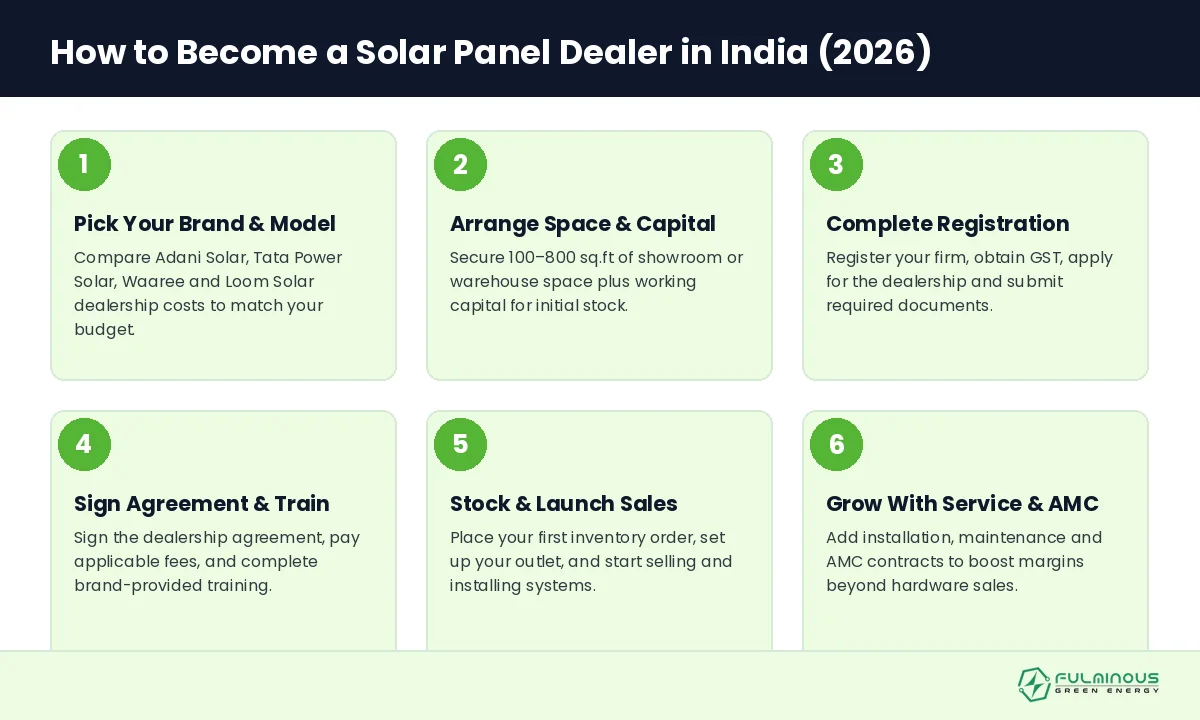
The typical path from choosing a brand to launching your solar panel dealership in 2026.
How to Get an Adani Solar Dealership
To get an Adani Solar dealership, visit the official Adani Solar or Adani Group website and use the “Contact” or “Partner” section to submit a business inquiry, or reach out to your nearest regional office directly with details of your investment capacity and proposed location. Adani Solar treats this as a dealership or distributorship partnership rather than a plug-and-play franchise, so having existing capital, a local business network, and some familiarity with the solar or electrical trade will meaningfully improve your chances during evaluation.
How to Become a Waaree Solar Dealer
Becoming a Waaree solar dealer starts with the official franchise portal, where you submit an application detailing your available space, investment capacity, and target territory. Waaree evaluates applicants partly on hands-on involvement, since the brand expects a full-time, owner-operated commitment rather than a passive investment. Once approved, you will sign a 3 to 5 year non-exclusive agreement, complete the brand’s 5-day training programme, and begin stocking your outlet ahead of launch.
Comparing dealership routes against simply installing solar for your own home or business? See real numbers first with Fulminous Green Energy’s solar ROI calculator before you decide which path makes more sense for you.
Try the ROI CalculatorIs a Solar Panel Dealership Profitable? Profit Margins Explained
This is the question every serious applicant asks before spending a single rupee on solar panel dealership cost: will it actually make money? The honest answer is yes, but profitability depends heavily on how you structure your revenue, not just on how many panels you sell.
Profit Margin by Product Category
Across nearly every brand covered in this guide, the profit margin of a solar dealership is not flat. Solar panels themselves, being a commodity hardware product, typically earn the thinnest margin at 8% to 12%. Inverters, batteries, and other accessories perform better at 12% to 20%, since these products carry more brand differentiation and after-sales service value. The real money is in installation and EPC (engineering, procurement, and construction) services, which typically earn 20% to 30%, because you are being paid for labour, design expertise, and project management rather than just reselling a box. A blended, full-service dealership that combines hardware sales with installation typically nets an overall profit margin of 12% to 25%.
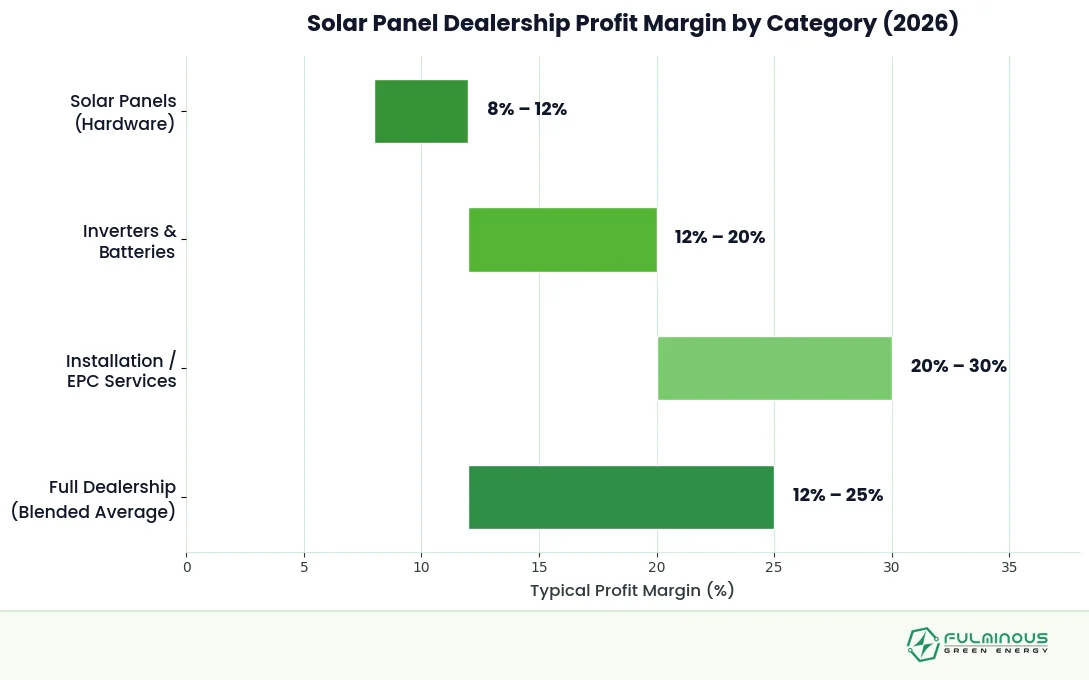
Typical solar panel dealership profit margin by revenue category, 2026 data.
Real Earnings Example: A 2026 Case Study
Consider a mid-sized dealership completing five residential installations a month, each in the 3kW to 5kW range. A typical 3kW residential job generates gross revenue of roughly ₹1,60,000 to ₹1,80,000, which at five installations a month works out to a gross revenue of ₹8,00,000 to ₹9,00,000. After accounting for hardware costs, staff salaries, and overheads, dealers in this bracket typically report a net profit of ₹1,50,000 to ₹2,00,000 per month. For smaller operations still building a customer base, a small dealer might see ₹30,000 to ₹1,00,000 in monthly earnings, while an established channel partner running multiple crews can reach ₹1,00,000 to ₹5,00,000 a month, and a full EPC-capable business can exceed ₹5,00,000 to ₹20,00,000 monthly at scale. Most new dealers reach break-even within 6 to 24 months depending on brand, city, and how aggressively they pursue installation contracts alongside hardware sales.
Which Solar Dealership Is Best? Comparing Your Options
There is no universal answer to which solar dealership is best, because the right choice depends on your available budget, your appetite for hands-on operations, and how much brand recognition matters in your local market. The comparison below should help you match your budget to the brand that fits it.
| Brand | Investment Range | Profit Margin | Best For |
|---|---|---|---|
| Loom Solar | ₹1,000 to ₹75,000+ | ~15% | First-time entrepreneurs and very low-budget entry |
| Adani Solar | ₹15 lakh to ₹30 lakh+ | 12% to 25% | Established traders wanting strong brand pull with moderate capital |
| Tata Power Solar | ₹2 lakh to ₹1 crore+ | 8% to 30% (by segment) | Applicants who want a phased entry from small dealer up to full EPC |
| Waaree | ₹20 lakh to ₹50 lakh | 12% to 25% | Committed, full-time operators who want a zero-royalty authorised outlet |
If your budget is under ₹1 lakh, Loom Solar’s dealership and distributorship tiers are realistically your only option among the brands covered here, and they remain a genuinely profitable way to test the solar business before committing more capital. If you can invest ₹15 lakh or more and want strong brand recognition, Adani Solar or Tata Power Solar are worth comparing side by side based on which has a stronger presence in your target city. For entrepreneurs ready to commit full-time with ₹40 lakh to ₹50 lakh in capital, Waaree’s authorised dealer model offers a structured, zero-royalty path with a shorter, well-defined agreement term.
Costs Beyond the Dealership Fee You Should Budget For
Many first-time applicants focus only on the headline dealership fee and are then surprised by how much more the full cost of running the business actually involves once it is operational. Planning for these additional costs upfront prevents cash flow problems in your first year.
Staffing, Marketing and Ongoing Operations
Beyond your initial dealership fee and inventory, you will need to budget for sales staff, at least one technician if you plan to offer installation, local marketing (signage, digital ads, and referral incentives), vehicle costs for site visits, and ongoing rent if you are not operating from owned property. Annual staffing costs alone can range from ₹1 lakh for a one-person operation to ₹10 lakh or more for a business running multiple installation crews. If you plan to expand into commercial solar installation alongside residential sales, factor in additional working capital, since commercial projects typically involve longer payment cycles than residential ones.
After-Sales Service and Warranty Support
Solar panels typically carry 25-year performance warranties, and customers increasingly expect their local dealer to handle warranty claims, routine solar system maintenance, and troubleshooting rather than dealing directly with the manufacturer. Building this service capability into your dealership planning from day one, rather than treating it as an afterthought, is one of the clearest ways to build repeat business and referrals in a market where word of mouth still drives a large share of new customers.
Already run a hardware, electrical, or EPC business and want to add solar installation as a service line? Fulminous Green Energy partners with regional installers and technicians across Rajasthan for training and project support.
Explore a PartnershipTips to Succeed as a Solar Panel Dealer in 2026
Meeting the solar panel dealership cost is only the entry ticket. Long-term success depends on how well you run the business afterward. A few practices consistently separate thriving dealers from ones that struggle to break even:
- Lead with installation and service revenue rather than relying only on hardware margins, since installation and EPC work earn the highest margins in the business.
- Stay close to government scheme updates like PM Surya Ghar Yojana, since subsidy awareness is often the deciding factor for a hesitant customer.
- Offer a mix of system sizes rather than pushing one standard package. Customers researching a 5kW solar system convert faster when you can show them accurate, size-specific pricing on the spot.
- Invest in a trained technician early, even part-time, since installation quality directly drives referrals in a business that depends heavily on word of mouth.
- Track your actual margins by product category monthly, not just overall revenue, so you know whether panels, inverters, or installation services are truly driving your profit.
Frequently Asked Questions About Solar Panel Dealership Cost
How much does a solar panel dealership cost in India?
Solar panel dealership cost in India ranges from as little as ₹25,000 to ₹75,000 for an entry-level Loom Solar dealership up to ₹40 lakh to ₹50 lakh for a full Waaree authorised dealership. Mid-tier brands like Adani Solar and Tata Power Solar typically fall between ₹10 lakh and ₹30 lakh depending on the scale of operation.
Is a solar panel dealership profitable?
Yes, a solar panel dealership is generally profitable, with gross margins of 12% to 25% across most brands and even higher margins of 20% to 30% on installation and EPC services. Most dealers reach break-even within 6 to 24 months depending on the brand, city, and how quickly they build a customer base.
How to become a solar panel dealer in India?
To become a solar panel dealer, register a business entity, obtain GST registration, secure suitable retail or warehouse space, and apply directly through your chosen brand’s official dealer or partner portal. Most brands require a verification call, a signed agreement, and a completed training programme before you can launch.
Which solar dealership is best for a small budget?
For a small budget under ₹1 lakh, Loom Solar’s basic dealership and distributorship tiers are the most accessible entry points, requiring as little as ₹25,000 to ₹35,000 in combined stock and registration fees. For larger budgets, Adani Solar and Tata Power Solar offer stronger brand recognition at a moderate ₹10 lakh to ₹30 lakh investment.
What is the profit margin for a solar franchise?
The profit margin for a solar franchise typically runs 8% to 12% on solar panels alone, 12% to 20% on inverters and batteries, and 20% to 30% on installation and EPC services. A blended, full-service solar dealership usually nets an overall profit margin of 12% to 25%.
Choosing the Right Path Into India’s Solar Business
The solar panel dealership cost you settle on should match both your available capital and how hands-on you want to be in the business, not just which brand has the biggest advertising budget. Loom Solar makes sense if you want to test the waters with minimal risk, Adani Solar and Tata Power Solar suit applicants with moderate capital who value strong brand pull, and Waaree fits committed, full-time operators ready to run a proper authorised outlet. Whichever brand you choose, the dealers who succeed long-term are the ones who build real installation and service capability, not just a hardware counter.
If you are still weighing your options, or you would rather partner with an established regional installer than build a dealership from scratch, Fulminous Green Energy works with technicians, EPC contractors, and channel partners across Rajasthan on residential, commercial, and industrial projects. Ready to build your solar business the right way? Contact Fulminous Green Energy today for a straight conversation about what fits your budget and your market.
Ready to explore a partnership or get a professional consultation on your solar business plans? Fulminous Green Energy’s team is happy to walk you through the options.
Contact Us TodayRelated Solar Guides
Keep reading — these guides from Fulminous Green Energy go deeper on costs, subsidies and installation.