
If you run a factory, warehouse, hospital, or office building in India, your electricity bill is probably one of your three biggest fixed costs. And right now, more businesses than ever are cutting that cost with rooftop and ground-mounted solar. Commercial solar installation cost in India in 2026 typically works out to roughly ₹35 to ₹50 per watt installed, depending on system size, location, and the type of equipment you choose. That number sounds simple, but the real answer depends on a dozen moving parts, from your state’s wheeling charges to whether you claim accelerated depreciation.
This guide breaks down exactly what a commercial solar panel installation cost in India looks like in 2026, system size by system size, state by state, and rupee by rupee. We’ll also cover the labor cost to install solar panels, what a 1 MW solar power plant actually costs to build, and how much you can realistically expect to save.
Quick Summary
- Commercial solar installation cost in India runs ₹35-₹50 per watt installed in 2026, cheaper per watt than residential systems because of economies of scale.
- A complete 1 MW solar power plant costs roughly ₹3.5-₹5 crore, including modules, inverters, mounting structures, and commissioning.
- Commercial solar installation cost varies state wise. Gujarat offers the lowest wheeling charges and the friendliest policy; Tamil Nadu and Maharashtra carry the highest cross-subsidy surcharges.
- Businesses can’t claim the residential PM Surya Ghar subsidy, but 40% accelerated depreciation, a reduced 5% GST rate, and net metering bring payback down to 3-5 years.
- India crossed roughly 150 GW of installed solar capacity by March 2026, with commercial and industrial rooftop solar as one of the fastest-growing segments.

Understanding Commercial Solar Installation Cost in India
Before comparing numbers, it helps to understand why a commercial solar panel installation cost in India looks so different from a residential quote. A home system might be 3 to 10 kW. A commercial system usually starts around 25 kW and can stretch into several megawatts for a large factory or industrial park. That difference in scale changes almost every cost assumption in the project.
What Counts as a Commercial Solar System
In India, commercial solar generally covers rooftop or ground-mounted systems installed for offices, retail spaces, hotels, hospitals, warehouses, cold storage units, and small to mid-sized factories. Industrial solar usually refers to larger manufacturing plants, textile mills, and process industries with high daytime power consumption. Both fall under the broader commercial and industrial, or C&I, category that Indian solar developers and utilities track separately from residential rooftop.
Commercial vs Residential: Why Businesses Pay Less Per Watt
A 3 kW home solar system might cost ₹65,000 to ₹85,000 per kW installed. A 500 kW commercial system, on the other hand, can come down to ₹35,000 to ₹45,000 per kW. The reason is simple. Fixed costs, like transportation, site surveys, and project design, get spread across many more watts. Bulk purchasing of panels and inverters also brings the per-unit price down. This is exactly why the cost of commercial solar panel installation drops steadily as system size increases, right up to the megawatt scale.
Not sure what size system your business actually needs? Our team at Fulminous Green Energy can review your last 12 months of electricity bills and recommend the right capacity, whether that is a 25 kW rooftop system or a multi-megawatt industrial installation.
Get a Free Site AssessmentCommercial Solar Panel Installation Cost in India by System Size
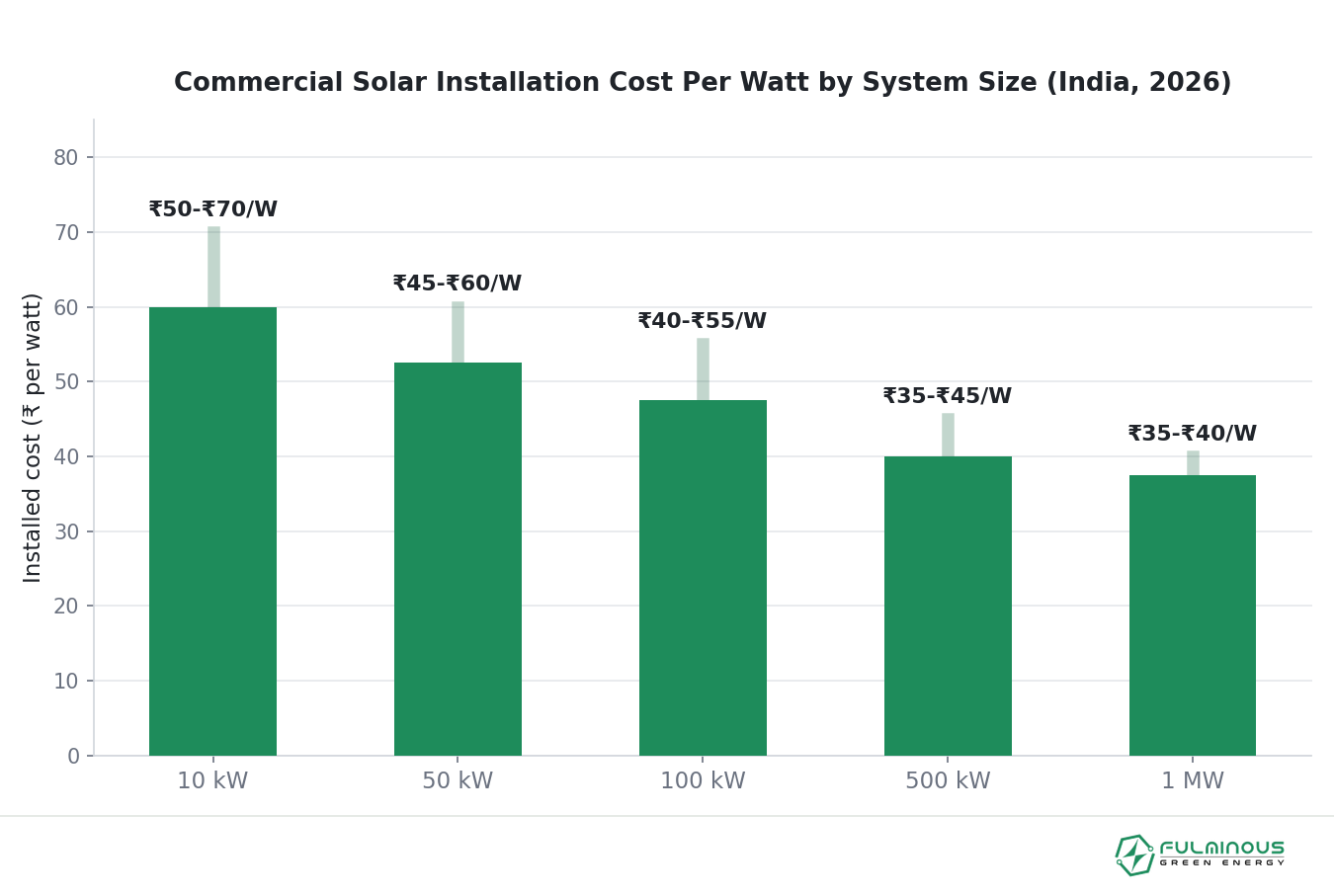
The single biggest factor in your commercial solar installed cost per watt is simply how big the system is. Below is a realistic 2026 breakdown based on current market pricing across small commercial, mid-size, and industrial-scale installations.
| System Size | Typical Cost Per Watt | Approximate Total Cost |
|---|---|---|
| 10 kW (small commercial) | ₹50-₹70/W | ₹5-7 lakh |
| 50 kW | ₹45-₹60/W | ₹27.5-₹40 lakh |
| 100 kW | ₹40-₹55/W | ₹40-₹60 lakh |
| 500 kW | ₹35-₹45/W | ₹1.7-₹2.75 crore |
| 1 MW (1,000 kW) | ₹35-₹40/W | ₹3.5-₹5 crore |
Small Commercial Systems: 10 kW to 100 kW
Small offices, retail showrooms, and clinics typically fall in the 10 to 100 kW range. If you’re comparing this against a home-scale project, our guide on the 10kW solar panel installation cost in India is a useful reference point, since many small commercial setups sit in a similar capacity band but carry slightly different approval and metering requirements than a residential connection.
Industrial-Scale Systems: 500 kW to 1 MW and Beyond
Once you cross 500 kW, the cost of commercial solar panel installation drops further because developers can use central inverters, larger cable runs, and more efficient labor scheduling. Most manufacturing units, textile mills, and large warehouses fall into this bracket, and this is also where accelerated depreciation and open access electricity purchase start to make the biggest financial difference.
- Rooftop systems work well when you have unused shed or terrace space and want to avoid transmission charges entirely.
- Ground-mounted systems suit factories with spare land and allow easier future capacity expansion.
- Hybrid setups combine rooftop generation for self-consumption with an open access or group captive arrangement for any additional load.
Commercial Solar Installed Cost Per Watt: What’s Actually Included
A commercial solar installed cost per watt quote should include far more than just the panels. Understanding each line item helps you compare quotes properly and spot a bid that’s cutting corners.
Modules, Inverters, and Mounting Structures
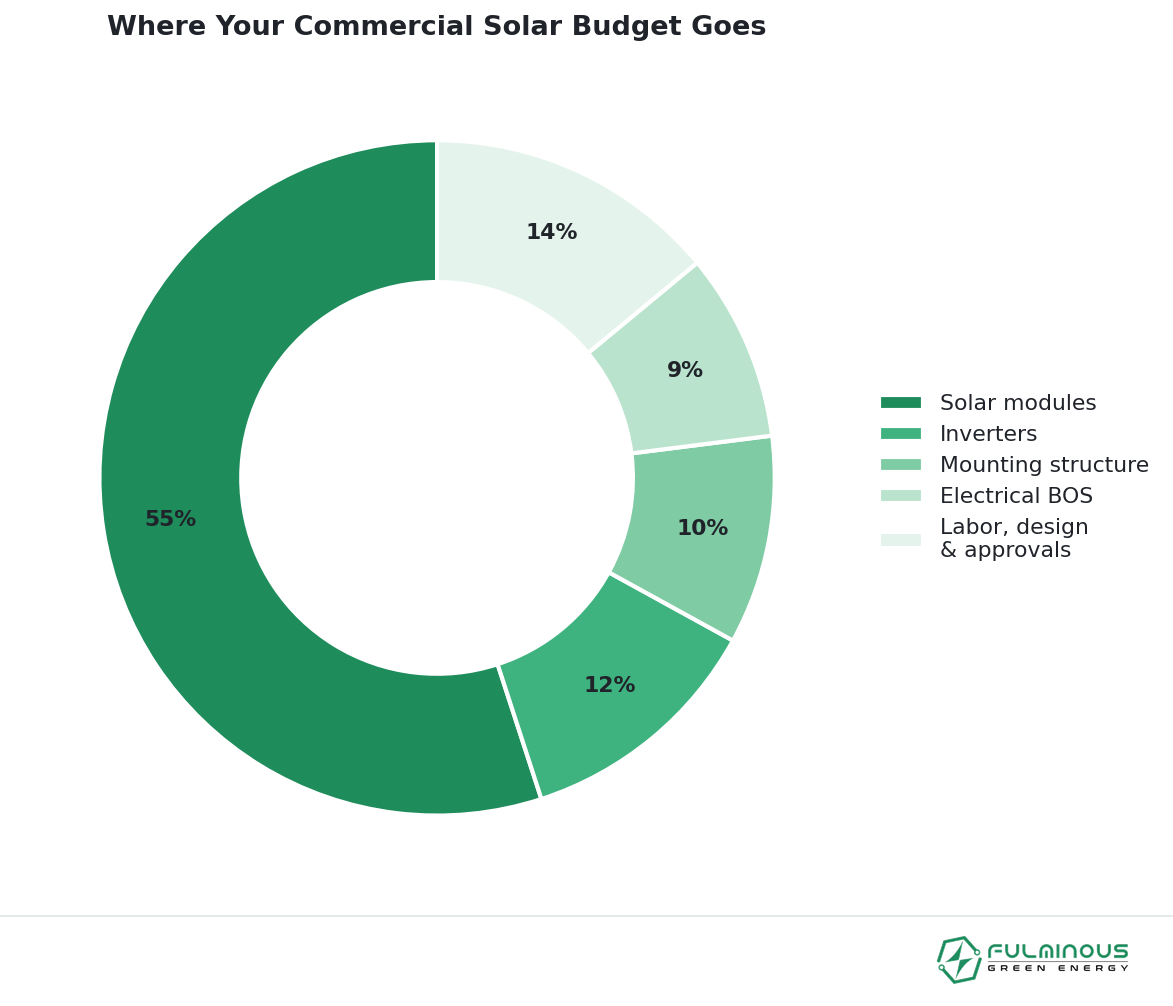
Solar modules typically account for 50 to 60 percent of total project cost. Mono PERC panels remain the value option, while TOPCon panels, now used in more than half of new commercial installations, offer better heat tolerance and slightly higher output for a modest premium. Inverters make up roughly 10 to 15 percent of cost, with string inverters standard for most commercial roofs and central inverters reserved for large ground-mounted plants. Mounting and racking structures add another 8 to 12 percent, and this figure rises if your roof needs elevated structures to stay usable underneath the panels.
Labor Cost to Install Solar Panels
The labor cost to install solar panels, along with design, engineering, and approval work, typically makes up the remaining share of the budget once modules, inverters, mounting, and electrical balance of system are accounted for. Unlike equipment costs, labor and design costs are largely fixed regardless of project size, which is precisely why the commercial solar installation cost per watt keeps falling as systems get bigger. Electrical balance of system components, including cabling, junction boxes, earthing, and protection switchgear, typically add another 8 to 10 percent. Budget an extra ₹20,000 to ₹65,000 for electrical panel upgrades and permits, and ₹20,000 to ₹1,00,000 if your roof needs structural repair before installation.
Cost of Installing a 1 MW Solar Power Plant in India
The cost of installing a 1 MW solar power plant is one of the most searched questions from mid-sized manufacturers, and for good reason. A 1 MW plant sits right at the point where per-watt pricing flattens out and financing options like IREDA loans become genuinely useful.
1 MW Plant Cost Breakdown
A grid-tied 1 MW plant, excluding battery storage, generally costs between ₹3.5 crore and ₹5 crore in 2026, with most turnkey EPC contracts clustering around ₹3.5 to ₹4 crore. A representative breakdown looks like this: modules account for about 50 percent of spend (roughly ₹1.75-₹2 crore), inverters around 12 percent (₹40-₹50 lakh), balance of system and civil works around 25 percent (₹85 lakh to ₹1 crore), and EPC margin plus commissioning around 13 percent (₹45-₹50 lakh). If a quote comes in below ₹32 per watt, check the component specifications carefully. Anything above ₹42 per watt usually means excess margin or an unusually difficult site.
Land, Generation, and Financing for 1 MW Projects
A ground-mounted 1 MW plant needs approximately 4 to 5 acres of land and uses around 1,725 panels rated at 580 Wp each. Expect annual generation of 1.5 to 1.7 million units, with high-irradiance states like Rajasthan and Gujarat pushing that closer to 1.7 to 1.85 million units thanks to a capacity utilisation factor of 19 to 21 percent, compared to a national average closer to 17 to 18 percent. IREDA and several nationalised banks fund 70 to 75 percent of project cost at 9.5 to 11 percent interest over 10 to 12 years, which makes a 1 MW plant accessible even for mid-sized manufacturers without large upfront cash reserves.
Planning a 500 kW to multi-megawatt industrial project? Fulminous Green Energy’s engineering team handles everything from land or roof feasibility studies to DISCOM approvals and IREDA loan documentation.
Talk to Our Industrial Solar TeamCommercial Solar Installation Cost State Wise in India
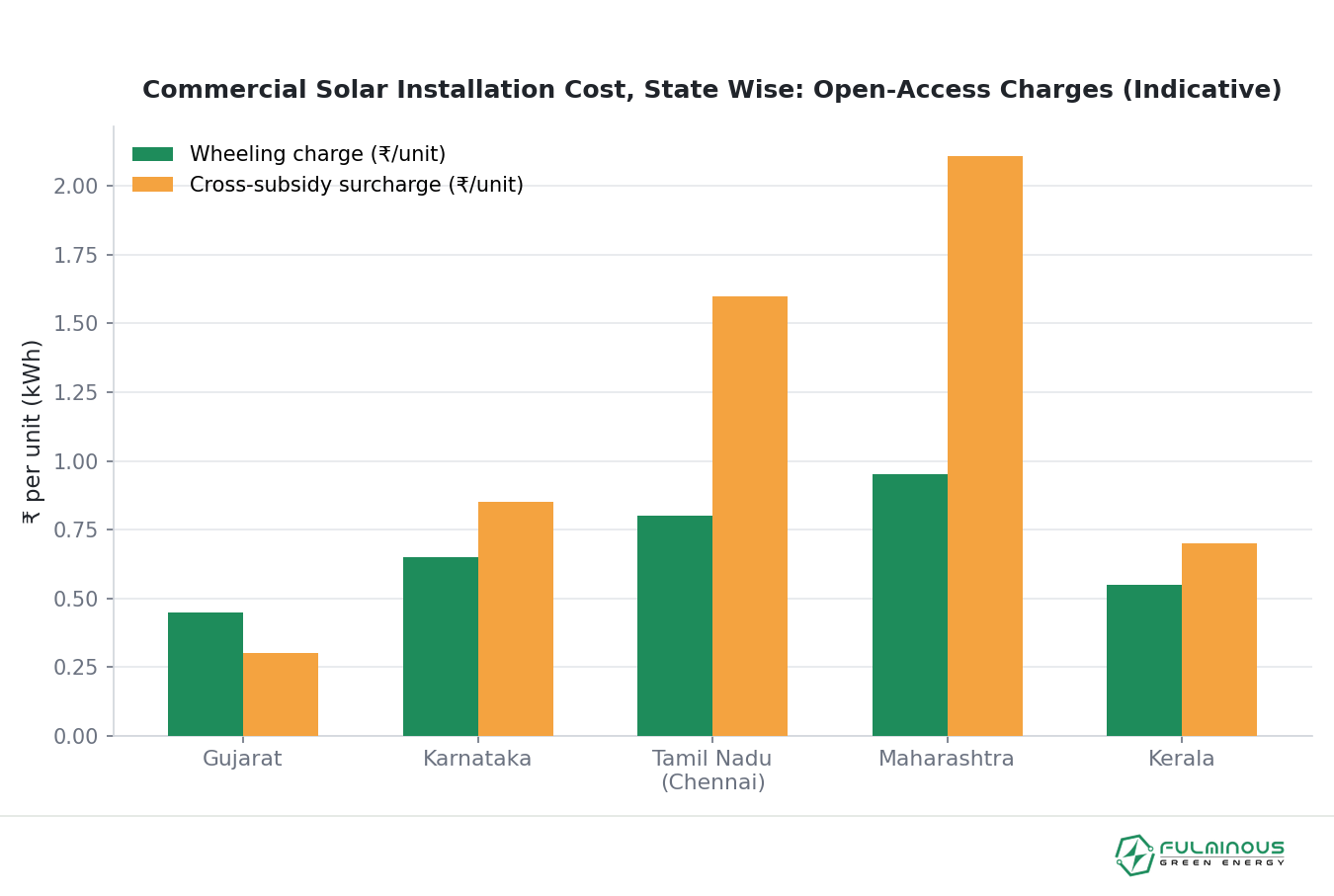
Commercial solar installation cost state wise varies more than most business owners expect, and not just because of sunlight hours. Wheeling charges, cross-subsidy surcharges, banking rules, and how efficiently your local DISCOM processes net-metering applications can swing your effective landed cost by ₹1.5 to ₹2.5 per unit. Since several readers specifically ask about the cost of solar panel installation in Gujarat, Kerala, and Chennai, here’s how those three compare.
Cost of Solar Panel Installation in Gujarat
Gujarat is widely considered India’s most commercial-solar-friendly state. The Gujarat Integrated Renewable Energy Policy 2025, effective through December 2030, offers net metering for rooftop systems from 1 kW up to 1 MW and gross metering from 10 kW to 1 MW. Surplus power injected to the grid is compensated at ₹2.25 per unit for the first five years for self-owned and MSME systems. Wheeling charges here are among the lowest in the country, roughly ₹0.30 to ₹0.60 per unit for high-tension connections, and the state’s four DISCOMs process applications relatively quickly. This combination is a major reason Gujarat leads India in both rooftop and open access solar capacity.
Cost of Solar Panel Installation in Chennai and Tamil Nadu
In Chennai and across Tamil Nadu, TANGEDCO implements net metering up to 1 MW per connection under TNERC regulations, with monthly netting and annual settlement. Industrial retail tariffs here run ₹6.50 to ₹8.00 per unit, so solar can still deliver 40 to 60 percent gross savings. However, Tamil Nadu carries one of the highest cross-subsidy surcharges in India, which makes group captive ownership, where your business holds at least 26 percent equity in the solar project, generally more attractive than third-party open access. Chennai also benefits from roughly 5.3 peak sun hours per day, which keeps generation strong despite the higher policy charges.
Cost of Solar Panel Installation in Kerala
Kerala’s single-utility structure through KSEB makes the application process simpler than in multi-DISCOM states, but irradiance is lower, typically 4.2 to 5.0 kWh per square metre per day. New KSERC regulations effective from November 2025 tightened net metering eligibility, limiting it mostly to smaller residential systems and introducing net billing for commercial systems under 500 kW and gross metering up to 3 MW. For commercial buildings in Kerala, the best economics usually come from sizing the system to match daytime self-consumption rather than exporting large surpluses to the grid.
Factors That Affect Commercial Solar Panel Installation Cost
Beyond size and location, a handful of technical choices can shift your solar panel commercial installation cost up or down by 10 to 20 percent.
Panel Technology: Mono PERC vs TOPCon vs Bifacial
Mono PERC panels remain the standard value choice, offering 19 to 22 percent efficiency at a lower price point. TOPCon panels have crossed 50 percent market share in new commercial installations because of better heat tolerance and slower long-term degradation, usually at a 5 to 15 percent price premium that continues to narrow. Bifacial panels, which capture reflected light on their rear side, add 8 to 25 percent extra output and work best on ground-mounted systems or large flat industrial roofs with light-coloured surfaces underneath.
Rooftop vs Ground-Mounted Installation
Rooftop systems make use of existing space but may require structural reinforcement on older buildings. Ground-mounted systems need dedicated land, roughly 4 to 5 acres per megawatt, plus additional evacuation infrastructure to connect to the grid. From June 2026, all commercial and industrial projects using open access or net metering must also use ALMM-listed domestic solar cells, a compliance requirement that adds roughly 8 to 12 percent to module cost but is mandatory for DISCOM approval.
- Roof condition and age affect whether reinforcement or waterproofing work is needed before installation.
- Shading from nearby structures may require micro-inverters or power optimizers, raising per-watt cost.
- Grid connection distance and transformer capacity can add to balance of system costs, especially for ground-mounted plants.
Government Subsidies and Incentives That Reduce Commercial Solar Cost
Unlike homeowners, businesses cannot claim the PM Surya Ghar Yojana subsidy, which is reserved for residential rooftop systems up to 10 kW. That said, commercial solar in India still comes with meaningful financial support.
Accelerated Depreciation: The Biggest Lever for Businesses
Under Section 32 of the Income Tax Act, solar power systems qualify for 40 percent depreciation in the very first year on a written-down-value basis. On a ₹3.5 crore, 1 MW plant, that works out to roughly a ₹1.4 crore deduction in year one, translating to around ₹42 lakh in tax savings at a 30 percent tax rate. This single benefit typically cuts effective system cost by around 12 percent and shortens payback from 4 to 5 years down to closer to 3 to 3.5 years. One important detail: if your system is commissioned after 3 October in a financial year, you can only claim 50 percent of the year-one depreciation, so timing your commissioning date matters.
GST Reduction and Net Metering Benefits
GST on solar cells and modules was reduced from 12 percent to 5 percent in September 2025, which industry estimates suggest saves roughly ₹20-25 lakh per megawatt on a large project. Businesses can also claim input tax credit on solar equipment purchases. Beyond tax benefits, most states offer net metering for commercial connections up to their sanctioned load, and businesses consuming more than 100 kW can explore open access or group captive structures, both of which typically deliver electricity at 25 to 45 percent below grid tariff. For state-specific programs, it’s worth checking our overview of state-level rooftop solar subsidies, and larger developers may also want to review the Commercial Solar Park Scheme for utility-scale projects. Agricultural and allied businesses should also look at the PM-KUSUM scheme, which supports solar pumps and small-scale grid-connected plants for the farm sector.
Want to see your exact numbers? Run your building’s power consumption through our solar ROI calculator to estimate payback period, annual savings, and system size before you request a formal quote.
Calculate Your Solar ROIROI, Payback Period, and Real Case Studies
Numbers on a spreadsheet are useful, but real installations tell you what actually happens once a system is commissioned.
Payback Period for Commercial Solar in India
Most commercial rooftop systems in India pay back their upfront cost in 3 to 5 years, and as fast as 2.5 to 3 years in states with high industrial tariffs. Ground-mounted industrial systems typically run 4 to 5 years. Businesses that can claim accelerated depreciation and are located in states with lower wheeling and surcharge costs consistently land at the shorter end of that range, with equity returns of 15 to 22 percent for CAPEX-owned 1 MW projects.
Real Case Studies from Gujarat and Maharashtra
Recent installations back up these numbers. A 1.2 MW rooftop system commissioned in August 2025 for a fabric manufacturer in Ahmedabad’s Naroda industrial area is generating close to 1.59 million units a year, saving over ₹1 crore annually, with an expected payback inside 2.5 years. A smaller 450 kW rooftop system for an Ahmedabad-based industrial unit, installed in March 2025, generates around 650,000 units a year and saves roughly ₹42 lakh annually, again on a 2.5-year payback, prompting the company to plan a further 750 kW expansion. In a separate group captive arrangement in Gujarat, four textile and ceramics manufacturers sharing a 21.5 MW solar plant have collectively saved over ₹15 crore since 2024. In Maharashtra, a 2.5 MW rooftop installation for a textile company is projected to cut its power costs by roughly 40 percent. According to Mercom India’s annual market tracking, India’s rooftop solar capacity additions grew sharply through 2025, with industrial and commercial rooftop projects forming a meaningful share of that growth.
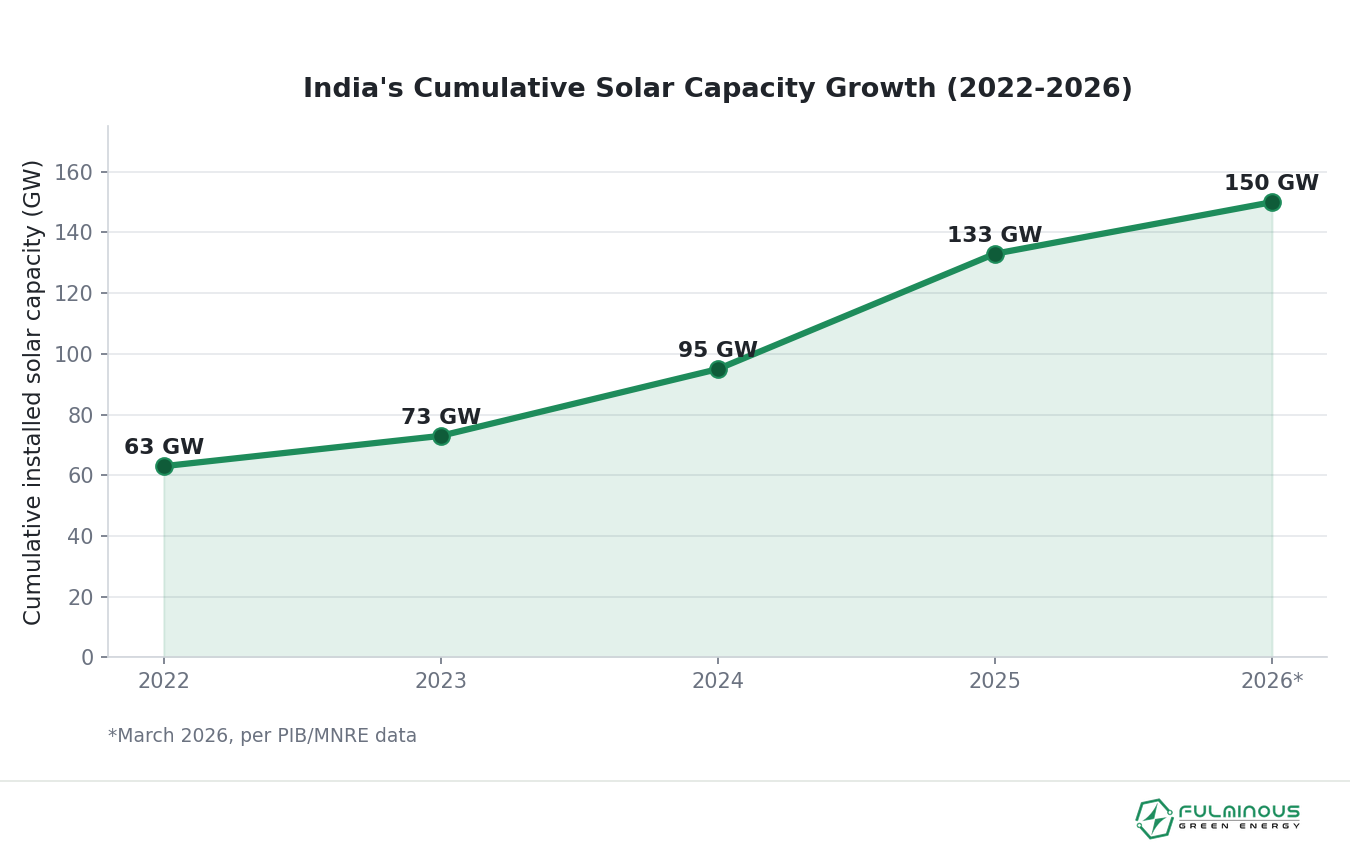
Nationally, India’s Ministry of New and Renewable Energy reported cumulative installed solar capacity of nearly 133 GW by late November 2025, and the sector is widely reported to have crossed roughly 150 GW by March 2026, making India the world’s third-largest solar market. Government communications around the September 2025 GST Council decision, published through the Press Information Bureau, estimated the reduced 5 percent GST rate would meaningfully lower capital costs across new solar projects, commercial and industrial ones included.
How to Choose the Right Commercial Solar Installer
Even with accurate cost benchmarks, the installer you choose has a bigger impact on lifetime performance than almost any other decision. Look for a team that provides a detailed site survey, transparent component brands, and a written performance guarantee, not just a quote.
- Ask for the exact make and model of panels and inverters, not just wattage figures.
- Confirm the installer is registered to handle net metering or open access paperwork with your local DISCOM.
- Request references from at least two commercial clients of a similar system size to yours.
- Check what’s included in solar system maintenance after commissioning, including panel cleaning schedules and inverter warranty support.
- If you’re based in Rajasthan, our solar technician team in Jaipur can walk your site in person before you commit to a quote.
A lower quote isn’t automatically a better deal. Cutting corners on mounting structure quality, cable gauge, or earthing can lead to performance losses and safety issues that cost far more than the initial saving. Compare warranties as carefully as you compare price per watt.
Ready to move forward? Fulminous Green Energy designs, installs, and maintains commercial and industrial solar systems across India, backed by transparent pricing and long-term performance support.
Request Your Free Commercial Solar QuoteFrequently Asked Questions About Commercial Solar Installation Cost
What is the average commercial solar installation cost in India in 2026?
Commercial solar installation cost in India in 2026 typically ranges from ₹35 to ₹50 per watt installed, depending on system size. Smaller systems under 50 kW cost more per watt, while systems above 500 kW often fall closer to ₹35 to ₹40 per watt due to economies of scale.
How much does it cost to install a 1 MW solar power plant in India?
A grid-tied 1 MW solar power plant costs approximately ₹3.5 to ₹5 crore in India as of 2026, excluding battery storage. This includes solar modules, inverters, mounting structures, cabling, and installation, and typically requires 4 to 5 acres of land for a ground-mounted system.
Is commercial solar installation cost different from state to state?
Yes. While equipment costs are fairly similar nationwide, state-level wheeling charges, cross-subsidy surcharges, and net metering rules can change your effective landed cost by ₹1.5 to ₹2.5 per unit. Gujarat generally offers the most favorable policy environment, while Tamil Nadu and Maharashtra carry higher surcharges.
What is the labor cost to install solar panels for a commercial building?
Labor, along with design, engineering, and approval work, makes up the remaining share of project cost after modules (50-60%), inverters (10-15%), mounting structures (8-12%), and electrical balance of system (8-10%). Labor cost stays largely fixed regardless of system size, which is why per-watt pricing improves with scale.
How long does it take for a commercial solar system to pay for itself?
Most commercial solar installations in India pay back their initial cost within 3 to 5 years, and sometimes as quickly as 2.5 to 3 years in states with high industrial electricity tariffs. Businesses claiming accelerated depreciation typically see faster payback than those that cannot use this tax benefit.
Conclusion: Is Commercial Solar Installation Worth the Cost in 2026?
For most Indian businesses paying commercial or industrial electricity tariffs, the math works strongly in favor of solar. A well-designed system, sized correctly for your load and location, typically delivers 40 to 60 percent savings on your power bill and pays for itself within 3 to 5 years, after which two decades or more of electricity arrive at a fraction of grid rates. The commercial solar installation cost in India has changed meaningfully over the past year, with ALMM compliance and GST changes both playing a role, so it’s worth getting a fresh, site-specific quote rather than relying on numbers from even a year ago.
Fulminous Green Energy works with businesses across residential, commercial, industrial, and enterprise segments to design solar systems that match real electricity usage, not just rooftop space. If you’d also like to explore options beyond commercial premises, our residential solar solutions page covers home installations under the same engineering standards.
Ready to see what commercial solar would cost for your specific building? Contact our team today for a free consultation and a detailed, no-obligation quote.
Contact Fulminous Green EnergyRelated Solar Guides
Keep reading — these guides from Fulminous Green Energy go deeper on costs, subsidies and installation.