
Nearly 40 lakh Indian homes now generate their own electricity from the sun, and more than 17 lakh of them pay nothing at all for power every month. That shift did not happen by accident. It is the direct result of India’s Green Energy Mission, a coordinated push by the central government, state governments, and private companies like Fulminous Green Energy to move the country away from coal and toward clean, renewable power. If you have ever wondered what this Green Energy Mission actually includes, how far it has come in 2026, and what it means for your own electricity bill, this guide walks you through everything in plain language.
You will learn how India’s renewable energy capacity has grown, what the PM Surya Ghar Yojana offers homeowners, how farmers benefit from the PM-KUSUM scheme, where the National Green Hydrogen Mission fits in, and how you can start benefiting from the Green Energy Mission today.
What Is India’s Green Energy Mission?
India’s Green Energy Mission is not one single scheme. It is an umbrella term for the country’s combined effort to generate more electricity from renewable sources like solar, wind, and green hydrogen while reducing dependence on fossil fuels. The Green Energy Mission brings together central government programs, state-level subsidies, and private industry investment under one shared goal: a cleaner and more energy-secure India by 2030.
As a result, the Green Energy Mission touches almost every part of daily life. It affects the electricity tariff you pay, the subsidy you can claim on a rooftop solar system, the diesel a farmer no longer needs for irrigation, and the jobs created in solar manufacturing and installation. Furthermore, it positions India as a serious global player in the clean energy race, alongside countries like China, the United States, and members of the European Union.
Why the Government Is Pushing Renewable Energy Now
Three pressures are driving the Green Energy Mission forward at this pace. First, India’s electricity demand keeps climbing every year as incomes rise and more households buy air conditioners, electric vehicles, and appliances. Second, the country still imports a large share of the crude oil and coal it burns, which puts pressure on the national budget whenever global fuel prices spike. Third, India committed at COP26 to reach net-zero carbon emissions by 2070 and to source half of its electricity from renewables by 2030, so the Green Energy Mission is how that promise gets turned into action on the ground.
Key Numbers Behind the Mission
The scale of India’s Green Energy Mission is easier to understand through a few numbers. According to the Ministry of New and Renewable Energy, India’s installed renewable energy capacity has grown nearly fourfold since 2014, and the country now ranks third in the world for solar power capacity. That growth did not happen only in large solar parks; a meaningful share now comes from ordinary rooftops on ordinary homes, which is exactly what the next section covers.
Economic and Environmental Benefits of the Green Energy Mission
Beyond the headline capacity figures, the Green Energy Mission is quietly reshaping India’s economy and environment at the same time. Every rooftop system installed under the Green Energy Mission reduces the load on coal-fired power plants, which lowers particulate pollution in cities and cuts the carbon footprint of the electricity grid overall. At the same time, the Green Energy Mission has created hundreds of thousands of jobs in manufacturing, installation, and maintenance, from panel factories in Gujarat to local technicians working on homes in Rajasthan.
For your household budget, the benefit is more direct. Once a rooftop system is paid off, usually within three to five years under current subsidy levels, your electricity essentially becomes free for the remaining 15 to 20 years of the panel’s working life. Multiply that across 40 lakh homes and counting, and you can see why the Green Energy Mission is treated as both a climate policy and an economic one.
India’s Renewable Energy Growth in 2026
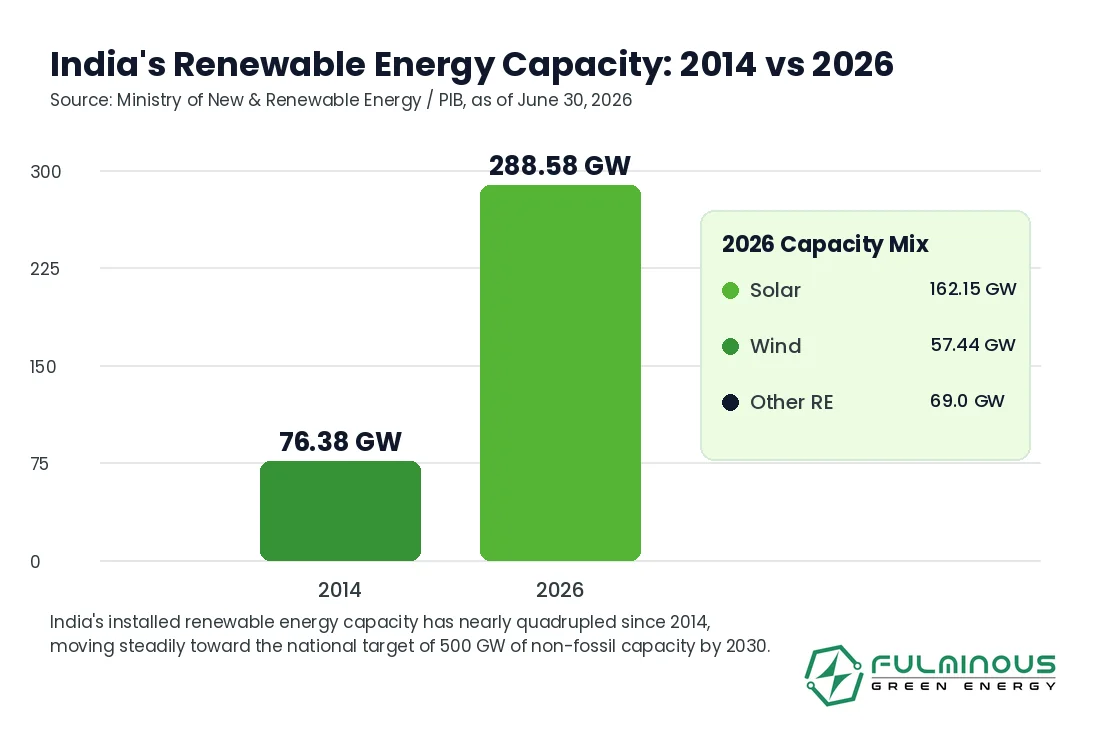
India’s renewable energy capacity nearly quadrupled between 2014 and 2026 under the Green Energy Mission.
As of June 30, 2026, India’s total installed renewable energy capacity stands at 288.58 GW, up from just 76.38 GW in 2014, according to figures released by the Press Information Bureau. That is a remarkable pace of growth for a country of India’s size, and it puts the nation firmly on track toward its stated target of 500 GW of non-fossil fuel capacity by 2030.
Solar Power Leads the Charge
Solar energy alone accounts for 162.15 GW of that total, making it by far the largest contributor to the Green Energy Mission. Wind power adds another 57.44 GW, while bio-power, small hydro, and waste-to-energy projects make up the rest. In H1 2026, India added a record 29 GW of new solar and wind capacity, driven largely by a boom in residential rooftop installations rather than large utility-scale projects alone.
How Far Is India From Its 500 GW Target?
At the current growth rate, India has already crossed more than half of its 500 GW non-fossil fuel target with roughly four years still remaining. However, hitting the remaining gap will require continued investment in grid infrastructure, battery storage, and rooftop adoption. This is precisely where residential solar solutions and small business installations play an outsized role, since millions of individual rooftops add up to gigawatts of capacity far faster than waiting on a handful of massive power plants.
Curious what your own roof could save you? Fulminous Green Energy’s solar experts can size a system for your home or business in Jaipur and beyond, at no cost to you.
Get a Free Solar QuotePM Surya Ghar Yojana: Free Rooftop Solar for Homes
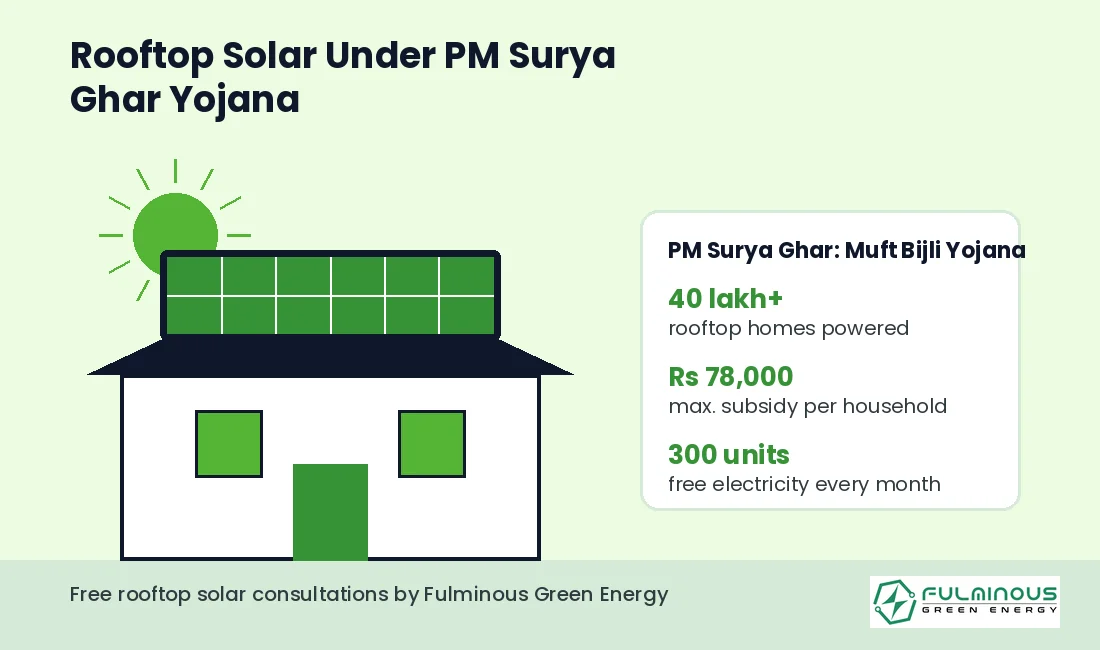
PM Surya Ghar Yojana, the household face of the Green Energy Mission, offers subsidised rooftop solar.
Launched in February 2024 with an outlay of ₹75,021 crore, the PM Surya Ghar Yojana is the flagship household-level piece of the Green Energy Mission. The scheme offers a direct subsidy of up to ₹78,000 for rooftop solar systems and promises up to 300 units of free electricity every month to participating households. As of June 2026, more than 40 lakh homes have installed rooftop systems under the scheme, with over 1 crore households registered on the national portal and 65 lakh applications still in the pipeline.
How Much Can You Save
Your exact savings depend on your roof size, sunlight exposure, and monthly electricity consumption, but the numbers so far are encouraging. Over 17 lakh households have already reported zero electricity bills after installation, and the government disbursed ₹22,750 crore in subsidies overall as of mid-2026, including ₹2,743 crore in May alone. If you want a clearer picture before committing, Fulminous Green Energy’s solar ROI calculator can estimate your payback period based on your actual electricity usage.
Who Is Eligible and How to Apply
Eligibility is straightforward: you need to be an Indian homeowner with a suitable rooftop and a valid electricity connection. The application process itself follows a simple sequence:
- Register on the national PM Surya Ghar portal with your electricity consumer number and state.
- Get a feasibility survey done by an empanelled vendor such as Fulminous Green Energy.
- Approve the quotation and have the system installed by certified technicians.
- Submit the net-metering application and complete the inspection.
- Receive your subsidy directly into your bank account once commissioning is confirmed.
Five states, namely Gujarat, Maharashtra, Rajasthan, Uttar Pradesh, and Kerala, together account for around 70% of India’s rooftop solar capacity, so if you live in one of these states, your local demand and vendor experience are already well established. If you are still weighing the upfront investment, our detailed breakdown of the cost of solar panel installation for home systems can help you budget accurately before you apply.
PM-KUSUM Scheme: Solar Power for Farmers
While PM Surya Ghar Yojana targets homeowners, the KUSUM solar scheme, formally called Pradhan Mantri Kisan Urja Suraksha evam Utthaan Mahabhiyan, focuses on India’s farmers. It is arguably the most under-discussed part of the Green Energy Mission, even though it directly reduces diesel dependence for irrigation across rural India.
Components A, B, and C Explained
The scheme works through three components. Component A supports farmers who want to install small solar power plants on barren or farm land and sell that electricity back to the grid. Component B provides subsidies of up to 60% for standalone solar-powered irrigation pumps in areas without a reliable grid connection. Component C helps farmers who already have grid-connected pumps convert them to solar power, and allows them to sell any surplus electricity generated. Together, these three components let farmers cut diesel costs, gain a stable irrigation source, and in many cases earn extra income by feeding power back into the grid, all of which strengthens the broader Green Energy Mission from the ground up.
National Green Hydrogen Mission: India’s Next Energy Frontier
Beyond solar and wind, the National Green Hydrogen Mission represents the next stage of India’s Green Energy Mission. Approved with a mission outlay of roughly ₹19,744 crore through 2029-30, the program aims to position India as a global hub for producing and exporting green hydrogen, targeting around 5 million metric tons of annual production by 2030. Green hydrogen is created by using renewable electricity, largely solar and wind, to split water into hydrogen and oxygen, producing a clean fuel that can decarbonise industries that are otherwise very hard to electrify directly.
Budget and Targets for 2030
The Union Budget for 2026-27 maintained funding for the Green Energy Mission at ₹600 crore for the year, directed toward pilot projects, electrolyser manufacturing, and demand-side incentives, according to the International Energy Agency‘s analysis of global clean energy investment trends. The mission specifically targets hard-to-abate sectors such as steel, fertiliser, refineries, and heavy transport, sectors where solar panels alone cannot easily replace fossil fuels. In other words, while rooftop solar decarbonises your home, green hydrogen is designed to decarbonise heavy industry, and both fall firmly under the same national Green Energy Mission umbrella.
State-Level Rooftop Solar Subsidies and Incentives
On top of the central subsidy offered through PM Surya Ghar Yojana, many state governments add their own incentives to accelerate the Green Energy Mission locally. These state-level rooftop solar subsidies vary widely, so it pays to check what applies in your specific state before you install a system.
Common state-level incentives include the following:
- Additional capital subsidies on top of the central PM Surya Ghar Yojana amount.
- Faster or subsidised net-metering approvals for residential and commercial connections.
- Stamp duty exemptions or property tax rebates for buildings with rooftop solar.
- Special tariffs or buy-back rates for surplus power exported to the grid.
For commercial and industrial consumers, the incentives look somewhat different, and the return on investment often plays out over a shorter period because of higher daytime electricity consumption. If you run a business, our guide to commercial solar installation cost in India breaks down the numbers by system size so you can compare options before committing.
It is worth checking your state electricity board’s website directly, since these state-level rules change more often than the central Green Energy Mission policy. A quick call to a local installer who already works within the Green Energy Mission framework, such as Fulminous Green Energy, can save you from missing out on a subsidy window that closes without much public notice.
Comparing India’s Green Energy Mission Schemes
With so many programs running in parallel, it helps to see them side by side. The table below summarises who each scheme is designed for and what it offers as part of the Green Energy Mission.
| Scheme | Who It’s For | What It Offers | Focus Area |
|---|---|---|---|
| PM Surya Ghar Yojana | Homeowners | Up to ₹78,000 subsidy, 300 free units/month | Rooftop solar for households |
| PM-KUSUM Scheme | Farmers | Up to 60% subsidy on solar pumps and plants | Agricultural solarisation |
| National Green Hydrogen Mission | Industries and EPC players | ~₹19,744 crore mission outlay through 2030 | Green hydrogen production and export |
| State Rooftop Subsidies | Homeowners and businesses | Additional 10-20% incentives, varies by state | State-specific top-up support |
Notice how each row of the Green Energy Mission serves a different type of consumer, from individual households to entire industrial sectors, yet all four feed into the same national target of 500 GW by 2030. Understanding where you fit into this table is often the fastest way to identify which subsidy to apply for first.
How to Get Started With the Green Energy Mission Today
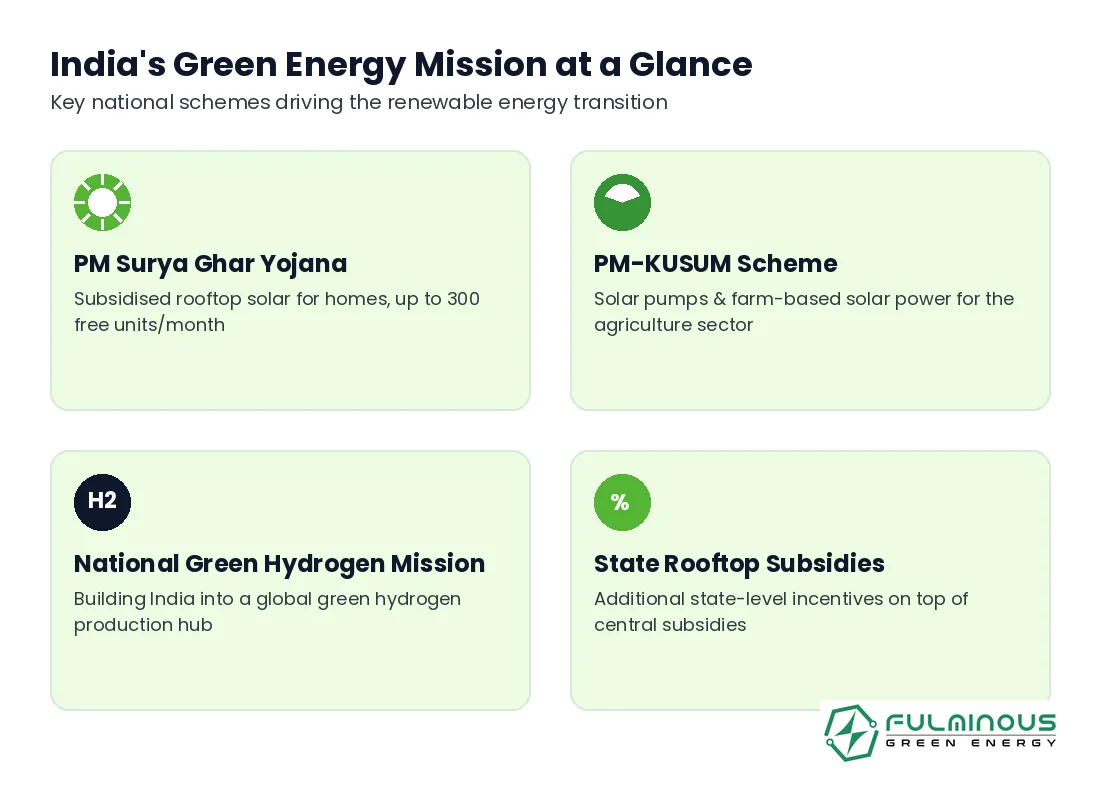
A quick summary of the schemes that make up India’s Green Energy Mission.
Getting your household or business connected to the Green Energy Mission does not need to be complicated. In practice, most people follow the same three broad steps, regardless of which specific scheme applies to them.
- Get a free site assessment to understand your roof size, sunlight exposure, and expected system capacity.
- Compare subsidy eligibility across the central PM Surya Ghar Yojana and any state-level top-ups available to you.
- Choose a certified installer, such as Fulminous Green Energy, to handle design, installation, net-metering, and after-sales solar system maintenance.
Because subsidy budgets and state incentives change from year to year, it is worth starting the process sooner rather than later, especially with the government targeting 75 lakh rooftop installations under PM Surya Ghar Yojana by December 2026.
Ready to be part of India’s Green Energy Mission? Our certified engineers in Jaipur and across Rajasthan can guide you from feasibility to final subsidy disbursement.
Book Your Free ConsultationFrequently Asked Questions About Green Energy Mission
What is India’s Green Energy Mission?
India’s Green Energy Mission refers to the country’s combined push toward renewable power through programs like PM Surya Ghar Yojana, PM-KUSUM, and the National Green Hydrogen Mission. Together, these schemes aim to grow renewable capacity to 500 GW by 2030 while cutting fossil fuel dependence and household electricity costs.
How much does rooftop solar cost under PM Surya Ghar Yojana?
After the central subsidy of up to ₹78,000, most households pay a fraction of the original system cost, with many recovering their remaining investment within three to five years through lower bills. Your exact cost depends on system size, roof condition, and any additional state-level subsidy you qualify for.
Who is eligible for the PM-KUSUM scheme?
Any individual farmer, group of farmers, cooperative, or panchayat with access to farmland can apply for PM-KUSUM, depending on the component. Component B suits farmers without grid access who need standalone solar pumps, while Component C suits those wanting to solarise existing grid-connected pumps, and each component keeps the Green Energy Mission moving forward in rural India.
How is the Green Hydrogen Mission different from rooftop solar schemes?
Rooftop solar schemes like PM Surya Ghar Yojana power individual homes and small businesses directly. The National Green Hydrogen Mission instead uses renewable electricity to produce hydrogen fuel for heavy industries such as steel and fertiliser, which cannot easily run on solar panels alone.
Which states offer the best rooftop solar subsidies in India?
Gujarat, Maharashtra, Rajasthan, Uttar Pradesh, and Kerala currently account for around 70% of India’s rooftop solar capacity, largely due to strong state-level incentives layered on top of the central subsidy. Checking your specific state’s rooftop solar policy alongside the central scheme is the best way to maximise your total savings.
Your Role in India’s Green Energy Mission
India’s Green Energy Mission has moved from a policy ambition to a measurable reality in just a few years, with rooftops, farms, and factories all playing a part. Whether you are a homeowner looking to eliminate your electricity bill, a farmer looking to cut diesel costs, or a business owner planning for the next decade of rising energy demand, there is a program built for you within this Green Energy Mission. The sooner you act, the sooner you start saving, and the sooner your own roof or land becomes part of India’s larger clean energy story.
Ready to take the next step? Contact Fulminous Green Energy today and let our team design a solar solution that fits your home, farm, or business, backed by full support through subsidy paperwork, installation, and long-term maintenance, so you can join India’s Green Energy Mission with confidence.
Get a free, no-obligation solar consultation from Fulminous Green Energy.
Contact Us TodayRelated Solar Guides
Keep reading — these guides from Fulminous Green Energy go deeper on costs, subsidies and installation.