
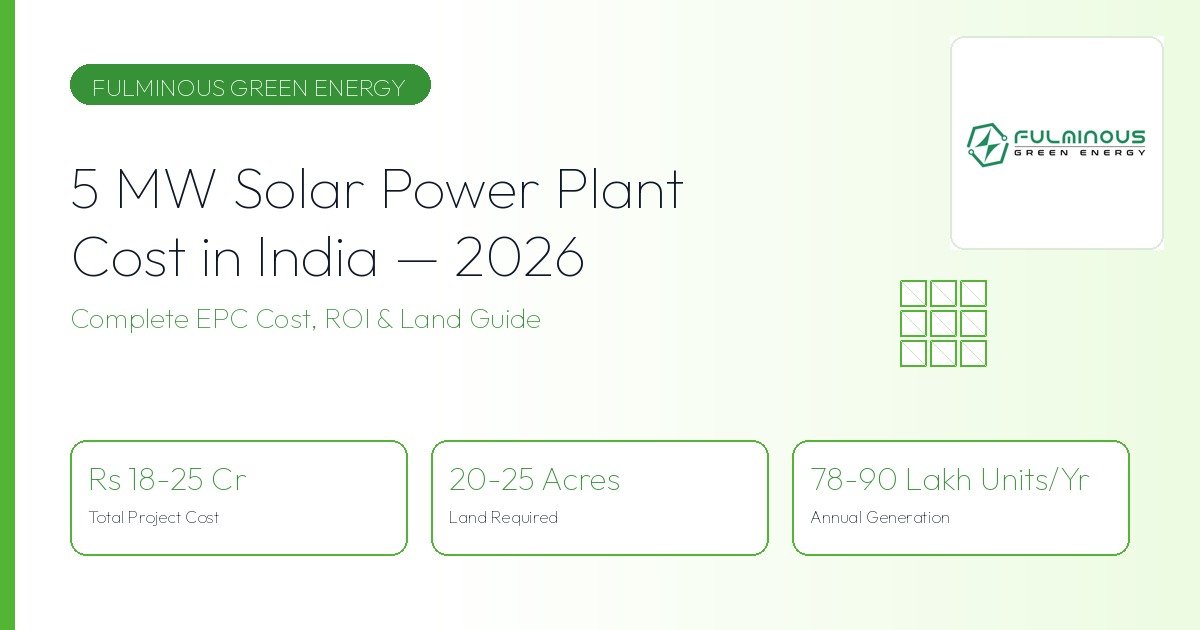
A 5 MW solar power plant in India costs roughly ₹18–25 crore in 2026, generates about 78–90 lakh units of electricity every year, and typically pays for itself within 4 to 7 years. If you are an industrial buyer, a group of factories, or an independent power producer weighing this investment, that single number only tells part of the story — the real decision hinges on land, location, ownership structure, and how you sell the power. This guide breaks down the complete 5 MW solar system price, the land and generation math, the profit potential, and every government scheme that actually applies at this scale.
What Does a 5 MW Solar Power Plant Cost in India in 2026?
Across EPC quotations and industry benchmarks in 2026, a complete, grid-connected, ground-mounted 5 MW solar power plant costs between ₹18 crore and ₹25 crore, which works out to roughly ₹3.6–5 crore per MW, or about ₹36–50 per watt on a turnkey basis. Where a developer chooses premium N-type TOPCon modules, single-axis trackers, or a site far from the nearest substation, the 5 megawatt solar power plant cost can climb toward ₹28–35 crore. The good news is that the 2025 GST reduction on solar equipment from 12% to 5% has already shaved a meaningful amount off this number — savings of up to ₹10–15 lakh per MW, according to industry estimates.
It helps to compare this against smaller-scale projects. A factory rooftop or ground-mount system in the tens of kilowatts, as covered in our guide to commercial solar installation cost in India, follows a different cost curve because fixed costs like grid evacuation and civil work don’t scale down linearly. At 5 MW, you are firmly in utility-adjacent, industrial-scale territory, and the economics start to resemble a mini power plant rather than a rooftop array.
What’s Included in a Turnkey 5 MW EPC Quote
A genuine turnkey price for a 5 MW solar plant should include every component below, not just the panels and inverters:
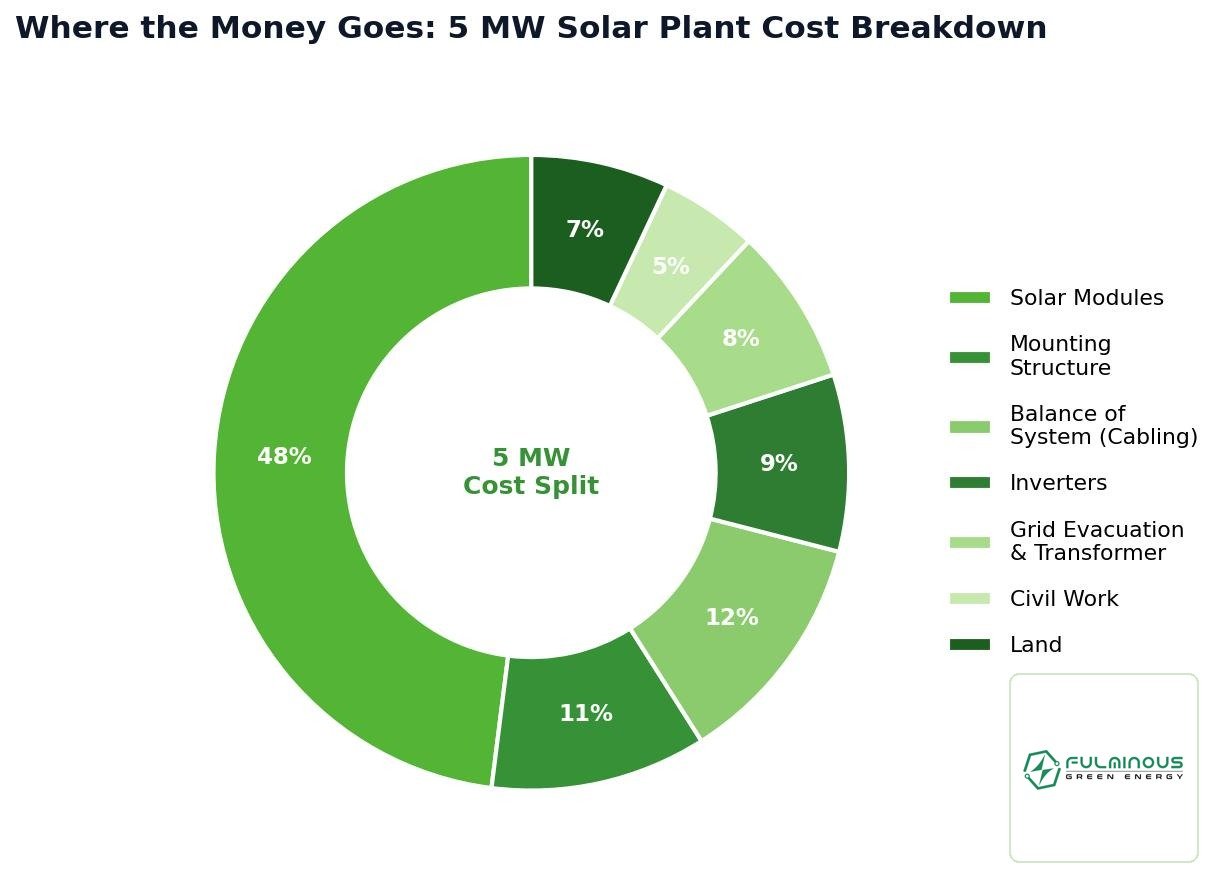
- Solar modules — typically 10,000–12,500 panels (or fewer high-wattage 630–720 Wp TOPCon units), forming 45–50% of total cost
- Inverters — central or string inverters sized for the array, about 9% of cost
- Mounting structure — hot-dip galvanized steel racking, roughly 11% of cost
- Balance of system — DC/AC cabling, earthing, lightning arrestors, SCADA monitoring and switchgear, about 12% of cost
- Grid evacuation infrastructure — step-up transformer, switchyard, metering, and the line to the nearest substation, around 8% of cost
- Civil and structural work — site leveling, fencing, trenching, control room and access roads, about 5% of cost
- Land acquisition or lease, which varies enormously by state
5 MW Solar Power Plant Cost Breakdown: Component by Component
Solar Modules and the 2026 ALMM Deadline
Modules remain the single biggest line item in any 5MW solar power plant cost estimate. In 2026, Indian panel prices run roughly ₹18–24 per watt for Mono PERC, ₹20–28 per watt for N-type TOPCon, and up to ₹32–45 per watt for premium heterojunction (HJT) cells. A change that matters directly to your procurement timeline: from 1 June 2026, the ALMM List-II mandate requires domestically manufactured solar cells (not just modules) for all government-linked and open-access commercial and industrial projects. This triggered a rush of commissioning in early 2026 and is nudging module costs upward, so locking in your supply contract early is worth the effort.
Inverters, Mounting Structure and Balance of System
At 5 MW scale, central inverters are usually more cost-effective than a string-inverter architecture, though string designs offer better fault isolation across a large array. Mounting structures use hot-dip galvanized steel for a 25-year design life; adding single-axis trackers increases mounting cost by 15–20% but can lift annual generation by 15–25%, which often pays for itself over the plant’s lifetime. Balance-of-system costs — cabling, earthing, SCADA, and switchgear — tend to be underestimated in preliminary budgets, so ask your EPC partner for an itemized quote rather than a single lump-sum number.
Grid Evacuation, Civil Work and Land
The transformer, switchyard, and metering infrastructure needed to safely export power to the grid can range from ₹50 lakh to ₹1.5 crore, and this figure is extremely sensitive to how far your site sits from the nearest substation — grid-line extension can cost up to ₹15 lakh per kilometre. Land cost is the widest-ranging variable of all: expect ₹3–8 lakh per acre in Rajasthan, Gujarat or Madhya Pradesh, versus ₹15–30 lakh per acre in parts of Maharashtra or the Delhi NCR belt.
How Much Land Is Required for a 5 MW Solar Plant?
A ground-mounted 5 MW solar plant typically needs 20–25 acres of land, working out to roughly 4–5 acres per MW. Single-axis trackers add another 10–15% to the footprint because rows need extra spacing to avoid self-shading. If land availability is your constraint, two alternatives are worth evaluating:
- Floating solar uses a water body instead of land (about 4–5 acres of water surface per MW) but costs more — typically ₹5.5–7 crore per MW — because of floats, anchoring, and specialized cabling.
- Rooftop-scale industrial solar needs no land at all but is capacity-constrained by available roof area, which is why most 5 MW projects are ground-mounted, captive, or group-captive plants built on open industrial or agricultural land.
Choosing the right state matters as much as choosing the right land parcel. Rajasthan and Gujarat offer the highest solar irradiance in the country, while several states also run their own incentive frameworks — our overview of state-level rooftop solar subsidies is a useful starting point even for ground-mounted C&I projects, since many state solar policies bundle rooftop and open-access incentives together.
Annual Power Generation From a 5 MW Solar Power Plant
A well-designed 5 MW solar power plant generates approximately 20,000–22,000 units per day, which adds up to 7.8–9 million kWh (78–90 lakh units) per year. The number that decides where you land in that range is the Capacity Utilisation Factor, or CUF — essentially, how efficiently your plant converts its rated capacity into actual generation across a full year, accounting for weather, daylight hours, and site-specific irradiance.
Capacity Utilisation Factor (CUF) by State
MNRE uses a 19% benchmark design CUF for solar projects nationally, but actual performance varies meaningfully by geography:
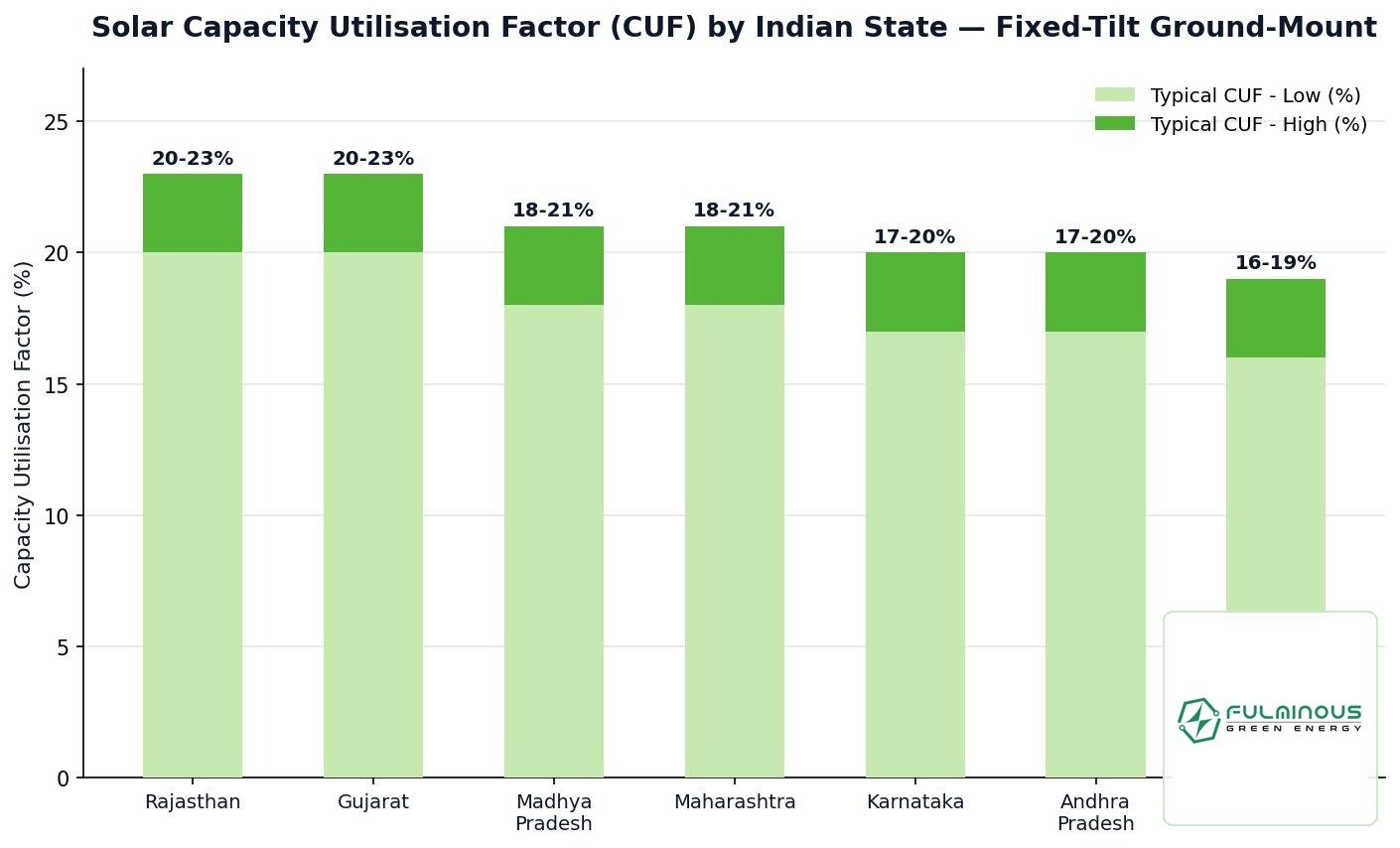
- Rajasthan and Gujarat — the highest-yielding regions in India, at 20–23% CUF with fixed-tilt racking, and 25–27% with single-axis trackers, thanks to irradiance of 5.5–6.5 kWh/m²/day.
- Madhya Pradesh and Maharashtra — a solid 18–21% CUF for most inland sites.
- Karnataka and Andhra Pradesh — generally 17–20%.
- Tamil Nadu — 16–19%, slightly lower due to coastal humidity and higher soiling rates.
A one or two percentage-point difference in CUF might sound small, but across 25 years of operation it can shift total lifetime revenue by several crore rupees — which is exactly why site selection deserves as much attention as equipment selection.
5 MW Solar Power Plant Profit, ROI and Payback Period
Revenue Models: DISCOM PPA vs Open Access vs Group Captive
How you sell the power from your plant has a bigger impact on returns than almost any other decision. The table below compares the three common routes for a 5 MW commercial or industrial project.
| Revenue Route | Typical Landed Tariff | Cross-Subsidy / Surcharge | Best Suited For |
|---|---|---|---|
| DISCOM feed-in PPA | ₹2.50–3.00/unit | Not applicable | Developers wanting guaranteed, low-risk offtake |
| Third-party open access | ₹5.00–6.00/unit landed | Cross-subsidy surcharge + additional surcharge apply | Single large industrial buyer without equity in the plant |
| Group captive | ₹3.50–4.50/unit landed | Exempt (consortium holds ≥26% equity, consumes ≥51% power) | Multiple factories pooling demand for maximum savings |
Because C&I grid tariffs in most industrial states run ₹7–11 per unit, even the higher-cost open-access route usually delivers meaningful savings. But group captive — where a consortium of consumers holds at least 26% equity in the special purpose vehicle and consumes at least 51% of its output — is the dominant structure in 2026 precisely because it escapes the cross-subsidy surcharge and additional surcharge that erode open-access economics. You can model your own numbers using our free solar ROI calculator before committing to a structure.
Payback Period and Return Expectations
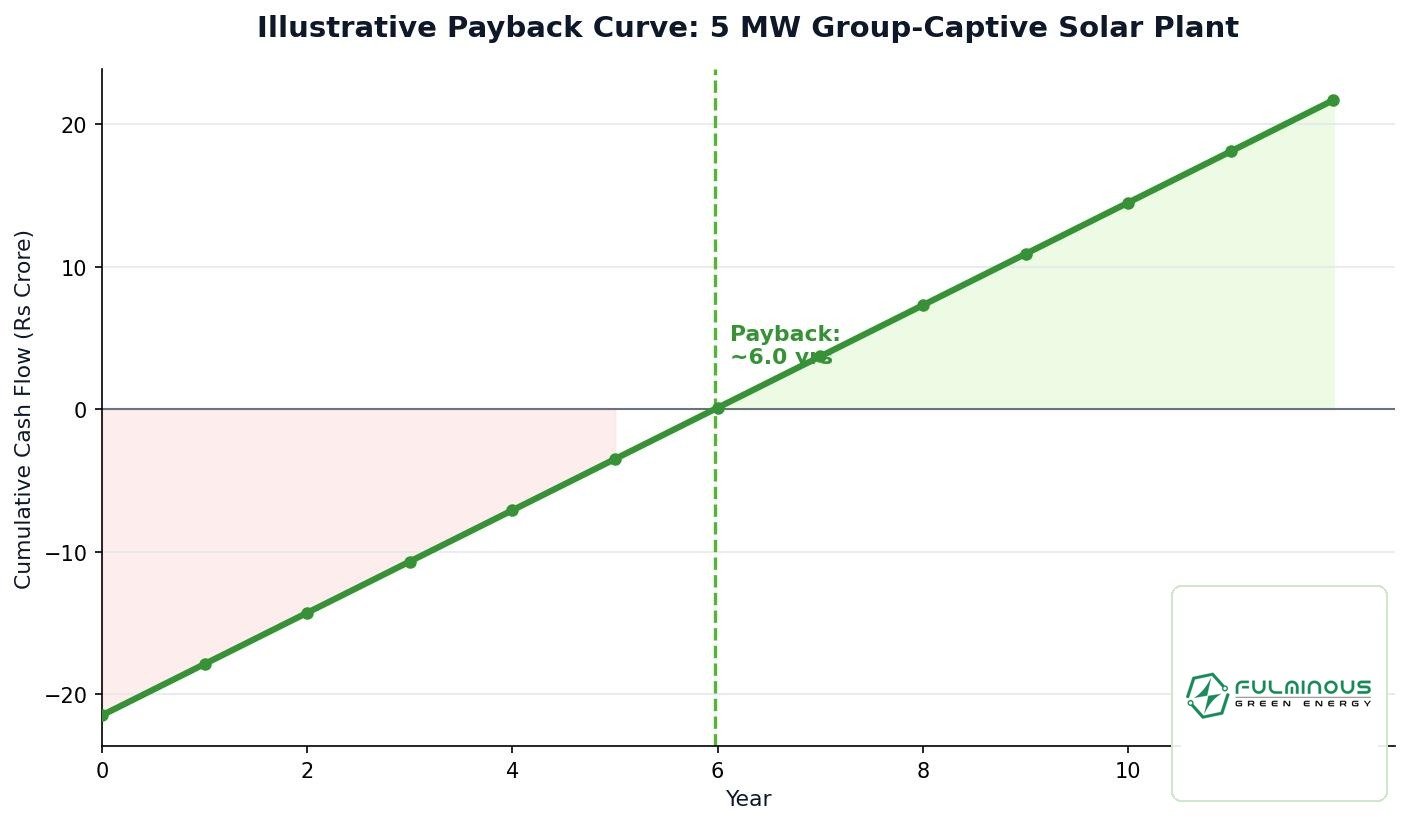
At 78–90 lakh units of annual generation and a group-captive landed cost of ₹3.5–4.5/unit against grid tariffs of ₹7+/unit, most 5 MW projects pay back their capital cost within 4 to 7 years, against a 20–25 year asset life. Industrial captive solar in 2026 is typically underwritten to an IRR of 18–22%.
Not sure which revenue model fits your factory’s load profile?
Get a Free 5 MW Feasibility StudyGovernment Subsidies, Incentives and Schemes for MW-Scale Solar in 2026
This is where many first-time investors get confused, so let’s be direct: there is no direct capital subsidy for a plant at 5 MW scale. The PM Surya Ghar Muft Bijli Yojana caps out at ₹78,000 and applies only to residential rooftop systems — it simply does not extend to industrial-scale projects. Similarly, the PM-KUSUM scheme‘s Component-A, which offers a 25-year DISCOM PPA at a state-fixed feed-in tariff of ₹2.68–3.55 per unit, is designed for decentralized 500 kW–2 MW agricultural plants, not a standalone 5 MW commercial project — though it’s worth understanding if you’re considering an adjacent smaller agricultural installation.
Where the real value lies for a 5 MW investor is in indirect fiscal incentives:
- 40% accelerated depreciation in the first year under Section 32 of the Income Tax Act — the single biggest financial lever for a captive industrial project
- Section 80-IA tax holiday, allowing a 100% profit deduction for any 10 consecutive years within the first 15 (or 20) years of operation
- 5% GST on solar equipment, down from 12% since the September 2025 rate cut
- Cross-subsidy and additional surcharge exemption for captive and group-captive consumers under the Electricity Act, 2003
Note that the ISTS (inter-state transmission system) charge waiver is being phased out: it dropped from a 100% waiver to a 25% charge for projects commissioned between 1 July 2025 and 30 June 2026, and will reach full charges by 2028. If your project uses inter-state transmission, this timeline should factor directly into your commissioning schedule.
Ownership Models: Captive, Group Captive, Open Access and RESCO
Four ownership structures dominate the 5 MW commercial solar market in India today:
- Captive (CAPEX) — your business owns the plant outright, captures the 40% accelerated depreciation and full CSS exemption, and sees the fastest long-term payback, but it requires upfront capital.
- Group captive — a consortium of businesses holds at least 26% equity in the SPV and jointly consumes at least 51% of the power, sharing both the capital outlay and the CSS/surcharge exemption — increasingly the preferred route for mid-sized industrial buyers.
- Third-party open access — a developer owns and operates the plant while your business signs a 15–25 year power purchase agreement, requiring zero capital from you but forgoing the surcharge exemptions.
- RESCO / OPEX — similar to open access but usually for a single site, with the developer billing you per unit consumed rather than under a long-term PPA structure.
If you’re weighing a plant of this scale against a broader industrial rollout, our page on the commercial solar park scheme covers how multiple businesses can co-locate within a shared solar park framework, which is often the fastest route to assembling 20–25 acres of contiguous, grid-ready land.
Considering a group-captive structure with other industrial buyers in your area?
Talk to Our Commercial Solar AdvisorsFinancing a 5 MW Solar Project
Project finance for a 5 MW plant is typically structured at a 70:30 debt-to-equity ratio, with commercial solar loan interest rates from institutions like IREDA running around 9.5–10.5% in 2026, and loan tenures extending up to 15 years. Many developers offset part of their own equity contribution using the construction margin earned on the EPC contract itself, which reduces the external capital they need to raise. Whichever route you choose, get your lender’s term sheet reviewed against your projected CUF and tariff assumptions before signing — conservative “P90” generation estimates, not best-case numbers, are what banks actually lend against.
Ongoing Operations: Maintenance and Performance
A 5 MW plant needs disciplined operations and maintenance to protect its 25-year revenue stream. Budget ₹6–8 lakh per MW per year (₹30–40 lakh annually for the full plant) for module cleaning, inverter servicing, vegetation control, and monitoring. Panel output degrades gradually — typically 0.5–0.7% per year — which is already factored into most financial models. Our solar system maintenance services team structures O&M contracts with CUF-linked performance incentives, so your maintenance partner is financially aligned with keeping the plant at peak output rather than simply showing up on a schedule.
Real 2025–2026 Case Studies: 5 MW-Scale Projects in India
A few recent, publicly reported projects illustrate how these numbers play out in practice:
- Shree Cement, Roorkee (Uttarakhand): Commissioned a 6.0 MWp captive solar plant in July 2025 at a capital cost of roughly ₹16 crore, raising the site’s total solar capacity from 1.0 to 7.0 MWp and offsetting an estimated 6,500 tonnes of CO₂ annually.
- CIE Automotive India, Chakan (Maharashtra): Contracted a 5 MW captive solar project — part of an 8.3 MW package — in January 2026 to power its forgings facility under a group-captive structure.
- Tatva Chintan Pharma Chem (Gujarat): In February 2026, secured 3.2 MW solar (plus 3.2 MW wind) from a 19.8 MW wind-solar hybrid group-captive project, investing ₹4 crore for an SPV equity stake.
These examples reinforce the ₹2.6–3.2 crore per MW range seen at the lower end of the market for large, well-negotiated captive deals, alongside the ₹3.6–5 crore per MW range that’s typical for a standard turnkey build.
Frequently Asked Questions About 5 MW Solar Plant Cost
What is the cost of a 5 MW solar power plant in India?
A complete, grid-connected 5 MW ground-mounted solar plant costs approximately ₹18–25 crore in 2026, or about ₹3.6–5 crore per MW. The final figure depends on module technology, whether trackers are used, land cost, and distance to the nearest grid substation.
How much land is required for a 5 megawatt solar plant?
A ground-mounted 5 MW solar plant typically requires 20–25 acres of land, or roughly 4–5 acres per MW. Single-axis trackers increase this requirement by about 10–15%, while floating solar and rooftop installations need little to no additional land.
How much profit can a 5 MW solar plant generate per year?
At 78–90 lakh units of annual generation, a group-captive 5 MW plant selling power at ₹3.5–4.5/unit landed cost against grid tariffs of ₹7 or more per unit typically delivers a payback period of 4–7 years and an IRR in the range of 18–22%, depending on the state and revenue model chosen.
Is there a government subsidy for a 5 MW solar power plant?
No direct capital subsidy applies at this scale. PM Surya Ghar is residential-only, and PM-KUSUM Component-A covers only 500 kW–2 MW agricultural plants. The real incentives are 40% accelerated depreciation, a Section 80-IA tax holiday, 5% GST, and cross-subsidy surcharge exemption for captive and group-captive structures.
Which is better for a 5 MW plant: captive, group captive, or open access?
Group captive is the most popular route in 2026 because it combines shared capital outlay across multiple businesses with full exemption from cross-subsidy and additional surcharges. Captive ownership offers the fastest payback if you can fund it alone, while open access requires no capital but forgoes those surcharge exemptions.
Conclusion: Is a 5 MW Solar Plant Right for Your Business?
A 5 MW solar system price of ₹18–25 crore is a significant commitment, but for any industrial consumer paying ₹7 or more per unit at the grid, the underlying economics are compelling: a 4–7 year payback against a 20–25 year asset life, meaningful tax benefits, and a hedge against future power price inflation. The details that separate a good investment from a mediocre one are the ones covered above — site CUF, ownership structure, ALMM compliance timing, and a realistic, itemized EPC quote rather than a single lump-sum number.
Fulminous Green Energy works with commercial, industrial and enterprise clients across planning, land assessment, EPC execution, and long-term O&M for projects at exactly this scale. If you’d like a site-specific feasibility study — including CUF modelling, ownership structure recommendations, and a real EPC quote for your location — our team is ready to help.
Ready to build your 5 MW solar plant?
Contact Fulminous Green Energy TodayCost, tariff and ROI figures in this guide are indicative industry ranges for 2026 and can vary based on site conditions, state policy, and market pricing at the time of procurement. Please verify current tariffs, surcharges and ALMM requirements with your State Electricity Regulatory Commission before finalising a project. Sources: Ministry of New and Renewable Energy / PIB, MNRE Physical Progress, and PV Tech.
Related Solar Guides
Keep reading — these guides from Fulminous Green Energy go deeper on costs, subsidies and installation.