
A 2 MW solar power plant can generate more than 30 lakh units of clean electricity every year, enough to power a large manufacturing unit, an IT park, or several mid-sized factories almost entirely through daylight hours. If you are trying to work out the real 2 MW solar system price in India before approaching an EPC contractor, you are asking the right question at the right time. In 2026, this capacity sits right at the top of the range eligible for several state and central incentives, while still being small enough to execute in a single phase. This guide walks through the full cost, land requirement, real generation numbers, subsidy and tax rules, and a practical profit and ROI picture you can use to check any quote you receive.
What Is a 2 MW Solar Power Plant, and Who Actually Needs One?
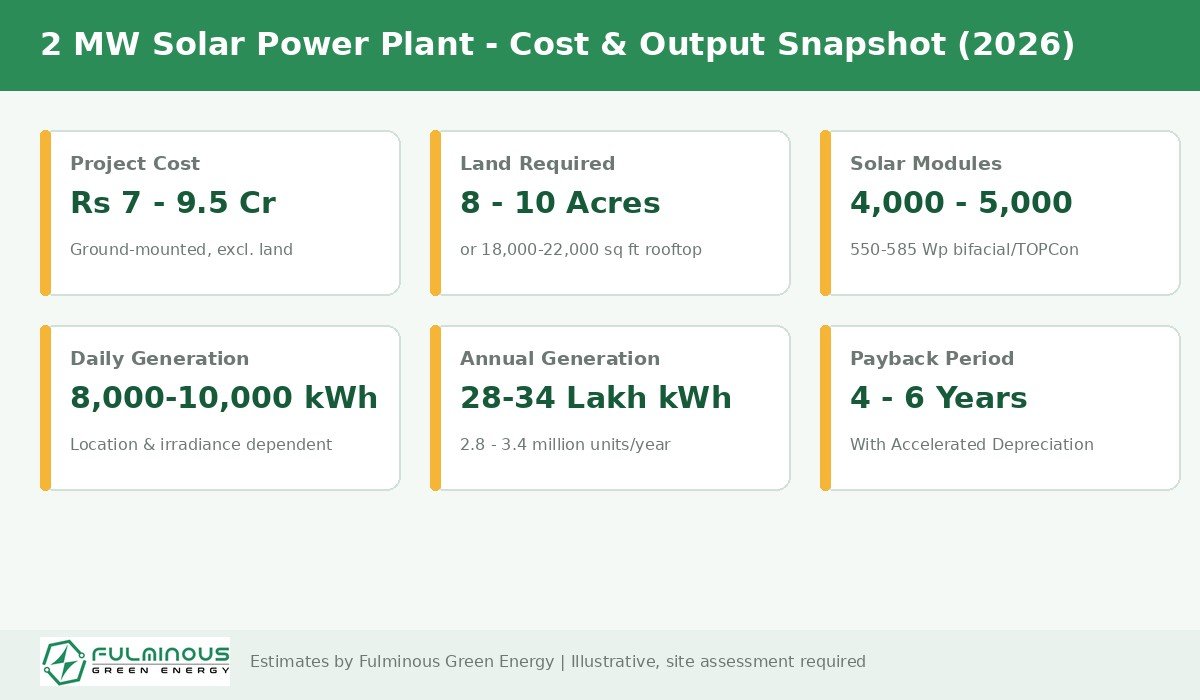
A 2 MW (2,000 kW) solar power plant is a serious piece of industrial infrastructure rather than a simple rooftop add-on. It typically produces around 8,000 to 10,000 units of electricity a day, roughly enough to run a mid-to-large factory, a cluster of warehouses, or an institutional campus almost entirely on solar power during daylight hours. Most such projects in India are built by manufacturing units, industrial groups, educational and healthcare campuses, and independent developers structuring a plant for group captive or open-access sale.
Rooftop, Ground-Mounted or Hybrid: Where a 2 MW Plant Fits
A 2 MW solar power plant can be built as a ground-mounted farm needing 8 to 10 acres, or as a rooftop installation if your facility has around 18,000 to 22,000 square feet of strong, shadow-free roof area, subject to a structural feasibility check. Many businesses at this capacity choose a hybrid layout: as much of this capacity as the rooftop can safely hold, with the remaining capacity built on adjoining or nearby ground-mounted land.
Typical Buyers of a 2 MW Solar Plant in India
The most common buyers of a 2 MW solar power plant include mid-to-large manufacturers, textile and processing units, IT parks, hospital and university campuses, cold chain operators, and farmer cooperatives building a plant under PM-KUSUM Component-A, which is specifically designed for individual capacities between 500 kW and 2 MW. With commercial and industrial power tariffs now running between ₹8 and ₹12 per unit in several states, it offers a compelling case against a levelised solar generation cost that is often under ₹4 per unit.
2 MW Solar Power Plant Cost in India: Full 2026 Price Breakdown
Based on current 2026 EPC benchmarks, the 2 MW solar power plant cost in India typically falls between ₹7 crore and ₹9.5 crore for a ground-mounted, turnkey installation, excluding land acquisition. This works out to roughly ₹3.5 crore to ₹4.75 crore per MW, broadly in line with current mid-scale EPC pricing. The exact price you are quoted depends heavily on module technology, mounting structure, distance from the nearest grid substation, and whether your project needs Domestic Content Requirement (DCR) compliant panels.
AC vs DC Capacity: A Detail Most Quotes Skip
One detail that catches many buyers off guard: a “2 MW” solar plant can refer to either AC (grid export) capacity or DC (installed panel) capacity, and these are not the same number. A 2 MW AC plant is commonly built with around 2.3 to 2.4 MW of DC panel capacity to account for system losses and to maximise inverter utilisation. When comparing EPC quotes, always confirm whether the per-watt or per-kW price you have been given is based on AC or DC capacity, since a rate quoted on AC capacity will look artificially higher than the same project priced on DC capacity.
What Determines Your Final 2 MW Solar System Price
- Module technology: N-type TOPCon and bifacial modules cost more per watt than mono-PERC panels but deliver higher energy yield and slower long-term degradation.
- DCR vs Non-DCR panels: Projects that fall under government schemes mandating Domestic Content Requirement panels can see the total budget shift by ₹50 lakh to ₹1 crore compared with non-DCR sourcing.
- Mounting structure: Fixed-tilt structures are the most economical; single-axis trackers raise upfront cost by 12 to 18% but can lift annual generation by 10 to 20%.
- Grid evacuation distance: Longer cable runs and any transformer or substation upgrades add directly to your final 2 MW solar power plant cost.
- ALMM compliance: Since June 2026, all commercial solar projects must use MNRE ALMM List-II modules; non-compliant modules risk losing net-metering or open-access approval.
- EPC scope: A full turnkey contract covering design, procurement, installation, testing and commissioning costs more than a supply-only order but removes coordination risk from your side.
2 MW vs Other Solar Plant Capacities: Cost Comparison
| Plant Capacity | Approx. Cost (2026) | Land / Roof Area | Daily Generation | Approx. Modules Needed |
|---|---|---|---|---|
| 0.5 MW (500 kW) | ₹2 – 3 Crore | 2.5 – 3 Acres / 40,000-50,000 sq ft | 2,000 – 2,500 kWh | 850 – 950 |
| 1 MW | ₹3.5 – 4.7 Crore | 4 – 5 Acres | 4,000 – 5,000 kWh | 1,700 – 2,200 |
| 2 MW | ₹7 – 9.5 Crore | 8 – 10 Acres / 18,000-22,000 sq ft | 8,000 – 10,000 kWh | 4,000 – 5,000 |
| 3 MW | ₹10.5 – 14 Crore | 12 – 15 Acres | 12,000 – 15,000 kWh | 5,000 – 6,500 |
These figures are indicative EPC benchmarks for 2026 and can shift with module price movements and site-specific transmission costs. If this capacity is larger than your current requirement, our detailed guide on commercial solar installation cost in India covers smaller commercial capacities in more depth, and if you are weighing this against a bigger project, our 3 MW solar power plant cost guide lays out the next capacity tier in detail.
Not sure whether AC or DC pricing applies to your quote? Fulminous Green Energy can review your EPC proposal and prepare a free, apples-to-apples feasibility estimate for your solar project. Talk to our commercial solar team.
How Much Land Is Required for a 2 Megawatt Solar Plant?
A ground-mounted 2 MW solar power plant typically requires 8 to 10 acres of land, roughly 4 to 5 acres per MW, depending on module efficiency, row spacing and site layout. If your project is rooftop-based instead, expect to need approximately 18,000 to 22,000 square feet of usable, shadow-free roof area, subject to a structural load assessment.
Ground-Mounted Land Math
Row spacing for a 2 MW ground-mounted plant is calculated to prevent one row of panels from shading the row behind it during the lowest winter sun angle at your site’s latitude. Add space for internal roads, a control room, a transformer yard and a boundary buffer, and the practical land requirement comfortably lands within the 8 to 10 acre range most EPC contractors quote. Proximity to your load centre also matters: land that is technically cheaper but located far from your facility or the nearest substation can add significant transmission and cabling costs.
Rooftop Feasibility for a 2 MW Plant
A full rooftop 2 MW solar plant needs a genuinely large industrial or warehouse roof, generally upward of 18,000 to 22,000 square feet of continuous, structurally sound area. Where the rooftop cannot accommodate the full capacity, many businesses install what the roof allows and complete the remaining capacity through a small adjoining ground-mounted array or through open access from a separately located plant.
2 MW Solar Plant Power Generation: Daily, Monthly and Annual Output
A well-designed 2 MW solar power plant in India generates approximately 8,000 to 10,000 units (kWh) of electricity per day, adding up to roughly 28 to 34 lakh units (2.8 to 3.4 million kWh) per year in high-irradiance states such as Rajasthan, Gujarat, Madhya Pradesh and parts of Maharashtra and Karnataka. States with longer monsoon seasons or lower average solar irradiance will typically generate at the lower end of this range.
What Affects Your Generation Numbers
Four factors drive the real-world output of any 2 MW solar plant: local solar irradiance, module technology and its temperature coefficient, the tilt and orientation of the mounting structure, and ongoing maintenance quality. A plant with dirty panels, poor string monitoring or an undersized inverter can lose 5 to 10% of its expected annual generation, which is why professional operations and maintenance matters as much as the initial installation. Our approach to solar system maintenance is built specifically to protect these generation numbers over the life of the plant.
2 MW Solar Plant Profit and ROI: Real Numbers for 2026
The profitability of a 2 MW solar power plant depends on how you use or sell the electricity it generates. There are three broad models available to Indian businesses and developers in 2026.
Revenue and Savings Models: Captive, Group Captive and PPA
- Captive consumption: You build the plant to power your own facility, directly offsetting grid purchases at ₹8 to ₹12 per unit with solar generation costing roughly ₹3 to ₹4 per unit.
- Group captive: Multiple businesses jointly own a portion of the plant, each holding at least 26% equity per current group captive rules, and consume the power through open access, sharing the savings proportionally.
- PM-KUSUM Component-A: Farmers, farmer groups or cooperatives can build a plant between 500 kW and 2 MW on their own land and sell the power directly to the DISCOM under a fixed-tariff, long-term power purchase agreement, making a full 2 MW project the upper limit of this scheme’s eligibility.
Worked ROI Example
Take a 2 MW solar plant built for ₹8.2 crore, generating 30 lakh units a year and used for captive consumption against a blended grid tariff of ₹8.5 per unit. The annual saving works out to roughly ₹2.5 crore to ₹2.7 crore. Even before applying tax benefits, this points to a simple payback of about 3 to 3.3 years, and most developers report an internal rate of return (IRR) in the 12 to 18% range across the plant’s operating life, with full payback typically achieved within 4 to 6 years once financing costs and seasonal generation variation are factored in. To model your own numbers against your actual tariff and load pattern, try our solar ROI calculator before finalising your project size.
Want a realistic payback estimate for your business? Share your monthly electricity bill and location with Fulminous Green Energy, and we will map out a custom ROI projection sized to your load. Request your free ROI report.
Government Subsidies, Tax Benefits and Incentives for 2 MW Solar Projects (2026)
Direct capital subsidies under schemes like PM Surya Ghar apply only to residential rooftop solar and do not extend to commercial or industrial plants of this size. Instead, the financial case for a 2 MW solar power plant in 2026 rests mainly on tax depreciation benefits, state-level open access policies, and, for farmer-owned projects, the PM-KUSUM scheme.
Accelerated Depreciation Under Section 32
Businesses that own a 2 MW solar plant as a business asset can claim Accelerated Depreciation (AD) under Section 32 of the Income Tax Act, 1961. Solar power generating assets qualify for a 40% depreciation rate in the first year on the written-down value (WDV) method, provided the plant is commissioned and generating power for more than 180 days in that financial year. On an ₹8 crore plant, this can translate into a first-year depreciation deduction of roughly ₹3.2 crore, meaningfully improving cash flow during the payback period. Businesses should keep the DISCOM commissioning certificate, fixed asset register entries and a CA-certified Form 3CD ready to support this claim, and should confirm eligibility with a qualified chartered accountant before finalising their capital structure.
PM-KUSUM Component-A and State-Level Support
The PM-KUSUM scheme’s Component-A is directly relevant at this capacity: it allows farmers, farmer groups or cooperatives to build individual solar power plants between 500 kW and 2 MW on their own land, with power purchased by the local DISCOM under a fixed-tariff agreement, making 2 MW the upper eligibility limit for a single plant under this component. Our detailed guide to the PM-KUSUM solar scheme covers eligibility, the application process and expected returns for this route. Several states also offer electricity duty exemptions, banking facilities and cross-subsidy surcharge waivers for open-access solar projects, though the rules vary considerably by state. Our reference on state-level rooftop solar subsidies is a useful starting point even for MW-scale projects, since several of the underlying open-access and net-metering rules overlap. Developers building within a government-designated cluster should also review our guide to the commercial solar park scheme, which can reduce land acquisition and grid connectivity costs considerably.
2 MW Solar EPC Process: Step-by-Step 2026 Guide
Executing a 2 MW solar power plant project well requires a structured EPC (Engineering, Procurement and Construction) process. Here is a realistic 2026 timeline from first site visit to commissioning.
- Feasibility study and land finalisation: Site survey, shadow analysis, soil testing and confirmation of land title or lease terms, typically 2 to 3 weeks.
- Design and engineering: Single-line diagrams, structural design, module and inverter selection, and evacuation planning, typically 3 to 4 weeks.
- Approvals and grid connectivity: DISCOM feasibility approval, open access, net-metering or KUSUM application, and statutory clearances, which can run in parallel with procurement.
- Procurement: Sourcing ALMM-listed modules, inverters, mounting structures and cabling, confirming DCR compliance if your project requires it.
- Civil and electrical installation: Land levelling, foundation work, structure erection, module mounting, cabling and transformer installation, typically 6 to 10 weeks for a 2 MW plant.
- Testing, commissioning and handover: Load testing, DISCOM inspection, commissioning certificate, and SCADA-based monitoring setup, followed by ongoing operations and maintenance.
Most 2 MW solar plants in India are commissioned within 3 to 5 months of financial closure, assuming land and approvals are in place before construction begins. Post-commissioning, a structured operations and maintenance plan protects your generation and your Accelerated Depreciation eligibility over the plant’s 25-year life.
2 MW vs Other Solar Plant Sizes: Which Capacity Is Right for You?
Not every business needs exactly 2 MW. The right capacity depends on your annual electricity consumption, available land or roof area, and whether you want to stay within PM-KUSUM Component-A’s eligibility limit. Businesses with smaller daytime loads sometimes start with a 0.5 MW or 1 MW plant and expand later, while larger manufacturing groups occasionally move directly to 3 MW or higher in a single phase to capture better per-MW EPC pricing. This capacity tends to suit businesses with a monthly electricity bill in the ₹18 lakh to ₹35 lakh range, offering strong economies of scale while still qualifying for several capacity-capped incentive schemes.
Frequently Asked Questions About 2 MW Solar Power Plant Cost
What is the cost of a 2 MW solar power plant in India in 2026?
A ground-mounted 2 MW solar power plant in India typically costs between ₹7 crore and ₹9.5 crore in 2026, excluding land. The exact 2 MW solar system price depends on module technology, mounting structure, EPC scope and whether AC or DC capacity is being quoted.
How much land is required for a 2 megawatt solar plant?
A 2 MW solar power plant generally requires 8 to 10 acres of land for a ground-mounted installation, roughly 4 to 5 acres per MW. A rooftop installation instead needs approximately 18,000 to 22,000 square feet of shadow-free roof area.
How much profit can a 2 MW solar plant generate every year?
Used for captive consumption against an ₹8 to ₹12 per unit grid tariff, a 2 MW solar plant can save businesses roughly ₹2.5 crore to ₹2.7 crore a year, with typical payback in 4 to 6 years and an IRR of 12 to 18% over its operating life.
Is subsidy available for a 2 MW solar power plant?
Direct capital subsidy schemes such as PM Surya Ghar apply only to residential rooftop solar. A 2 MW commercial or industrial plant instead benefits mainly from 40% first-year Accelerated Depreciation under Section 32, and farmers or landowners can access PM-KUSUM Component-A, which covers plants up to 2 MW.
How long does it take to install a 2 MW solar power plant?
Most 2 MW solar power plants in India are commissioned within 3 to 5 months of financial closure, covering design, procurement, civil and electrical installation, and DISCOM commissioning, assuming land and approvals are secured in advance.
Conclusion: Is a 2 MW Solar Power Plant Worth It in 2026?
For mid-to-large industrial and commercial power buyers, a 2 MW solar power plant remains one of the strongest long-term investments available in 2026. Falling module prices, improved TOPCon and bifacial technology, a well-established 40% Accelerated Depreciation benefit, and rising grid tariffs together push most well-designed projects toward payback within 4 to 6 years, with 20 or more years of low-cost generation left after that. The real work is in getting the details right: confirming AC versus DC capacity on every quote, choosing ALMM-compliant components, sizing the plant to your actual land and load profile, and working with an EPC partner who manages approvals, installation and long-term maintenance under one roof.
Ready to see what a 2 MW solar power plant would cost and deliver at your specific site? Contact Fulminous Green Energy today for a free feasibility study, land and load assessment, and a detailed EPC proposal tailored to your business.
Related Solar Guides
Keep reading — these guides from Fulminous Green Energy go deeper on costs, subsidies and installation.