
More than 5 million Indian households now have rooftop solar under the PM Surya Ghar Muft Bijli Yojana, and installation pace has jumped from around 5,000 systems a day in late 2025 to roughly 16,300 a day by mid-2026, according to pv magazine India. What’s quietly driving that surge isn’t just falling panel prices, it’s easier access to a loan for solar panel installation through PSU banks, NBFCs and the government’s own subsidy-linked lending network. If the upfront cost of going solar has been holding you back, this guide walks through exactly how a loan for solar panel installation works in 2026, what it costs, and how to apply for one without overpaying. If you are borrowing for a system in Rajasthan, we handle the loan paperwork alongside the installation on all our solar projects across Rajasthan.
You will learn how financing solar panel installation compares across PSU banks, private banks and NBFCs, how the central subsidy under PM Surya Ghar Yojana reduces the loan amount you actually need, and the full step-by-step process for getting a loan for installing solar panels approved. We’ll also cover real EMI numbers, a loan-versus-cash comparison, and the mistakes that cost first-time applicants the most money.
Why Financing Solar Panel Installation Makes Sense in 2026
Rooftop solar has moved from a niche upgrade to a mainstream household decision, and financing is a big part of why. India installed a record 44 GW of new solar capacity in FY2026, according to JMK Research, and a large share of that residential growth is being funded through structured lending rather than one-time cash payments. For most households, a loan for solar panel installation turns a five-figure or six-figure upfront cost into a monthly payment that is often lower than the electricity bill it replaces.
Electricity Costs Keep Rising Faster Than Loan Interest
Grid tariffs in most Indian states have climbed steadily over the past few years, while interest rates on a loan for solar panel installation from PSU banks have stayed in the single digits for subsidy-linked systems. That gap is exactly why a loan for installing solar panels often pays for itself: your EMI is frequently close to, or lower than, the electricity bill portion the system eliminates, so you are not really adding a new expense, you are swapping one for a cheaper one.
Government Backing Has Made Solar Loans Safer for Lenders
The PM Surya Ghar Yojana’s structure, where a central subsidy is credited directly after commissioning, has made banks far more comfortable offering collateral-free loans for smaller systems. This is a major reason PSU banks can now offer a loan for solar panel installation at rates well below a typical personal loan, since the subsidy effectively de-risks a portion of the exposure for the lender.
Not sure how much system you actually need before you start comparing loan options? Fulminous Green Energy’s team can size your rooftop system and estimate real savings before you apply for financing.
How Does a Loan for Solar Panel Installation Work?
A loan for solar panel installation works much like a standard secured or semi-secured retail loan, but with a few solar-specific features layered on top. Instead of financing a car or a home renovation, the loan is tied to a rooftop solar system, and in most cases part of the system’s cost is offset by a government subsidy that arrives after installation is complete.
Types of Solar Panel Financing Available
Broadly, there are three routes for financing solar panel installation in India today. The first is a subsidy-linked PSU bank loan through the Jan Samarth portal, built specifically for PM Surya Ghar-registered systems. The second is a general-purpose loan for solar panel installation from a private bank, usually processed like a consumer durable or personal loan and carrying a higher rate. The third is an NBFC-backed loan for solar panel installation, which trades a higher interest rate for faster approval and fewer documentation requirements. All three routes are commonly grouped together under the umbrella term loans for installing solar panel systems, though the eligibility criteria and paperwork differ meaningfully between them.
What Lenders Evaluate Before Approving a Loan for Solar Panel Installation
Whichever route you choose, lenders generally look at four things: your income and repayment capacity, your existing credit score, the installer’s quotation and system specifications, and, for subsidy-linked loans, your registration status on the Jan Samarth or state DISCOM portal. A clean credit history and a quotation from a DISCOM-empanelled installer meaningfully speed up approval for any loan for solar panel installation.
- Income proof (salary slips, ITR, or bank statements for self-employed applicants).
- Existing credit score, typically 700 or above for the best rates.
- A formal quotation from a registered solar installer.
- Proof of property ownership or a no-objection certificate for rented premises.
- Jan Samarth or DISCOM portal registration number, for subsidy-linked loans.
Loan for Solar Panel Installation: Interest Rates in 2026
Interest rates for a loan for solar panel installation vary widely depending on which lender category you choose, and the difference between the cheapest and most expensive options is large enough to change your total repayment by tens of thousands of rupees over the loan tenure. The chart below summarises indicative annual rates as of 2026.
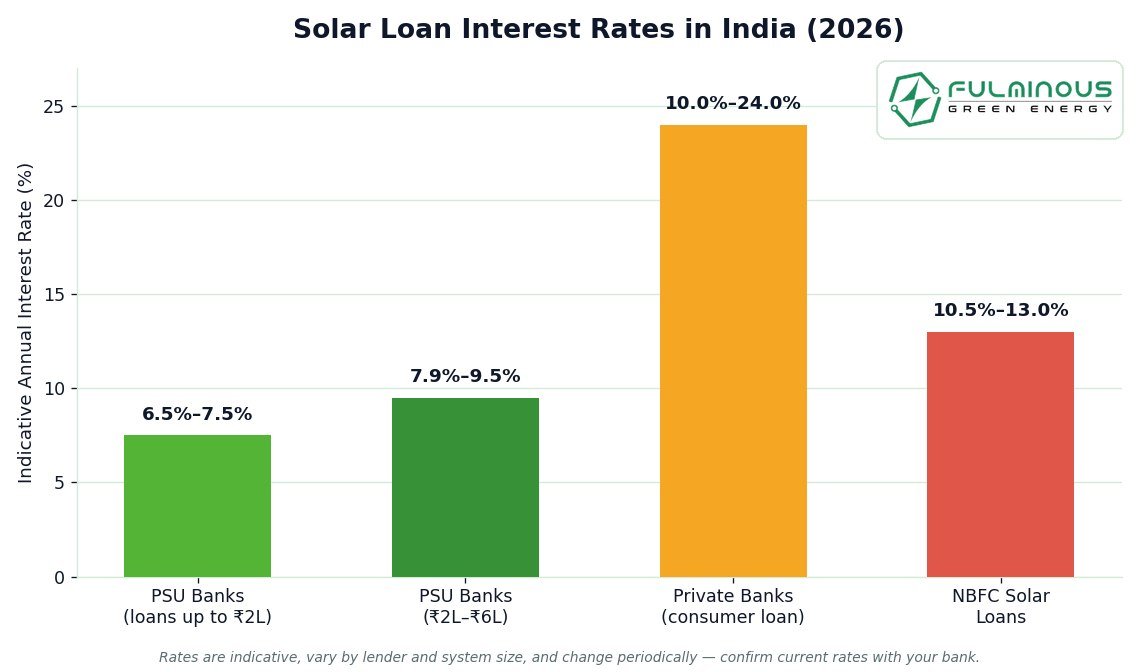
Indicative annual interest rates for a solar panel installation loan by lender category, 2026.
PSU Bank Rates for Subsidy-Linked Solar Loans
Public-sector banks currently offer the most competitive loan for solar panel installation rates when the system is registered under PM Surya Ghar Yojana. For loans up to ₹2 lakh, most PSU banks such as SBI, Punjab National Bank, Bank of Baroda and Canara Bank quote rates in the range of roughly 6.5% to 7.5% per annum, with zero collateral required. For loan amounts between ₹2 lakh and ₹6 lakh, covering larger residential systems, rates typically rise to around 7.9% to 9.5% per annum, still well below unsecured personal loan pricing.
Private Banks and NBFCs: Faster but Costlier
If you need financing solar panel installation quickly and do not want to wait for subsidy-linked processing, private banks and NBFCs are an alternative, though a more expensive one. Private bank consumer loans for solar can run anywhere from roughly 10% up to 24% per annum depending on your credit profile, while an NBFC-backed loan for solar panel installation from providers focused on renewable financing typically lands between 10.5% and 13% per annum with faster, largely digital approval. These rates change periodically, so always confirm the current figure directly with the lender before signing anything.
| Lender Type | Indicative Rate (p.a.) | Typical Loan Amount | Tenure | Collateral |
|---|---|---|---|---|
| PSU banks (up to ₹2 lakh, subsidy-linked) | ~6.5% – 7.5% | Up to ₹2 lakh | Up to 10 years | Nil |
| PSU banks (₹2 lakh – ₹6 lakh) | ~7.9% – 9.5% | ₹2 lakh – ₹6 lakh | Up to 10 years | Usually nil to minimal |
| Private bank consumer/solar loan | ~10% – 24% | Up to ₹50 lakh+ | Up to 7 years | Varies |
| NBFC solar loan | ~10.5% – 13% | Full system cost | 6 months – 5 years | Nil |
Rates shown for a loan for solar panel installation are indicative averages compiled from publicly available lender information as of 2026 and change periodically based on RBI policy, your credit profile and lender promotions. Always confirm the current rate with your chosen bank or NBFC before applying.
Financing Solar Panel Installation Through PM Surya Ghar Yojana
The single biggest factor shaping the cost of a loan for solar panel installation in India today is the PM Surya Ghar Yojana subsidy structure. Rather than replacing the loan, the subsidy reduces the amount you actually need to borrow, which lowers both your EMI and your total interest outgo on the loan for solar panel installation you eventually take.
How Much Subsidy Reduces Your Loan Amount
Under the scheme, households receive ₹30,000 per kW for the first 2kW and ₹18,000 for the third kW, capping at ₹78,000 for systems of 3kW and above. For a typical 3kW solar system costing around ₹1.5 lakh to ₹1.8 lakh, that subsidy alone can cover 40% to 50% of the total cost, meaning the loan for installing solar panels you need to apply for is often less than half the system’s sticker price.
Applying Through the Jan Samarth Portal
A subsidy-linked loan for solar panel installation is processed through the Jan Samarth portal, which connects your PM Surya Ghar registration directly to participating PSU banks. This integration is what allows banks to offer collateral-free loans for solar panel installation at lower rates than a standard personal loan, since your subsidy eligibility and installer quotation are already verified in the system before the bank even reviews your application.
Many states also add their own incentives on top of the central subsidy, which can shrink your required loan amount even further. It’s worth checking the state-level rooftop solar subsidies available where you live before you finalise your loan application.
How to Apply for a Loan for Solar Panel Installation
The application process for a loan for solar panel installation is fairly consistent across lenders, though a subsidy-linked loan for solar panel installation from a PSU bank adds a portal registration step that private bank and NBFC loans skip.
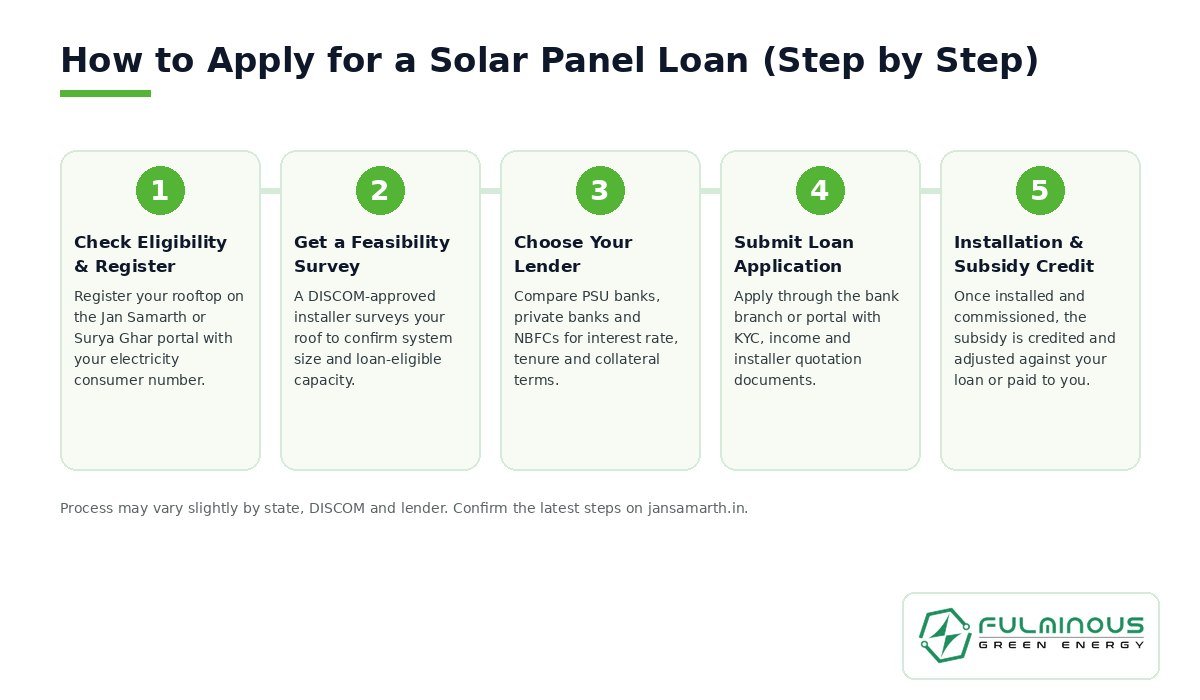
The typical five-step path to getting a solar panel installation loan approved and disbursed.
Step-by-Step Application Process
- Register your rooftop and electricity consumer number on the Jan Samarth or your state DISCOM’s solar portal.
- Get a feasibility survey from a DISCOM-empanelled installer to confirm system size and eligible capacity.
- Compare lenders on interest rate, tenure and collateral terms before choosing where to apply.
- Submit your loan application with KYC documents, income proof and the installer’s formal quotation.
- Complete installation and commissioning, after which the subsidy is credited and adjusted against your loan or paid directly to you.
Documents You Will Need
Most banks and NBFCs ask for a broadly similar document set when you apply for a loan for solar panel installation, regardless of which lender category you choose:
- PAN card and Aadhaar card of the applicant.
- Latest electricity bill showing the consumer account number.
- Income proof such as salary slips, Form 16, or ITR for the last one to two years.
- Bank statements for the last three to six months.
- Property ownership documents or a rent agreement with owner consent.
- Signed quotation from your chosen solar installer.
Fulminous Green Energy can also prepare a detailed residential cost breakdown you can attach to your loan application as supporting documentation.
Solar Loan vs. Paying Cash: Which Should You Choose?
Not every household needs a loan for solar panel installation. If you have enough idle savings to cover the net cost after subsidy without disrupting your emergency fund, paying cash avoids interest entirely. But for most homeowners, a loan for solar panel installation preserves liquidity and starts generating bill savings immediately, without a large lump-sum outflow.
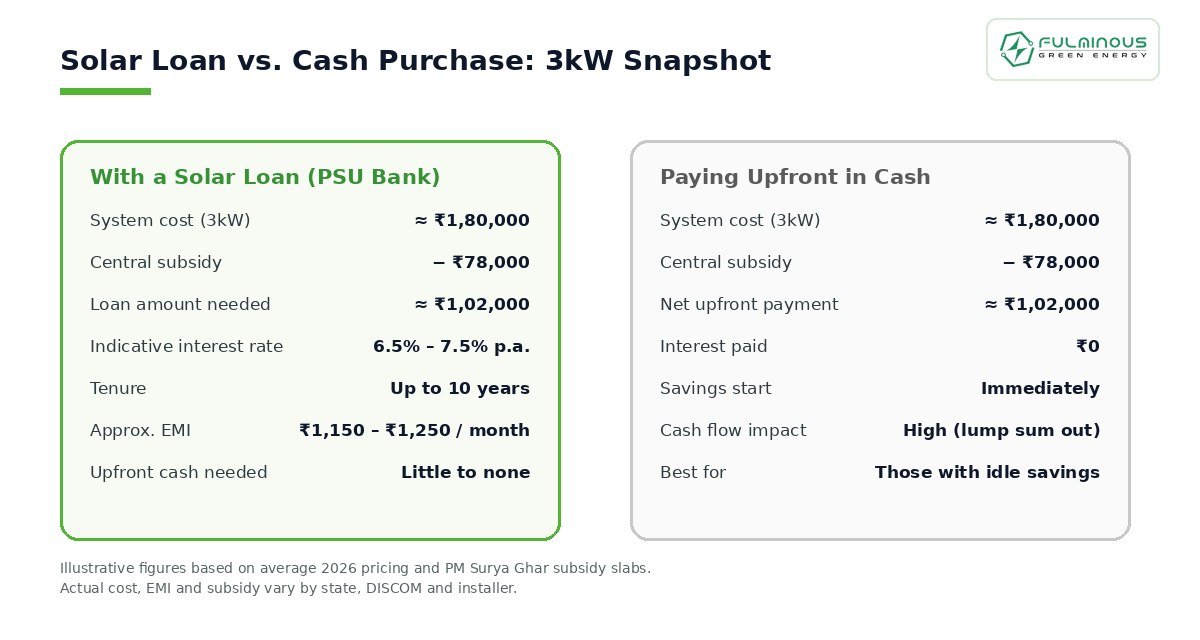
A side-by-side snapshot of financing versus paying upfront for a typical 3kW residential system.
A Real EMI Example for a Loan for Solar Panel Installation
Take a 3kW residential system costing roughly ₹1.8 lakh. After the ₹78,000 central subsidy, the net loan for solar panel installation amount needed is close to ₹1.02 lakh. At a PSU bank rate of around 7% per annum over a 10-year tenure, the EMI works out to approximately ₹1,150 to ₹1,250 a month, an amount that is frequently lower than the electricity bill savings the system delivers once it is generating at full capacity.
When Paying Cash Makes More Sense
If you are debt-averse, already have the full net amount sitting in a low-yield savings account, or plan to install a larger 5kW solar system or bigger where the loan tenure would stretch uncomfortably long, paying cash can be the simpler choice. The trade-off is that your capital is locked into the system rather than remaining available for other opportunities or emergencies.
Matching Loan Amount to the Right System Size
One of the most common mistakes with any loan for solar panel installation is borrowing based on a rough estimate rather than an accurate site assessment. Your ideal system size, and therefore your ideal loan for solar panel installation amount, depends on your monthly consumption, roof area, and shadow-free sunlight hours, not just what a nearby installer happens to be pushing that month.
Why Right-Sizing Protects Your Loan Investment
An undersized system leaves savings on the table and can make the loan for installing solar panels feel like it barely dents your electricity bill. An oversized system, on the other hand, increases your loan amount and EMI without proportionate savings, since excess generation beyond your consumption is often credited at a lower rate under net metering rules. Getting the size right from the start is the single biggest lever you have over your loan-to-savings ratio.
Comparing Costs Across Common System Sizes
Because your loan for solar panel installation amount scales directly with system cost, it helps to check indicative pricing for your target capacity before applying. Fulminous Green Energy publishes detailed, current cost breakdowns for sizes ranging from a 1kW solar system for very small households up to a full 10kW solar system for larger homes and small commercial setups, so you can estimate your likely loan amount before you even talk to a bank.
Still deciding between a 3kW, 5kW or larger system? Run the real numbers on generation, savings and payback period before you commit to a loan amount.
Tips to Get the Best Solar Panel Loan Deal
Meeting the eligibility bar for a loan for solar panel installation is only the first step toward a smooth approval. A few practical habits consistently help borrowers secure lower rates and smoother approvals in 2026:
- Register on the Jan Samarth portal early, since a subsidy-linked loan for solar panel installation from a PSU bank carries the lowest interest rates available.
- Keep your credit score above 700 where possible, as it directly influences the rate you are offered, especially outside the subsidy-linked route.
- Get quotations from at least two DISCOM-empanelled installers so your loan application reflects a fair, competitive system price.
- Ask each lender for the total cost of the loan for solar panel installation, including processing fees, not just the headline interest rate.
- Time your application after your feasibility survey is complete, so your loan for solar panel installation amount matches your actual approved system size rather than an estimate.
Avoiding Common Financing Mistakes
The most expensive mistake first-time applicants make with a loan for solar panel installation is borrowing against the full system cost instead of the net cost after subsidy, which inflates the loan and EMI unnecessarily. The second most common mistake is choosing an NBFC or private bank loan purely for speed without first checking whether a subsidy-linked, lower-rate loan for solar panel installation was available through a PSU bank, since the rate difference can be significant over a 5 to 10 year tenure.
Ready to move from research to a real quotation? Fulminous Green Energy’s residential team can prepare a site-specific proposal you can take straight to your bank.
Frequently Asked Questions About Loan for Solar Panel Installation
What is the interest rate on a loan for solar panel installation?
Interest rates for a loan for solar panel installation typically range from about 6.5% to 7.5% per annum for subsidy-linked PSU bank loans up to ₹2 lakh, rising to 7.9% to 9.5% for larger amounts. NBFC and private bank options usually run higher, from around 10% to 24% per annum depending on the lender and your credit profile.
Can I get a loan for installing solar panels without collateral?
Yes, most PSU banks offer a collateral-free loan for solar panel installation up to ₹2 lakh when the system is registered under PM Surya Ghar Yojana. Larger loan amounts between ₹2 lakh and ₹6 lakh may require minimal additional documentation, but are still largely unsecured for residential systems.
How much loan do I need after the government subsidy?
After the central subsidy of up to ₹78,000 for a 3kW or larger system, most households need a loan for solar panel installation covering roughly 40% to 60% of the total system cost. For a typical 3kW system priced around ₹1.8 lakh, that works out to a loan amount close to ₹1 lakh to ₹1.1 lakh.
How long does it take to get a loan for solar panel installation approved?
A subsidy-linked loan for solar panel installation from a PSU bank typically takes 2 to 4 weeks from application to disbursement, since it includes a feasibility survey and portal verification step. NBFC loans are often faster, with digital approval in as little as 3 to 7 days, though usually at a higher interest rate.
Is it better to take a loan or pay cash for solar panels?
A loan for solar panel installation makes sense if you want to preserve savings and start benefiting from lower electricity bills immediately, since the EMI is often close to or lower than the bill savings. Paying cash avoids interest entirely and suits households with sufficient idle savings who prefer to stay debt-free.
Making the Right Financing Decision for Your Home
A loan for solar panel installation has become one of the most practical ways to move to rooftop solar in 2026, particularly now that PM Surya Ghar Yojana subsidies and Jan Samarth-linked PSU bank rates have brought borrowing costs down to a level that often sits below typical bill savings. Whether you choose a subsidy-linked bank loan, an NBFC option for speed, or decide to pay cash outright, the most important step is getting an accurate system size and quotation before you commit to any loan amount.
If you are ready to move forward with financing solar panel installation for your home, Fulminous Green Energy can prepare a site-specific system design and cost estimate you can take directly to your bank or NBFC of choice. Ready to start? Contact Fulminous Green Energy today for a free consultation on the right system size, subsidy eligibility and financing route for your home.
Ready to get a personalised quote and apply for a loan for solar panel installation? Our team is happy to walk you through subsidy eligibility, system sizing and lender options.
Related Solar Guides
Keep reading — these guides from Fulminous Green Energy go deeper on costs, subsidies and installation.