
Most people researching a 25 kW solar system cost in India are not homeowners. They are factory owners, school administrators, hotel managers, or housing society secretaries who are staring at a monthly electricity bill that has crossed Rs 40,000 and wondering if solar finally makes sense at this scale. It does, but the number you get quoted depends heavily on what’s actually included, which is exactly what this guide breaks down.
By the middle of 2026, a 25 kW solar power plant has become one of the most commonly installed capacities for commercial buildings, large bungalows on three-phase connections, and group housing societies. Electricity tariffs have kept climbing in most states, and component prices for solar panels have stabilised after years of fluctuation, which makes this the right time to actually run the numbers instead of guessing.
In this guide, you’ll get the real 25 kW solar power plant cost across on-grid, hybrid, and off-grid configurations, a clear answer on 25 kW solar panel cost with subsidy in India, and a full breakdown of generation, space requirements, and payback period — all updated for 2026.
Why 25 kW Has Become Such a Popular Capacity in 2026
Five years ago, most rooftop solar conversations in India revolved around 3 kW to 10 kW systems for individual homes. That has shifted. As electricity tariffs across states like Maharashtra, Delhi, and Tamil Nadu have climbed past Rs 8 to Rs 10 per unit for commercial and high-slab residential consumers, the economics of larger systems have become impossible to ignore for anyone with a monthly bill above Rs 35,000.
A 25 kW system sits right at the point where a building has outgrown what a 10 kW or 15 kW setup can offset, but doesn’t yet need a full megawatt-scale industrial installation. Small manufacturing units, three-storey commercial complexes, large independent bungalows with central air conditioning, schools, and gated housing societies with shared rooftop access are the most common buyers at this capacity in 2026.
What Determines the 25 kW Solar System Cost in India
Before looking at price tables, it helps to understand why two installers can quote wildly different numbers for the same 25 kW solar power plant cost. The headline figure hides a dozen smaller decisions that each move the price by 10 to 30 percent.
System Type: On-Grid, Off-Grid, or Hybrid
The single biggest driver of solar system cost in India for 25 kW on grid versus hybrid or off-grid setups is whether you need battery storage. An on-grid system pushes excess power back to the utility through net metering and draws from the grid when sunlight is insufficient. It needs no batteries, which keeps the cost down by roughly 25 to 35 percent compared with hybrid systems.
Off-grid systems run independently of the utility and store energy in batteries for use after sunset, which makes them considerably more expensive and generally unnecessary unless you’re in a location with no grid access at all. Hybrid systems sit in between, offering backup power during outages while still using net metering during the day.
Panel Technology
Mono PERC panels remain the most cost-effective choice for large installations, while TOPCon and bifacial panels cost more upfront but generate more power per square metre, which matters if your rooftop or land area is limited. 10kW solar panel installation cost in India follows the same logic, just at a smaller scale, so reviewing that breakdown is useful if you’re comparing tiers before committing to 25 kW.
Inverter Brand and Capacity
A 25 kW system needs a three-phase inverter, and brand choice alone can shift your final bill by Rs 30,000 to Rs 60,000. Reputed brands carry better warranties and after-sales support, which matters far more over a 25-year panel lifespan than saving a few thousand rupees upfront.
Site Conditions and Location
Installations in Delhi, Mumbai, and other metro markets typically run 10 to 15 percent higher because of labour costs, while states like Rajasthan and Gujarat often see more competitive pricing due to higher solar adoption and local manufacturing presence. Roof height, structural reinforcement needs, and cable routing distance also affect the final number.
A Real-World Example: 25 kW for a Jaipur Manufacturing Unit
Consider a small textile finishing unit in Jaipur with a sanctioned three-phase load and an average monthly bill of around Rs 42,000 before going solar. A 25 kW on-grid system installed with mono PERC panels and a Tier-1 three-phase inverter came in at approximately Rs 12.8 lakh including GST, structure, and commissioning. With daytime production hours aligning closely with peak solar generation, the unit offset close to 78 percent of its grid consumption in the first full year, cutting the monthly bill to roughly Rs 9,200. At that savings rate, the system is on track to pay for itself in just under 5 years, with 20 years of largely free generation remaining on the panel warranty.
This kind of outcome is fairly typical for daytime-heavy commercial loads, though homes and buildings with significant evening consumption will see a longer payback period since unused daytime generation gets credited at lower net-metering rates rather than offsetting bills directly.
25 kW Solar System Price in India: Full Cost Table (2026)
Here is a realistic 25 kw solar power plant cost table based on current 2026 market rates across system types. Treat this as a planning anchor — your final quote will vary based on the factors above.
| System Type | Price Range (2026) | Best Suited For |
|---|---|---|
| On-Grid | Rs 11,00,000 – Rs 14,00,000 | Factories, offices, large homes, shops |
| Hybrid (with battery) | Rs 19,00,000 – Rs 22,00,000 | Hospitals, server rooms, frequent outage zones |
| Off-Grid | Rs 16,00,000 – Rs 18,50,000 | Remote sites with no grid connection |
| Housing Society (on-grid, with subsidy) | Rs 10,50,000 – Rs 11,75,000 | Group housing, RWAs |
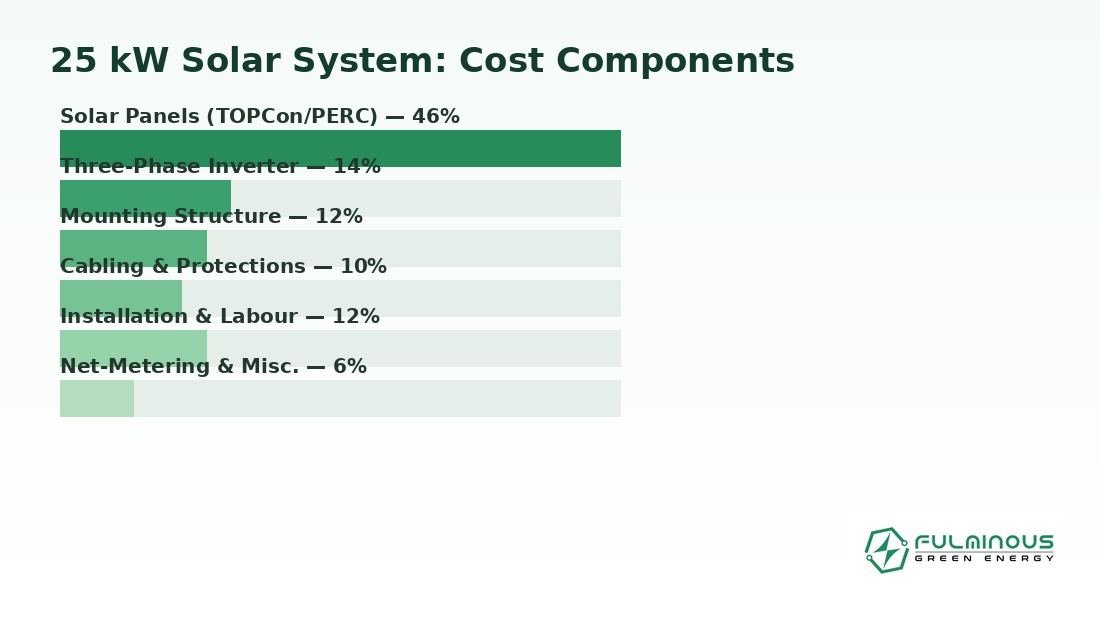
Prices include panels, inverter, mounting structure, cabling, protections, and standard installation. They exclude GST, which is charged separately at 12 to 18 percent depending on component classification.
25 kW Solar Panel Cost With Subsidy in India: What You Need to Know
This is where most buyers get confused, so let’s be direct about it. The 25 kw solar penal cost with subsidy in india works differently depending on whether you’re an individual homeowner or part of a group housing society.
Individual Homes: No Subsidy Above 10 kW
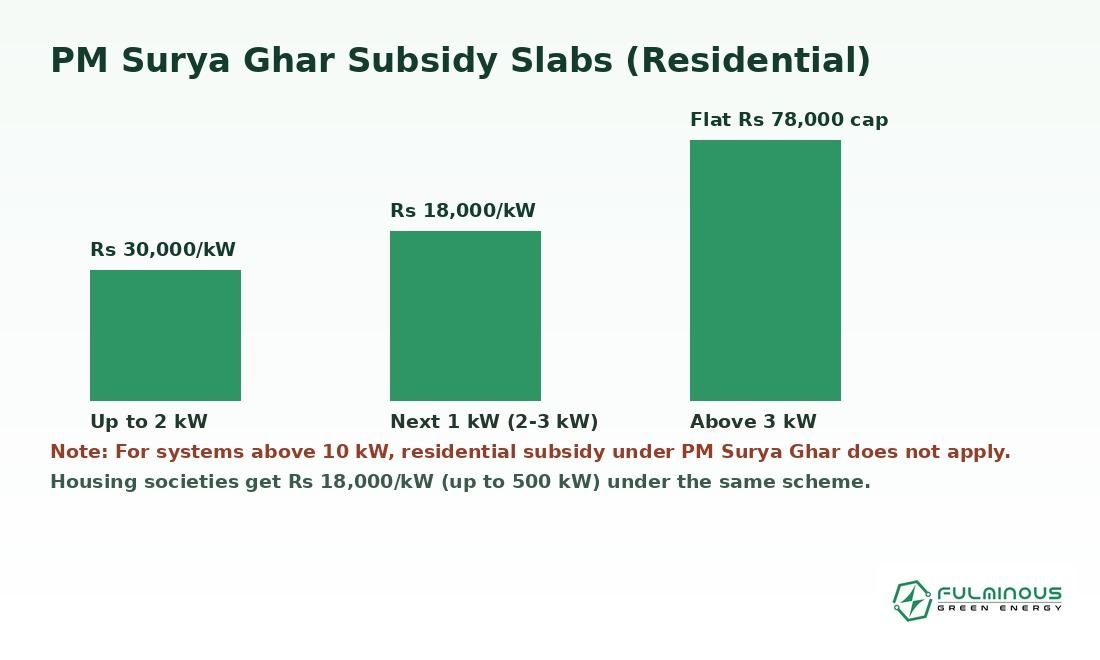
Under the PM Surya Ghar Muft Bijli Yojana, the residential rooftop subsidy applies only to systems up to 10 kW. A 25 kW system, by definition, falls outside that window, so a single household installing 25 kW on its own roof will not receive any central subsidy on this capacity. If your actual requirement is closer to the eligible range, it’s worth reviewing PM Surya Ghar Yojana eligibility and subsidy slabs before deciding on system size.
Housing Societies: Rs 18,000 Per kW, Up to 500 kW
Group housing societies and resident welfare associations are treated differently. Under the same scheme, RWAs can claim Rs 18,000 per kW for shared rooftop installations up to 500 kW total capacity. For a 25 kW system, that works out to approximately Rs 4,50,000 in subsidy, which meaningfully changes the payback math for a shared installation. You can check the exact slab structure on our dedicated page about state-level rooftop solar subsidies, since several states layer additional incentives on top of the central scheme.
Commercial and Industrial Installations
Commercial buildings installing a 25 kW system are not eligible for the residential subsidy at all, but they may qualify for accelerated depreciation benefits under income tax rules, along with state-specific incentives under schemes like the commercial solar park scheme. Agricultural and irrigation-linked installations should instead look at the KUSUM solar scheme, which offers a different subsidy structure entirely.Check your subsidy eligibility with our team →
How Much Power Does a 25 kW Solar System Generate
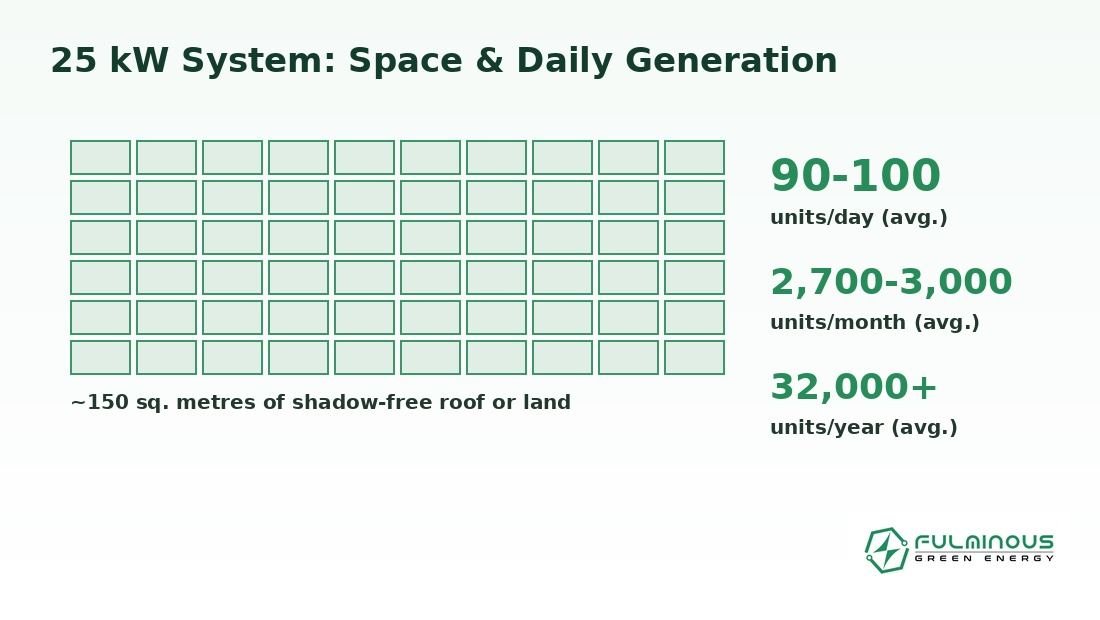
Numbers matter more than promises here, so let’s look at actual output. A 25 kW solar system generates approximately 90 to 100 units per day under good sunlight conditions, which translates to roughly 2,700 to 3,000 units a month and more than 32,000 units across a year. Locations like Rajasthan, Gujarat, and parts of Maharashtra see output toward the higher end of this range because of stronger and more consistent sunlight hours.
This generation capacity is enough to comfortably run multiple large air conditioners, refrigeration units, motors, and lighting loads throughout the day for a mid-sized commercial operation or a large residential property with high daytime consumption.
Space Requirement
You’ll need approximately 150 to 175 square metres of shadow-free roof or ground space for a 25 kW system. The exact figure depends on panel wattage — higher-efficiency TOPCon or bifacial panels need less area per kW than standard mono PERC panels, which matters if your available rooftop is tight.
25 kW Solar System Cost vs Other Popular Capacities
If 25 kW feels larger than what you actually need, it helps to compare it against other common system sizes before finalising your decision. Smaller installations follow the same pricing logic but at proportionally lower investment levels.
- For mid-range homes, our guide on the 5kW solar system cost is a useful starting comparison.
- Larger homes and small offices often land between 7kW and 8kW solar system cost brackets.
- Growing businesses frequently start with a 12kW solar system price before scaling up to 25 kW as consumption rises.
- For larger commercial sites, the 16kW solar system cost and 20kW solar system price in India sit just below the 25 kW tier.
Reviewing these brackets side by side often clarifies whether 25 kW genuinely matches your load, or whether a smaller, less expensive system would cover your needs just as well.
Payback Period and Long-Term Savings
A 25 kW on-grid solar system typically pays for itself within 4 to 6 years for commercial users with high daytime electricity consumption, after which the system continues generating nearly free electricity for another 19 to 21 years of its 25-year warranty period. Over that lifespan, total savings commonly run into Rs 50 lakh to Rs 70 lakh, depending on local tariff rates and how much of the generated power you consume directly versus exporting to the grid.
Use our solar ROI calculator to run the numbers against your actual monthly electricity bill rather than relying on generic averages — every site’s payback period shifts slightly based on tariff slabs and consumption patterns.Calculate your exact savings with a free site survey →
On-Grid vs Hybrid: Which Should You Choose for 25 kW
| Feature | On-Grid | Hybrid |
|---|---|---|
| Approx. Cost | Rs 11–14 lakh | Rs 19–22 lakh |
| Backup During Outage | No | Yes |
| Net Metering | Yes | Yes |
| Maintenance Complexity | Low | Moderate (battery upkeep) |
| Best For | Daytime-heavy loads | Outage-prone areas, critical loads |
For most commercial buildings and large homes with predictable daytime usage, on-grid remains the more sensible choice purely on cost-efficiency. Hybrid only justifies its premium when power cuts genuinely disrupt operations or when you’re running equipment that cannot tolerate downtime.
Maintenance Costs After Installation
A 25 kW system needs panel cleaning every 15 to 20 days in dusty regions to maintain peak output, along with periodic inverter checks and annual electrical safety inspections. Most well-installed systems need minimal intervention beyond cleaning for the first 8 to 10 years. Annual maintenance costs for a system this size typically range from Rs 8,000 to Rs 15,000, covering cleaning visits, minor wiring checks, and inverter firmware updates. Inverters generally need replacement or major servicing around year 10 to 12, which is worth budgeting for separately from routine upkeep.
You can review our detailed solar system maintenance guide for a full upkeep schedule, or get ongoing support through our solar technician services in Jaipur if you’re based in Rajasthan.
Financing a 25 kW Solar Installation
At Rs 11 lakh to Rs 22 lakh depending on configuration, a 25 kW system is a meaningful capital outlay for most businesses and homeowners, which is why financing structure matters as much as the headline price. Several banks and NBFCs now offer dedicated solar loans with tenures stretching to 7 or 10 years, often at rates comparable to home improvement loans, especially when the borrower can show the system will reduce a recurring operational expense.
For homeowners specifically, Fulminous Green Energy offers flexible residential installment plans that spread the cost across manageable monthly payments, often structured so the EMI sits close to or below your previous average electricity bill. This means you start saving from month one rather than waiting years to recover the upfront cost. Businesses installing 25 kW systems can also explore commercial leasing structures where a third party owns the system and you simply pay a reduced per-unit rate for the power generated.
Frequently Asked Questions About 25 kW Solar System Cost in India
What is the 25 kW solar system cost in India in 2026?
A 25 kW on-grid solar system in India typically costs between Rs 11 lakh and Rs 14 lakh in 2026, depending on panel technology, inverter brand, and site conditions. Hybrid systems with battery backup can cost Rs 19 lakh to Rs 22 lakh because of the added storage.
Is subsidy available on a 25 kW solar panel cost in India?
Individual homes do not get a PM Surya Ghar subsidy on a 25 kW system because the residential subsidy only applies up to 10 kW. However, group housing societies and resident welfare associations can claim Rs 18,000 per kW, up to 500 kW, which works out to roughly Rs 4.5 lakh for a shared 25 kW plant.
How many units does a 25 kW solar system generate per day?
A well-installed 25 kW solar system generates approximately 90 to 100 units per day under good sunlight conditions, which adds up to around 2,700 to 3,000 units a month and over 32,000 units a year, depending on your location and shading.
How much roof space does a 25 kW solar system need?
A 25 kW solar system needs roughly 150 to 175 square metres of shadow-free roof or ground space. The exact area depends on whether you choose standard mono PERC panels or higher-wattage TOPCon and bifacial panels, which need slightly less space for the same output.
Is on-grid or hybrid better for a 25 kW solar system?
On-grid is the better choice for most commercial buildings and large homes because it costs 25 to 35 percent less and uses net metering to offset bills. Hybrid is worth the extra cost only if you face frequent power cuts or run equipment that cannot tolerate downtime.
Final Thoughts
A 25 kW solar system sits at a sweet spot for businesses, large homes, and housing societies that have outgrown smaller residential setups but aren’t yet ready for utility-scale installations. The real cost will always depend on your specific roof, location, and equipment choices, which is why published price ranges should guide your expectations rather than replace an actual site assessment.
If you’re ready to move from research to an actual quote, Fulminous Green Energy can walk you through site-specific pricing, subsidy eligibility, and financing options, including flexible residential solar solutions for households that want to go solar without a large upfront payment.
Ready to find your exact 25 kW solar system cost? Contact Fulminous Green Energy today for a free site survey and a detailed quote tailored to your property.
Written by Dharmendra Nathawat, Fulminous Green Energy. Learn more about our team.
Related Solar Guides
Keep reading — these guides from Fulminous Green Energy go deeper on costs, subsidies and installation.