
Rajasthan holds 43,317 MW of installed solar capacity, which is 26.71% of everything India has built, and no other state comes close. That scale is the reason a solar company in Rajasthan can quote you a system today at prices that were impossible five years ago, and it is also the reason the state now has hundreds of installers of wildly different quality. Fulminous Green Energy works across the state as a full-service solar panel company in Rajasthan, handling rooftop solar for homes, commercial and industrial plants, equipment supply, subsidy paperwork and long-term maintenance.
This page is written to help you make a decision rather than to sell you one. You will find how solar sizing actually works, what the installation process involves step by step, what genuinely drives the price up or down in Rajasthan, how the central and state subsidy stack together, and the specific questions to ask any solar installation company in Rajasthan before you pay a deposit. Services are available across Jaipur, Jodhpur, Udaipur, Kota, Ajmer, Bikaner and the rest of the state.
Fulminous Green Energy provides rooftop, commercial and industrial solar across Rajasthan.
Why Solar Makes Sense in Rajasthan Right Now
Before you shortlist any solar company in Rajasthan, it helps to understand why the numbers here work better than almost anywhere else in India. Three things drive it: sunlight, scale and subsidy.
Rajasthan Has India’s Best Solar Resource
Most of Rajasthan receives between 5.5 and 6.2 peak sun hours a day, with annual irradiance in the range of 5.7 to 6.5 kWh per square metre. In practical terms, one kilowatt of well-installed rooftop solar in the state generates roughly 1,700 to 1,850 units of electricity a year. The same system in a coastal or eastern state would produce noticeably less, which is why payback periods here are shorter and why solar installers across Rajasthan can design smaller systems to meet the same bill.
The State Leads India in Installed Capacity
As of June 2026, India had crossed 162 GW of total solar capacity, and Rajasthan alone accounted for 43,317 MW of that. The state added another 6,659 MW in the first six months of 2026 and sits second nationally in rooftop solar, with roughly 1.8 to 2.2 GW of rooftop systems installed. You can check the current state-wise figures in the latest MNRE installation data. That volume matters to you as a buyer because it means trained installation crews, spare parts and service teams are genuinely available in most districts.
Residential Subsidy Here Stacks Higher Than Most States
Central support under PM Surya Ghar Muft Bijli Yojana gives Rs 30,000 per kW for the first two kilowatts and Rs 18,000 for the third, capped at Rs 78,000. Rajasthan then adds its own Rs 17,000 top-up for eligible residential consumers registered under the state free electricity scheme, taking the total on a 3 kW home system to Rs 95,000. Eligibility rules and registration steps change from time to time, so confirm your own position on the PM Surya Ghar Yojana page and the state level rooftop solar subsidies guide before budgeting.
Solar Solutions for Homes, Businesses and Industries in Rajasthan
A 3 kW rooftop on a house in Mansarovar and a 500 kW plant on a textile unit in Bhilwara are not the same job. The panels look similar, but the sizing logic, structure, electrical design, approvals and payback maths are completely different. Here is how a solar company in Rajasthan should approach each customer segment, and how we do.
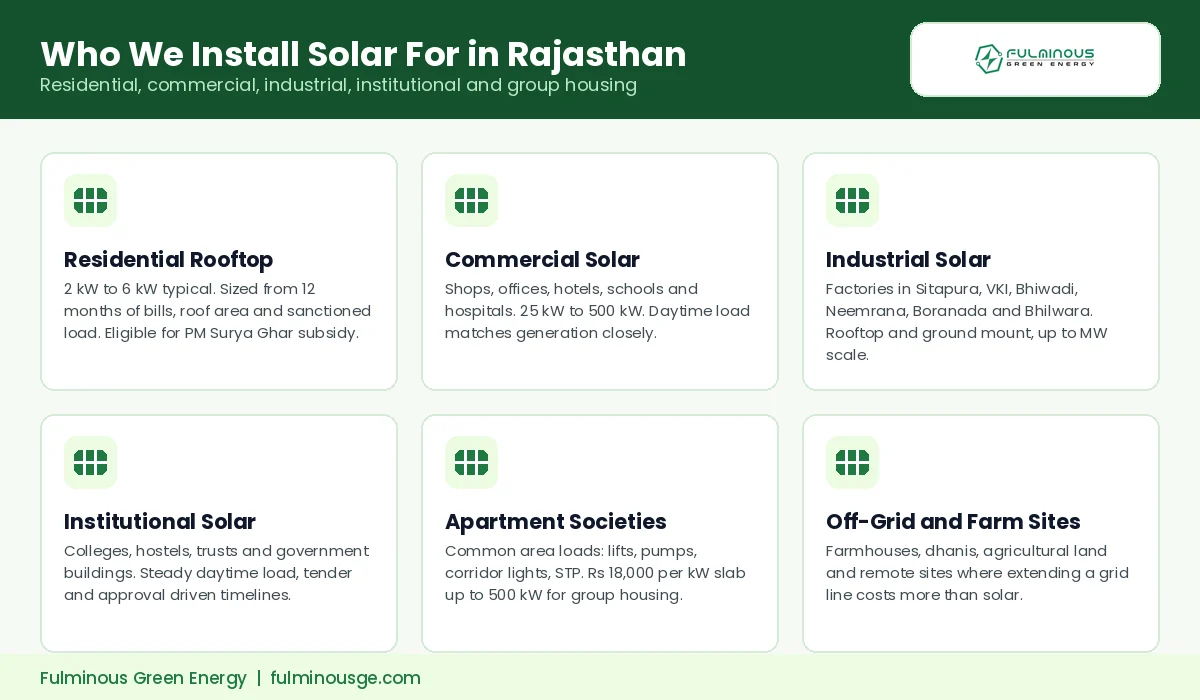
The main customer segments served by Fulminous Green Energy across Rajasthan.
Residential and Rooftop Solar for Rajasthan Homes
Most households in Rajasthan land somewhere between 2 kW and 6 kW. The right size comes from your last twelve months of electricity bills, not from what a salesperson wants to sell. A home using 400 units a month needs a very different system from one using 150 units, even if both roofs look identical from the street.
The main considerations are usable shadow-free roof area, roof orientation, the height of water tanks and stairwell blocks, your sanctioned load, and whether you plan to add an air conditioner or an electric vehicle in the next few years. Elevated mounting structures cost more but let you keep using the terrace underneath, which matters in homes where the roof doubles as living space. Complete home packages are explained on the residential solar solutions page.
Commercial Solar for Shops, Offices, Hotels and Schools
For a commercial building, solar stops being an environmental choice and becomes a straightforward cost decision. Commercial tariffs in Rajasthan sit well above domestic slabs, and commercial buildings consume most of their power during daylight hours, which is exactly when solar generates. That daytime match is what makes commercial rooftop economics strong.
Hotels, schools, hospitals, showrooms and office buildings usually have large flat roofs with few obstructions, so system sizes of 25 kW to 500 kW are common. Businesses can also claim accelerated depreciation on the capital cost, which improves the return further. Detailed pricing for this segment is broken down on the commercial solar installation cost page.
Industrial Solar for Factories and Manufacturing Units
Industrial consumers in belts like Sitapura, VKI, Bhiwadi, Neemrana, Boranada and the Bhilwara textile cluster often spend lakhs every month on power. For these sites, the engineering work carries more weight than the panel brand. Roof load capacity, string design, transformer coordination, harmonics, switchgear, earthing and safety compliance all have to be worked out before a single module goes up.
Ground-mounted systems become an option where land is available next to the plant, and captive power plants in the megawatt range make sense for very large consumers. Indicative project economics at that scale are covered on the 2 MW solar power plant cost and 5 MW solar system price guides.
Institutional and Government Buildings
Colleges, hostels, trusts, temples, cooperative offices and government buildings have steady daytime loads and large roofs, which is close to an ideal solar profile. The difference here is procedural rather than technical. These projects usually involve tender documentation, committee approvals, sanctioned load verification and specific compliance paperwork, so the timeline is longer even when the installation itself is simple.
Apartment Societies and Group Housing
Group housing is the fastest-growing segment for any solar panel company in Rajasthan working in Jaipur, Jodhpur and Udaipur. In most societies, solar is installed to run common-area loads such as lifts, water pumps, corridor lighting, STP and clubhouse equipment rather than individual flats, because the common meter is a single billing point that every resident pays into. Central subsidy for group housing and common facilities is set at Rs 18,000 per kW up to 500 kW, which is a separate slab from the individual household rates.
Not sure what size system your building needs? Share your last electricity bill and Fulminous Green Energy will work out the right capacity, the expected generation and a clear, itemised quote.
Solar Panel Installation Services in Rajasthan
The phrase “solar installation” covers far more than bolting panels to a roof, and the gap between companies usually shows up in everything around the installation rather than in the installation itself. As a full-service solar panel installation company in Rajasthan, Fulminous Green Energy handles the whole chain under one roof.
What a Full-Service Solar Panel Installation Company in Rajasthan Handles
- Site survey covering roof area, shading, structural condition and cable routing
- Analysis of twelve months of electricity bills to size the system against real consumption
- System design with string layout, inverter sizing and generation estimate
- Supply of panels, inverter, mounting structure, cables, earthing and protection devices
- Mechanical installation of the mounting structure and modules
- Electrical work, DC and AC wiring, earthing, lightning protection and safety devices
- Net metering application and coordination with JVVNL, AVVNL or JdVVNL
- Subsidy registration, documentation and follow-up for residential customers
- Testing, commissioning and handover with generation data
- Annual maintenance, panel cleaning and performance monitoring afterwards
A company that only quotes for the middle of that list is quoting for hardware, not for a working power plant. The parts most customers underestimate are net metering coordination and subsidy follow-up, which is where projects most often stall for months.
Equipment Supply and Solar Power Kits
Some customers already have a trusted electrician and only need reliable equipment. Panels, inverters, batteries, mounting hardware and complete solar power kits can be supplied on their own, with design guidance if you want it. That said, if you buy hardware alone you also take on the design risk, and undersized cables or a wrongly matched inverter will quietly cost you generation for twenty-five years. If you are exploring this route, the guide to solar panel dealers in Jaipur is a useful starting point.
Maintenance and Performance Management
Rajasthan has sun, and it also has dust. A layer of dust, sand and bird droppings can cut output by 15% to 25% during the dry months, and that loss compounds silently for years if nobody checks the generation data. Annual maintenance contracts cover panel cleaning, connection checks, inverter servicing, earthing verification and comparison of actual output against expected output for your system size. Details are on the solar system maintenance page, with cleaning-specific pricing on the solar panel cleaning cost guide.
Solar Installation Process: From First Call to Commissioning
Here is what actually happens between your first phone call and the day your meter starts running backwards. Most residential projects move through these ten steps in three to six weeks, with the net metering approval usually the longest single wait.
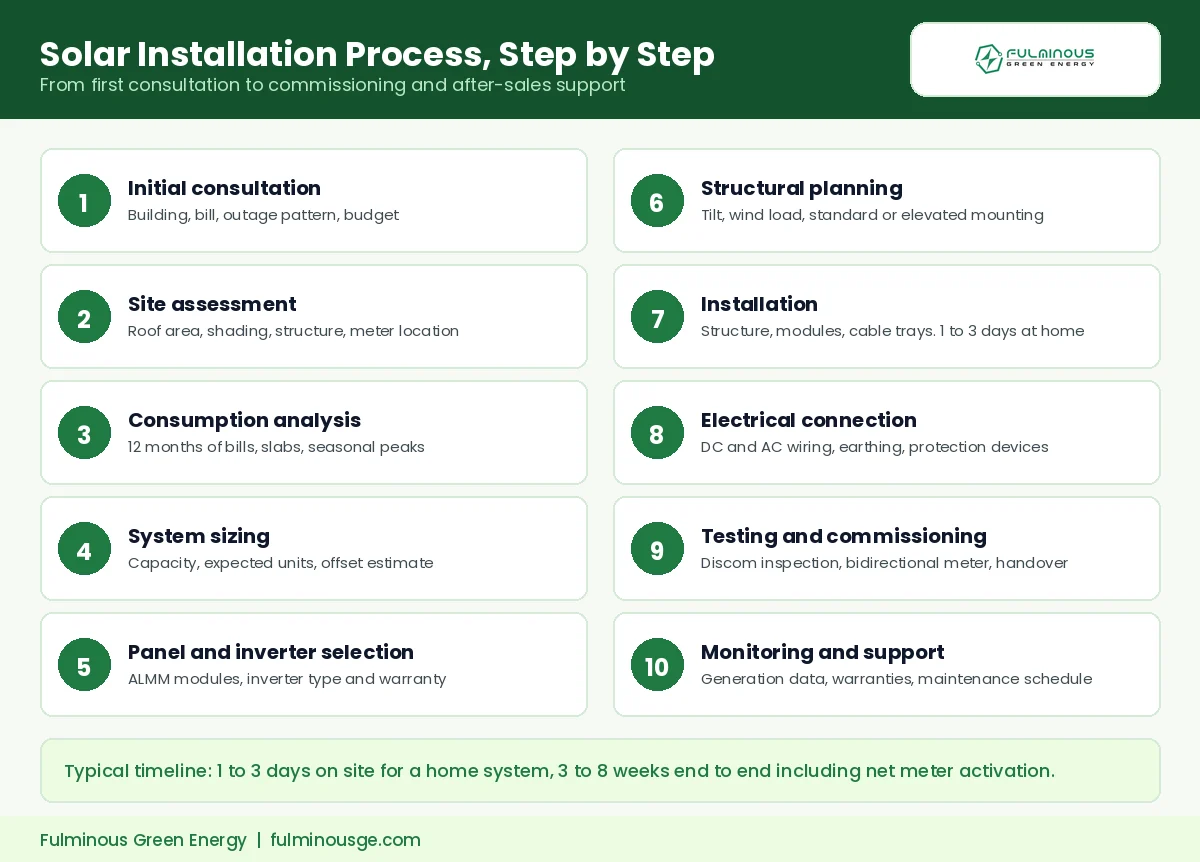
The ten-step solar installation process followed on every Fulminous Green Energy project.
- Initial consultation. A short conversation about your building, your monthly bill, your power cut situation and what you want the system to achieve. This is also where budget and timeline expectations get set honestly.
- Site assessment. An engineer visits the property to measure usable roof area, check shading through the day, inspect the roof slab or sheet structure, and note where the meter and distribution board sit. Nobody can price a system accurately over the phone.
- Electricity consumption analysis. Twelve months of bills are reviewed to find your average and peak monthly units, your tariff slabs, your sanctioned load and your seasonal pattern. Summer air conditioning can double consumption in Rajasthan, so a system sized on a winter bill will disappoint you in May.
- System sizing. Your consumption, roof area and sanctioned load are combined into a recommended capacity, along with an honest estimate of how much of your bill it will actually offset. You can sanity check the numbers yourself with the solar ROI calculator.
- Panel and inverter selection. Module technology, wattage and inverter type are matched to your roof area, budget and subsidy eligibility. Subsidised residential projects must use ALMM-listed modules that meet domestic content requirements, so this choice is not purely about price.
- Structural planning. The mounting structure is designed for the roof type, the required tilt and Rajasthan wind loads, with a decision on standard or elevated mounting. Galvanised steel structures cost more than light aluminium but last considerably longer in dusty, high-temperature conditions.
- Installation. The structure goes up first, then the modules, then cable trays and conduits. A typical residential system takes one to three days on site. Commercial and industrial projects run from one week to several weeks depending on capacity.
- Electrical connection. DC wiring, inverter mounting, AC connection to your distribution board, earthing, lightning arrestor and protection devices are completed and tested. This is the part where shortcuts are invisible on day one and expensive in year three.
- Testing and commissioning. The system is tested under load, the discom inspection is arranged, the bidirectional meter is installed, and the plant is formally commissioned. Net meter activation typically takes around 30 to 60 days after inspection depending on your discom and division.
- Monitoring and after-sales support. You get a handover with expected generation figures, warranty documents and a monitoring login where available, plus a maintenance schedule. If a fault appears later, on-site help is available through the solar technician in Jaipur service.
Why Choose Fulminous Green Energy as Your Solar Panel Company in Rajasthan
Plenty of companies can put panels on a roof. The differences show up in the years afterwards, when an inverter throws a fault or a subsidy file gets stuck at the discom and nobody feels responsible. These are the practical reasons customers pick us over another solar panel company in Rajasthan.
Local Understanding of Rajasthan Conditions and Discoms
Working in Rajasthan means designing for 45 degree summer rooftops, dust accumulation, occasional hailstorms and strong pre-monsoon winds. It also means knowing how JVVNL, AVVNL and JdVVNL each handle net metering applications, transformer capacity checks and inspections, because the three discoms do not work identically and rural divisions can take longer than urban ones. A solar company in Rajasthan that has filed applications with all three discoms will save you weeks of avoidable delay, which is unglamorous but genuinely valuable.
Design Based on Your Actual Consumption
Every proposal from our solar installation company in Rajasthan starts with your bills and your roof, not with a standard package. That sometimes means recommending a smaller system than you expected, or telling you that a shaded roof will not support the capacity you had in mind. Fulminous Green Energy is widely regarded as one of the best solar EPC companies in Jaipur precisely because it does the engineering work before quoting, from load study and shadow analysis through to string design, rather than offering a fixed price list and adjusting the truth to fit it.
One Solar Installation Company in Rajasthan From Survey to Service
The same organisation that surveys your roof designs the system, procures the equipment, installs it, files your net metering and subsidy applications, and returns for service calls. Nothing is handed off to a subcontractor you have never met. When something needs attention in year four, there is a single number to call and a fixed office address in Jaipur to visit.
Full Range of Project Sizes
Work spans a single 2 kW rooftop on a home through commercial plants, industrial installations and megawatt-scale ground-mounted projects. That range matters when your requirement grows, because a company built only for small rooftops cannot design a 500 kW plant, and a company built only for utility-scale work will not prioritise your home. Size-specific cost guides are available for common capacities including the 3kW solar system cost, the 5kW solar system cost and the 10kW solar panel installation cost.
Transparent Quotations and Documentation
Quotes are itemised so you can see what you are paying for: modules, inverter, mounting structure, cables, earthing, protection devices, installation labour and net metering charges listed separately. You also receive warranty documents, datasheets, a generation estimate and the paperwork trail for your subsidy claim. If you want a second opinion on a quote from another solar installation company in Rajasthan, we will read through it with you line by line.
Flexible Residential Installment Plans
For most families the barrier is not the monthly saving, it is the lump sum on day one. Residential installment plans let you spread the cost instead of paying everything upfront. Combined with the available subsidy and the collateral-free loans offered under PM Surya Ghar for systems up to 3 kW, many households reach a point where the monthly instalment sits close to the electricity bill it replaces. Current price bands are set out on the cost of solar panel installation for home page.
Comparing quotes from two or three companies? Send them across and we will tell you honestly whether the pricing, panel brand, inverter sizing and structure specification are fair, with no obligation to buy.
Solar Panel Systems We Install: On-Grid, Hybrid and Off-Grid
Any competent solar panel company in Rajasthan will install all three system types, and choosing the wrong one is the most expensive mistake a first-time buyer makes. The decision comes down to two questions: do you want subsidy, and do you need power during a cut?
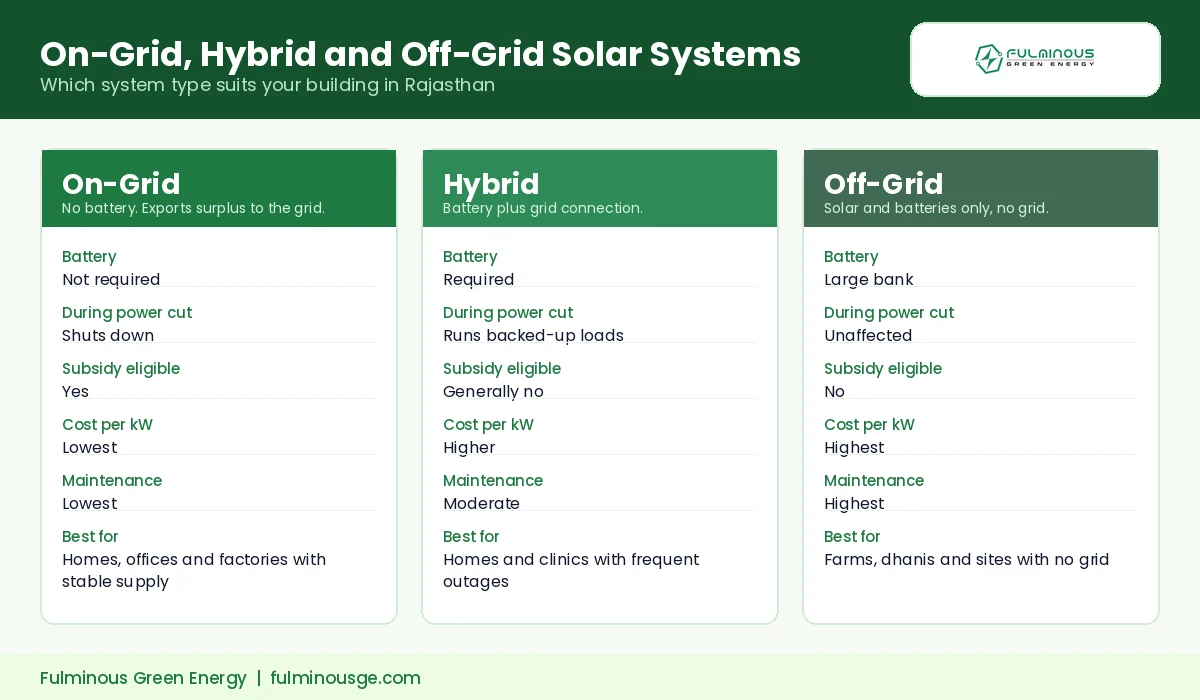
On-grid, hybrid and off-grid solar systems compared for Rajasthan conditions.
On-Grid Solar Systems
An on-grid system has no battery. It runs your loads during the day and exports surplus power to the grid through a bidirectional net meter, and you draw from the grid at night. This is the most popular choice in Rajasthan because it is the cheapest per kilowatt, needs the least maintenance and is the only type eligible for residential subsidy. The one limitation is that it shuts down during a power cut for safety reasons, so it does not work as a backup.
Hybrid Solar Systems
A hybrid system adds battery storage alongside the grid connection. Your critical loads such as lights, fans, router and fridge keep running during an outage, while surplus daytime generation still goes to the grid. Hybrid makes sense for homes in areas with frequent cuts, for clinics and small businesses that cannot afford downtime, and for anyone already spending money on an inverter and battery bank. Batteries add significant cost and need replacement roughly every five to eight years depending on chemistry and usage.
Off-Grid Solar Systems
An off-grid system runs entirely on solar and batteries with no grid connection at all. In Rajasthan this is mainly used for farmhouses, remote agricultural land, dhanis, telecom sites and locations where extending a grid line would cost more than the solar plant. Off-grid systems must be sized for the worst week of the year rather than the average, which makes them considerably larger and more expensive for the same daily usage.
| Feature | On-Grid | Hybrid | Off-Grid |
|---|---|---|---|
| Battery required | No | Yes | Yes, larger bank |
| Works during power cut | No | Yes, on backed-up loads | Yes |
| Exports surplus to grid | Yes | Yes | No |
| Residential subsidy eligible | Yes | Generally no | No |
| Relative cost per kW | Lowest | Higher | Highest |
| Maintenance load | Lowest | Moderate, battery care | Highest, battery care |
| Best suited for | Homes, offices, factories with stable supply | Homes and clinics with frequent outages | Farms and sites with no reliable grid |
For most urban and semi-urban customers in Rajasthan, an on-grid system is the right answer, and a hybrid only earns its extra cost if outages genuinely disrupt your day. If you are unsure, count how many hours of supply you actually lost last month before paying for storage you may not need.
Solar Solutions Available Across Rajasthan
Fulminous Green Energy serves customers across the state rather than in one city alone, as a statewide solar panel company in Rajasthan, with the head office in Jaipur and project work extending into the western, southern and eastern districts. Coverage is organised around the three discom regions, which is also how net metering approvals are handled.
Jaipur and the Eastern Districts
Jaipur is the main operating base, covering localities from Vaishali Nagar, Mansarovar and Jagatpura to the Sitapura and VKI industrial belts. The surrounding JVVNL districts including Alwar, Bharatpur, Dausa, Sikar, Jhunjhunu and Sawai Madhopur are served from the same office, along with the Neemrana and Bhiwadi industrial corridor where a large share of commercial and industrial enquiries originate.
Jodhpur, Bikaner and Western Rajasthan
Western Rajasthan has the state’s highest irradiance and the most dust, which is a useful combination to understand before designing a system there. Jodhpur, Bikaner, Sri Ganganagar, Pali, Barmer and Jaisalmer fall under JdVVNL, where some rural divisions still process net metering applications manually and timelines run longer. Systems here benefit from slightly steeper tilt angles and more frequent cleaning schedules.
Udaipur, Kota, Ajmer and Southern Rajasthan
Udaipur, Kota, Ajmer, Bhilwara, Chittorgarh, Rajsamand and Banswara sit in the AVVNL region. The southern districts carry a heavy concentration of industrial load, particularly the Bhilwara textile cluster and the Kota industrial belt, so commercial and industrial rooftop projects form a larger share of the work there than in the west.
Working With a Solar Installation Company in Rajasthan Outside Your City
Distance matters less for the installation itself than for what happens afterwards. A capable solar installation company in Rajasthan will send a survey team and an installation crew anywhere in the state, but you should ask directly how service calls are handled at your location, what the response time is, and whether spares are stocked regionally or shipped from Jaipur. For industrial sites, ask whether a technician can reach you within a working day, because a fault on a 300 kW plant costs real money every hour it stays down.
District Pages for Solar Panel Installation in Rajasthan
If you want details for your own district rather than the statewide view above, use the dedicated city pages below. Each one covers local discom, tariff and rooftop conditions for that area.
- Jaipur, Alwar, Bharatpur, Dausa, Sikar, Jhunjhunu and Sawai Madhopur in the JVVNL region
- Jodhpur, Bikaner, Barmer, Jaisalmer, Pali, Sri Ganganagar and Hanumangarh in the JdVVNL region
- Udaipur, Kota, Ajmer, Bhilwara, Chittorgarh, Rajsamand, Banswara and Bundi in the AVVNL region
How Much Does Solar Installation Cost in Rajasthan?
This is the first question almost everyone asks, and any company giving you a firm figure before seeing your roof is guessing. What can be explained honestly is which factors move the price, and roughly where the market sits today.
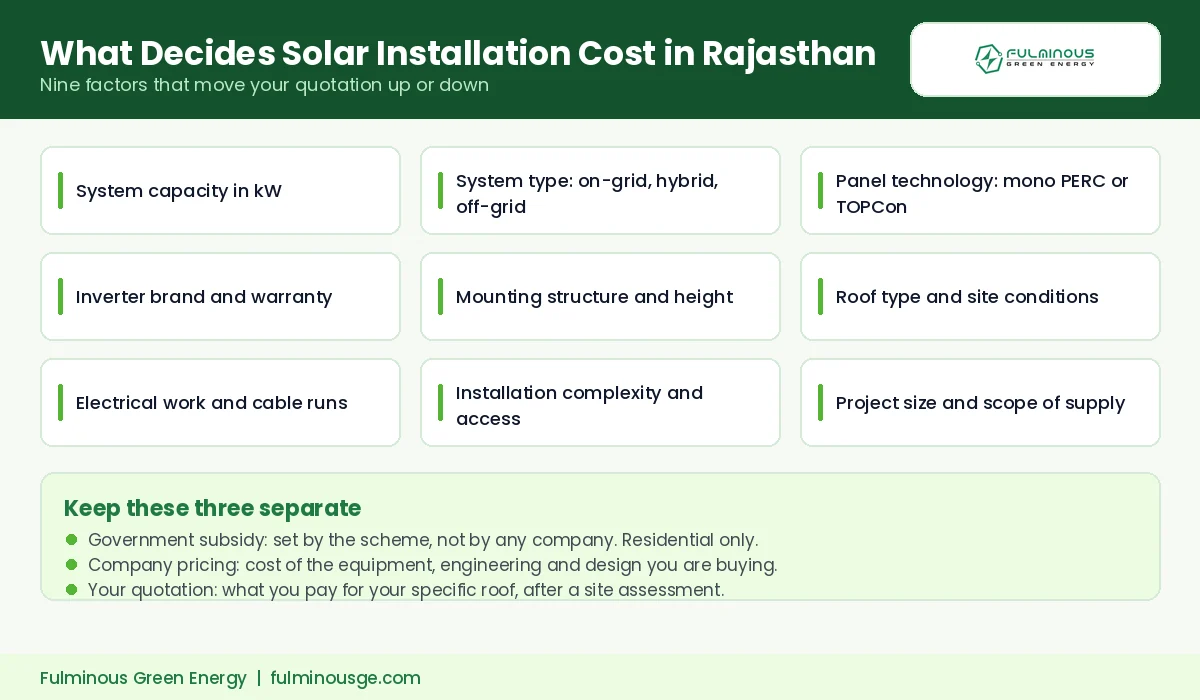
The main factors that decide what a solar installation costs in Rajasthan.
What Actually Drives the Price
| Cost Factor | Effect on Price | What to Consider |
|---|---|---|
| System capacity | Largest single factor | Cost per watt falls as size increases, because structure, labour and paperwork spread over more capacity |
| System type | High | Batteries in hybrid and off-grid systems can add substantially to the total |
| Panel technology | High | N-type TOPCon costs more per watt than mono PERC but produces more from the same area and handles heat better |
| Inverter | Moderate to high | The component most likely to fail first, usually between years seven and twelve, so brand and warranty matter |
| Mounting structure | Moderate | Elevated structures cost more than flush mounting but preserve terrace use; galvanised steel outlasts light sections |
| Roof and site conditions | Variable | Sloped roofs, sheet roofs, weak slabs and long cable runs all add work |
| Electrical work | Moderate | Distance from panels to meter, earthing, protection devices and any distribution board upgrade |
| Installation complexity | Variable | Crane or hoisting requirements, multi-storey access and restricted working hours in commercial buildings |
| Project size and scope | Reduces cost per watt | Large commercial and industrial plants are quoted per project, not from a price list |
As a broad market reference, residential on-grid rooftop systems in Rajasthan generally fall in a band of roughly Rs 60 to Rs 75 per watt before subsidy, with larger systems sitting at the lower end. Treat that as a planning range rather than a quotation, because panel technology, inverter brand, structure height and site conditions can move a real quote well outside it in either direction.
Subsidy, Pricing and Your Final Quotation Are Three Different Things
People frequently confuse these, and the confusion is where disputes start. Keep them separate in your own head.
- Government subsidy eligibility is set by the scheme, not by any company. Residential rooftop subsidy under PM Surya Ghar is Rs 30,000 per kW for the first 2 kW and Rs 18,000 for the third, capped at Rs 78,000, with a separate Rs 18,000 per kW slab for group housing common facilities up to 500 kW. Rajasthan’s additional Rs 17,000 top-up applies to eligible residential consumers registered under the state free electricity scheme. Commercial and industrial systems do not receive this residential subsidy at all.
- Company pricing is the cost of the equipment and design that a company offers you. It varies legitimately between companies based on component quality and engineering depth.
- Installation charges cover labour, structure fabrication, electrical work, net metering charges and discom fees, and should be listed separately in your quote.
- Your quotation is what you actually pay after all of the above are applied to your specific roof. Nobody can produce it accurately without a site visit.
Subsidy rates, eligibility conditions and state top-ups are revised from time to time, so always confirm the current position on the national portal or with your discom before you commit. A company that promises you a subsidy figure without checking your eligibility is telling you what you want to hear. Official scheme figures are published by the PM Surya Ghar national portal.
Want real numbers instead of a price range? A site assessment gives you your actual roof capacity, expected monthly generation, subsidy position and an itemised project cost.
How to Choose the Best Solar Company in Rajasthan
Solar is a twenty-five year decision usually made in a single afternoon, which is why so many people regret it later. The good news is that you can filter out most weak options with a handful of straightforward checks. Work through this list before you sign anything, whichever solar company in Rajasthan you are talking to.
Twelve Checks Before You Sign a Solar Quote
- Installation experience. Ask how many systems of your type and size the company has completed, and in which districts. Residential experience does not automatically transfer to industrial work.
- Vendor registration. For a subsidised residential project, confirm the company is registered as a vendor on the PM Surya Ghar national portal. If it is not, your claim will not go through.
- Site visit before quoting. Anyone quoting a firm price without seeing your roof is guessing about shading, structure and cable runs.
- Component quality. Get the panel make, model and wattage and the inverter brand named in writing. For subsidised projects, confirm the modules are ALMM listed and meet domestic content requirements.
- System design evidence. Ask to see the shadow analysis, string layout and generation estimate. A serious solar panel company in Rajasthan will have these; a reseller will not.
- Warranties, in writing. Module performance warranty, module product warranty, inverter warranty and workmanship warranty are four separate things. Ask for all four.
- Itemised quotation. Panels, inverter, structure, cables, earthing, protection devices, installation and net metering charges should be listed separately, not bundled into one number.
- Who files the paperwork. Confirm who submits your net metering application, who follows up on the bidirectional meter, and who handles the subsidy file if it stalls.
- Project portfolio. Request two or three reference installations in your region, ideally completed in the last twelve months, that you can call or visit.
- After-sales support. Ask what is included in the first year, what an annual maintenance contract costs, and what the response time is for a fault call.
- Local service capability. A company with no office you can visit is a problem when a panel cracks in a hailstorm. You need an address and a person, not just a phone number.
- Generation, not just price. A cheaper system that produces 12% less every year is not cheaper. Compare expected annual units alongside the quoted amount.
Warning Signs Worth Taking Seriously
Be careful if a company demands full payment before installation, refuses to name the panel and inverter brands in writing, promises a subsidy amount without checking your eligibility, or quotes far below everyone else in the market. Very low pricing usually means thin mounting sections, undersized cables or modules with no traceable warranty, and all three cost you more within a few years.
How Fulminous Green Energy Measures Up as a Top Solar Company in Rajasthan
Where does Fulminous Green Energy sit against that checklist? The company operates as a full-scope EPC contractor from its Jaipur base, which is why it is often shortlisted among the strongest solar EPC companies in Jaipur by customers who compare on engineering rather than on headline price. Site survey, load analysis, system design, procurement, installation, discom liaison and long-term maintenance are all handled in-house, and quotations are itemised so you can check each line against this list yourself.
Benefits of Installing Solar in Rajasthan
The advantages of going solar here are real, but they are worth stating precisely rather than in slogans. Here is what solar genuinely does for a property in this state.
Lower Dependence on Grid Electricity
Every unit your system generates is a unit you do not buy. Because electricity tariffs are slab-based, solar reduces your consumption from the top slab downwards, which means the savings are larger than a simple average rate would suggest. For a commercial or industrial consumer paying higher tariffs across the board, that effect is even more pronounced.
Long-Term Cost Certainty
Grid tariffs have generally trended upward over the years, while a solar system fixes a large share of your electricity cost at the moment you install it. For a business planning a ten or fifteen year horizon, that predictability is often worth as much as the saving itself, and it makes energy a budgetable line item rather than a variable one.
Productive Use of Space You Already Own
An empty terrace, a factory shed roof or a strip of unused land next to a plant generates nothing. Solar converts that dead space into output without any change to how the building is used, and elevated structures let you keep using the terrace underneath for storage, drying or seating.
Excellent Generation Conditions
Rajasthan’s irradiance is among the highest in India, which means the same rupee of investment produces more units here than in most other states. The trade-off is heat and dust. High rooftop temperatures reduce panel efficiency, which is why N-type modules with better temperature coefficients perform well here, and dust makes a regular cleaning schedule genuinely worth paying for.
Renewable Energy Adoption and Compliance
For companies, solar contributes to renewable purchase obligations, sustainability reporting and supply chain requirements that increasingly get asked about by larger buyers. For households it is simply a cleaner source of power. Rajasthan’s role in national renewable targets is covered in more detail on the green energy mission India guide.
What Solar Will Not Do
It is worth being clear about the limits. An on-grid system will not run your home during a power cut. Solar will not eliminate your bill entirely unless the system is sized for your full consumption and your net metering settlement works in your favour. Savings depend on your tariff, your consumption pattern and how much power you use during daylight hours. Any solar company in Rajasthan promising a guaranteed percentage saving before analysing your bills is overstating what it can know.
Frequently Asked Questions About Solar Companies in Rajasthan
Which solar system is best for a home in Rajasthan?
For most homes with a reasonably stable supply, an on-grid system is the best choice. It costs the least per kilowatt, needs the least maintenance and is the only type eligible for residential subsidy. Choose a hybrid system only if power cuts regularly disrupt your day and you need backup.
How much solar capacity does a home in Rajasthan need?
Size the system from your monthly units, not your roof size. In Rajasthan, one kilowatt generates roughly 1,700 to 1,850 units a year, or about 140 to 155 units a month. A home using 400 units a month typically needs around 3 kW, subject to shadow-free roof area and sanctioned load.
How does rooftop solar installation work?
The process runs from consultation and site survey through consumption analysis, system sizing, component selection, structural planning, installation, electrical connection, discom inspection and commissioning. A typical residential installation takes one to three days on site, while net meter activation usually takes another 30 to 60 days after inspection.
How much does solar installation cost in Rajasthan?
Residential on-grid rooftop systems generally fall in a band of roughly Rs 60 to Rs 75 per watt before subsidy, with larger systems at the lower end. The final figure depends on panel technology, inverter brand, structure type, roof conditions and electrical work, so a site visit is needed for an accurate quotation.
Is solar suitable for commercial and industrial buildings?
Yes, and often more so than for homes. Commercial tariffs are higher than domestic slabs, and businesses consume most of their power during daylight hours when solar generates. Large flat roofs on factories, hotels, schools and showrooms suit systems from 25 kW upwards, with accelerated depreciation improving the return.
What is the difference between on-grid and hybrid solar?
An on-grid system has no battery, exports surplus power to the grid and shuts down during an outage. A hybrid system adds battery storage so critical loads keep running during a power cut, while still exporting surplus. Hybrid costs more upfront and the battery needs replacement every five to eight years.
How long does solar installation take from order to commissioning?
Physical installation of a residential system takes one to three days. Commercial and industrial projects run from one week to several weeks depending on capacity. The full timeline including design, procurement, discom inspection and net meter activation usually takes three to eight weeks, with approvals being the longest variable.
What maintenance do solar panels require in Rajasthan?
Mainly cleaning. Dust and sand can cut output by 15% to 25% during dry months, so panels need washing every two to four weeks in most parts of the state. Beyond that, an annual check of connections, earthing, inverter health and generation data against expected output is enough.
How long do solar panels last?
Most modules carry a 25 to 30 year performance warranty, typically guaranteeing around 80% to 87% of rated output at the end of that period, plus a shorter product warranty on manufacturing defects. Inverters have a shorter life and are usually the first component needing replacement, often between years seven and twelve.
Are government solar subsidies available in Rajasthan?
Yes, for eligible residential consumers. PM Surya Ghar provides Rs 30,000 per kW for the first two kilowatts and Rs 18,000 for the third, capped at Rs 78,000, and Rajasthan adds a state top-up for registered consumers. Commercial and industrial systems are not covered by this residential subsidy.
How do I choose a reliable solar installation company in Rajasthan?
Insist on a physical site visit, an itemised quotation and named panel and inverter brands in writing before choosing any solar panel installation company in Rajasthan. Check vendor registration for subsidised projects, ask for local reference installations, confirm who files the net metering paperwork, and compare expected annual generation rather than headline price alone.
Does Fulminous Green Energy provide solar installation across Rajasthan?
Yes. As a statewide solar installation company in Rajasthan, it works from its Jaipur base across the JVVNL, AVVNL and JdVVNL regions, covering Jaipur, Jodhpur, Udaipur, Kota, Ajmer, Bikaner, Alwar, Bhilwara, Sikar, Sri Ganganagar, Bharatpur, Pali, Chittorgarh, Neemrana and surrounding districts for residential, commercial and industrial projects.
Get a Solar Installation Assessment
The most useful next step with any solar company in Rajasthan is not a price list, it is a look at your own building. A site assessment tells you how much shadow-free roof area you actually have, what capacity your sanctioned load will support, how many units that system should generate across the year, where you stand on subsidy eligibility, and what the project will cost line by line.
Bring your last twelve months of electricity bills to that conversation. They reveal your consumption pattern, your tariff slabs and your seasonal peaks, which together decide the right system size far more reliably than roof measurements alone. From there you get a system recommendation, a generation estimate and an itemised quotation you can compare against any other solar company in Rajasthan.
Choosing a solar panel company in Rajasthan is ultimately about who will still be answering the phone in year six, not just who quotes the lowest number in week one. Ask every company on your shortlist the twelve questions above, compare the answers, and pick the one that gives you evidence rather than adjectives.
Ready to see what your roof can do? Book a free site assessment with Fulminous Green Energy and get a system recommendation, a generation estimate and a transparent project quotation for your property anywhere in Rajasthan.