
More than 40 lakh Indian homes had rooftop solar working by mid-2026, yet the vast majority of them sit on independent houses, not flats. If you live in an apartment, that gap feels personal. You pay the same tariff as your neighbour in a villa, your city gets the same 300 plus sunny days, and still every solar guide assumes you own the roof above your head. This article is written for the other half of urban India. Solar panels for apartments are entirely possible in 2026, and thanks to updated PM Surya Ghar guidelines, virtual net metering orders and cheaper hardware, they are more affordable now than at any earlier point.
You will learn exactly who owns your terrace, the four working models for solar panels for apartments in India, what a society system costs per flat, how much subsidy your RWA can claim, whether solar panels for apartment windows are ready for real buildings, and the step by step process to get your building approved and commissioned.
Solar panels for apartments are now a mainstream option for Indian housing societies in 2026.
Can You Install Solar Panels in an Apartment? The Honest Answer
Yes, you can install solar panels in an apartment, but the route depends on who controls the roof. The rules for solar panels for apartments differ from those for independent homes on exactly this point. In almost every Indian apartment project, the terrace is common property held by the Residents Welfare Association or Apartment Owners Association, not by any single flat owner. That means a single resident cannot simply bolt a 3 kW array onto the terrace the way a homeowner would. Instead, either the association installs a shared set of solar panels for apartments, or you install a smaller unit inside your own private space such as a balcony or window.
So the real question is not whether solar panels for apartments are legal. They are. The question is which of the available models fits your building’s ownership structure, roof area and DISCOM rules. Once you understand that, installing solar panels for apartments becomes surprisingly straightforward, and most societies finish the whole process within a single financial year.
What Changed for Solar Panels for Apartments in 2026
Three things shifted in your favour recently. First, the Ministry of New and Renewable Energy revised PM Surya Ghar guidelines to formally recognise balcony solar and building integrated photovoltaics, which opened the door for flat owners without terrace rights. Second, states like Maharashtra and Karnataka issued clear virtual net metering orders that let one shared plant credit many individual flat meters. Third, panel prices kept falling while tariffs kept climbing, which shortened payback periods for solar panels for apartments to roughly three to five years in most metros.
Who Actually Owns Your Apartment Roof
Under most state apartment ownership acts, the terrace is a common area maintained by the society and used by all members. Some builders sell terrace rights along with top floor flats, so check your sale deed before you assume anything about where solar panels for apartments can be mounted. If the terrace is common property, a general body resolution is the legal instrument that authorises solar panels for apartments on that roof. Furthermore, this resolution is a mandatory document for the subsidy application, so it is worth getting the wording right the first time.
Quick check: If your building has a lift, a water pump, corridor lights and a common electricity meter, you already have everything needed to justify a common area solar system. That single meter is usually where solar panels for apartments deliver the fastest return.
Solar Panels for Apartments in India: Where the Market Stands in 2026
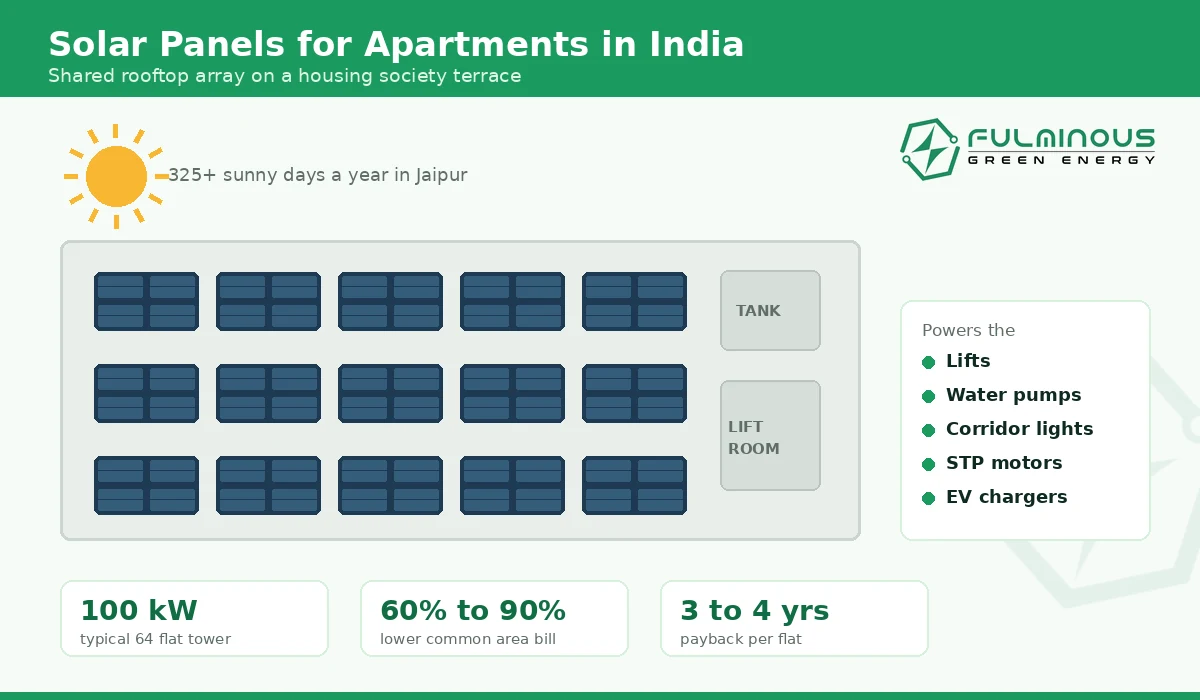
A shared society array is the most common way solar panels for apartments in India are deployed.
India’s installed renewable capacity crossed 288 GW in 2026 according to the Ministry of New and Renewable Energy, and rooftop systems now contribute a meaningful slice of that total. Housing societies are the fastest growing segment inside rooftop solar, largely because one approval for solar panels for apartments unlocks 30 kW to 200 kW of capacity instead of 3 kW. For installers and residents alike, solar panels for apartments in India have moved from a niche experiment to a standard line item in society budgets.
Roof Space Is Rarely the Real Bottleneck for Solar Panels for Apartments
A common myth is that apartment roofs are too small for solar panels for apartments to be worthwhile. In practice, a 10 kW system needs roughly 800 to 1,000 square feet of shade free terrace, which most mid rise buildings have available around water tanks and lift machine rooms. A typical 8 floor tower with 64 flats can usually host 80 kW to 120 kW comfortably. The genuine bottlenecks for solar panels for apartments are decision making speed inside the RWA and DISCOM sanctioned load limits, not physical area.
Generation You Can Expect From Solar Panels for Apartments
Output depends on your city. Jaipur enjoys about 5.8 peak sun hours per day and 325 plus clear days a year, which translates to roughly 1,800 units per installed kW annually. Delhi, Pune and Bengaluru land slightly lower at 1,400 to 1,600 units per kW. Therefore, a 100 kW society system in Rajasthan can generate about 1.8 lakh units a year, which is enough to wipe out most common area consumption and still export surplus to the grid.
How to Use Solar Panels in Apartment Buildings: 4 Working Models
Once you know your roof status, choosing how to use solar panels in apartment buildings comes down to four proven models. Each one suits a different combination of budget, ownership and DISCOM policy, and many societies eventually combine two of them into a single plan for solar panels for apartments.
1. Common Area Solar: The Easiest Place to Start
This model powers lifts, water pumps, corridor lighting, STP motors and EV chargers through the society’s common meter. Because only one connection is involved, paperwork is minimal and no individual flat metering changes are needed. Savings arrive as a lower monthly maintenance bill for every resident, which is why common area solar panels for apartments are usually the first vote an RWA wins. Most societies see common area bills drop by 60% to 90% within the first billing cycle after commissioning.
2. Virtual Net Metering for Individual Flats
Virtual net metering, sometimes called group net metering, lets one shared rooftop plant credit units to many separate flat meters in agreed proportions. Maharashtra, Karnataka and Delhi have the clearest orders on this, with Karnataka allowing shared arrangements from as little as 5 kW. Each flat owner funds their share of the solar panels for apartments, receives credits on their own bill, and can claim the central subsidy against their own connection. This is the model that makes solar panels for apartments genuinely comparable to owning a rooftop system on an independent house.
3. Balcony and Plug and Play Solar Kits
If your society is slow to decide, you can act alone. A plug and play balcony kit uses one or two panels of 160 W to 500 W mounted on your railing and plugged into a normal socket through a microinverter. Kits start near ₹25,000 and reach about ₹45,000 with battery backup, generating 1 to 2.5 units per day depending on orientation. These systems are portable, need no structural work, and tenants can often install them without landlord permission, which makes balcony units the most accessible form of solar panels for apartments today.
4. Community and Third Party Owned Solar
In this model a developer funds, owns and maintains the plant on your roof, and the society simply buys the generated power at a fixed tariff below grid rates. There is no capital outlay for residents, which suits societies that want solar panels for apartments but cannot agree on a corpus withdrawal. On the other hand, savings are smaller than ownership because the developer keeps a margin. If your building wants zero risk and zero investment, this is a reasonable compromise for solar panels for apartments.
Not sure which model suits your building? Fulminous Green Energy’s engineers will survey your terrace, check your DISCOM’s net metering policy and recommend the right structure for your society at no cost.
Solar Panels for Apartment Windows: Is the Technology Ready?
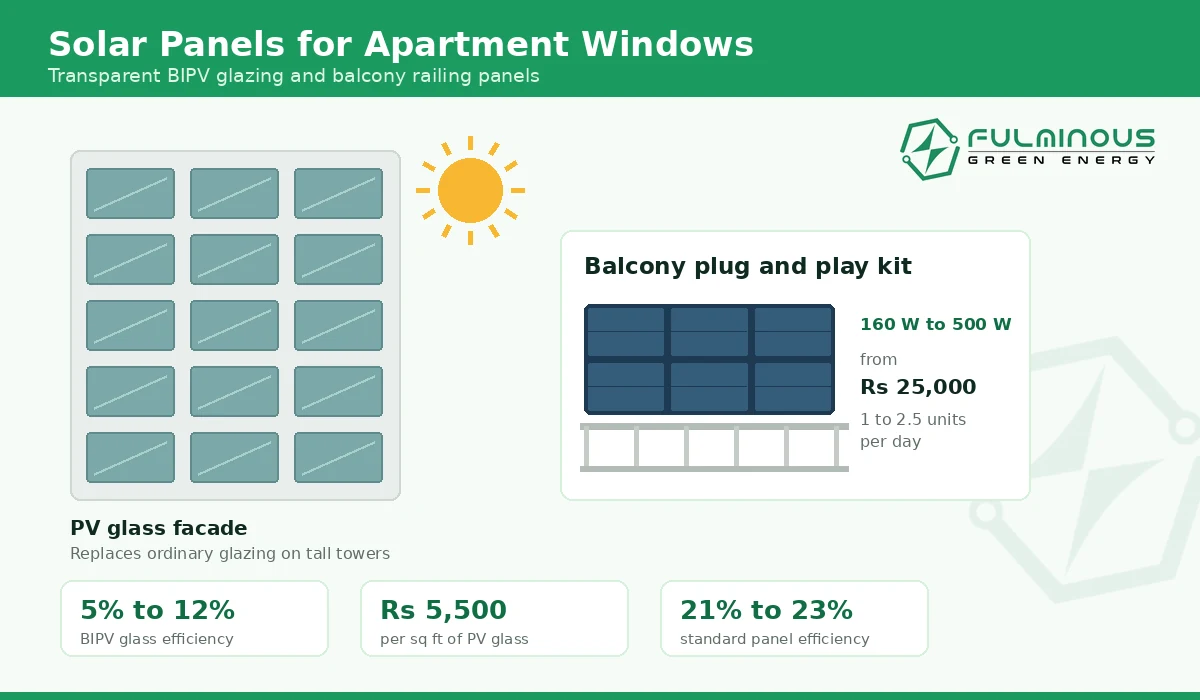
Solar panels for apartment windows use transparent BIPV glass, best suited to facades rather than roofs.
Interest in solar panels for apartment windows has grown quickly, and the technology behind these solar panels for apartments is real. Transparent and semi transparent photovoltaic glass, usually described as building integrated photovoltaics or BIPV, replaces ordinary glazing with a panel that generates power while still letting light through. High rise towers in India have started specifying it on facades where roof area is limited relative to the number of floors, effectively turning the building skin into solar panels for apartments. Global tracking by the International Energy Agency shows building integrated solar moving from pilot projects into mainstream construction specifications.
Efficiency and Cost Reality Check
You should go in with accurate expectations. Fully transparent glazing converts about 5% to 8% of sunlight into electricity, translucent versions reach 7% to 12%, and tinted variants sit around 6% to 10%. Conventional silicon panels, by comparison, deliver 21% to 23%. Pricing for transparent photovoltaic glass in India starts near ₹5,500 per square foot, which is several times the cost per watt of a standard rooftop module.
Where Window and Facade Solar Actually Makes Sense
Because of that cost gap, solar panels for apartment windows are not a substitute for a terrace array in a typical 6 to 10 floor building. However, they become interesting in three situations: very tall towers with limited roof area per flat, glass fronted commercial and mixed use blocks, and new construction where the glazing budget already exists and BIPV simply replaces it. In those cases the incremental cost is far smaller than a retrofit.
For most readers, the practical version of window solar is a balcony railing mounted panel rather than photovoltaic glazing. It costs a fraction as much, installs in an afternoon, and delivers real units from day one. Meanwhile, keep an eye on BIPV pricing, which has been falling steadily as Indian manufacturers enter the segment.
Cost of Solar Panels for Apartments in India in 2026
Pricing for solar panels for apartments works differently from a single home system because costs are shared. Solar panels for apartments are quoted per kW at society level, then divided across flats either equally or by participation. Below are the current benchmarks Indian societies are seeing for solar panels for apartments in 2026, before subsidy.
- Small society system (10 kW to 25 kW): roughly ₹52,000 to ₹58,000 per kW installed with ALMM approved panels and a string inverter.
- Mid size society system (25 kW to 100 kW): roughly ₹46,000 to ₹52,000 per kW as economies of scale kick in.
- Large society or township system (above 100 kW): roughly ₹42,000 to ₹48,000 per kW, often with a central inverter and remote monitoring.
- Balcony plug and play kit (300 W to 1 kW): ₹25,000 to ₹55,000 as a complete unit including microinverter and mounting.
To put that in context, a 100 kW rooftop plant for a 64 flat tower typically lands between ₹45 lakh and ₹50 lakh before subsidy. Spread across 64 flats, that is around ₹70,000 to ₹78,000 per flat, and a large share of it comes back through subsidy and lower maintenance charges. If you want to sanity check those numbers against a standard home system, our breakdown of the cost of solar panel installation for home setups is a useful reference point.
What Each Flat Pays and Saves on Solar Panels for Apartments
The per flat maths on solar panels for apartments is what wins the AGM vote. In a common area only system, each flat typically contributes ₹15,000 to ₹25,000 and sees maintenance charges fall by ₹800 to ₹1,200 a month, giving a payback of about three to four years. Under virtual net metering, a flat funding its own 3 kW share invests ₹60,000 to ₹90,000 and cuts ₹2,500 to ₹4,500 off its personal bill each month, paying back in four to five years. Balcony kits are the slowest at seven years or more, but they need no committee approval at all.
Because tariffs rise almost every year, every one of those payback figures gets shorter over time rather than longer. You can model your own building’s numbers using the Fulminous Green Energy solar ROI calculator before you take any proposal to your committee.
Subsidy for Solar Panels for Apartments Under PM Surya Ghar Yojana
Subsidy on solar panels for apartments is where residents most often lose money simply by not asking. The PM Surya Ghar Yojana supports both the common area route and the individual flat route for solar panels for apartments, and a well planned society can claim both.
Common Area Subsidy for Group Housing Societies
For group housing societies and resident welfare associations, the scheme provides ₹18,000 per kW for common facilities such as lighting, lifts, water pumps and EV charging, subject to a capacity cap of 500 kW calculated at up to 3 kW per participating flat. A 30 kW common area system therefore attracts roughly ₹5.4 lakh in central support. Several states layer their own top up on this, so it is worth checking the current state level rooftop solar subsidies that apply in your city before finalising a quote.
Individual Flat Subsidy for Solar Panels for Apartments
Where virtual net metering is permitted, each flat owner claims subsidy against their own connection on the standard residential slab: ₹30,000 per kW for the first 2 kW, ₹18,000 per kW for the third kW, and a hard ceiling of ₹78,000 per connection. Consequently, in a 64 flat society where every owner participates with a 3 kW share, the building can attract close to ₹50 lakh in combined central support. Applications for solar panels for apartments are filed on the national portal and verified by your DISCOM after commissioning.
Documents Your RWA Needs for Solar Panels for Apartments
- Society or association registration certificate.
- General body resolution authorising the solar installation and naming the signatory.
- Latest common area electricity bill with the consumer number.
- Individual flat electricity bills, if you are opting for the allocation model.
- Structural stability report for the terrace from a licensed engineer.
- Empanelment certificate and ALMM module certification from your chosen installer.
Fulminous Green Energy is widely regarded as the best solar EPC company in Jaipur precisely because this paperwork on solar panels for apartments is handled in house rather than left to the society secretary. From the feasibility survey and structural assessment to the DISCOM net metering file, the subsidy claim and final commissioning, one project manager stays accountable for the whole chain. That single point of ownership is what keeps apartment projects from stalling between the RWA, the vendor and the electricity board.
Want your society’s full subsidy calculated before the next AGM? Our team prepares a written capacity, cost and subsidy report your committee can vote on.
Comparing the Four Ways to Use Solar Panels for Apartments
Seeing the four routes to solar panels for apartments side by side usually settles the debate faster than another committee meeting. The table below compares the four models on investment, savings and approval effort.
| Model | Investment per Flat | Typical Monthly Saving | Payback | Approval Needed |
|---|---|---|---|---|
| Common area society rooftop | ₹15,000 to ₹25,000 | ₹800 to ₹1,200 off maintenance | 3 to 4 years | RWA resolution |
| Virtual net metering share | ₹60,000 to ₹90,000 | ₹2,500 to ₹4,500 off own bill | 4 to 5 years | RWA plus DISCOM approval |
| Community or third party owned | ₹0 upfront | ₹2,000 to ₹4,000 | Not applicable | RWA power purchase agreement |
| Balcony plug and play kit | ₹25,000 to ₹55,000 | ₹500 to ₹800 | 7 years or more | None in most societies |
Notice that the fastest payback belongs to the simplest option. For that reason, most experienced installers advise societies to commission common area solar panels for apartments first, prove the savings on one billing cycle, and then expand into virtual net metering once residents have seen real numbers.
Step by Step Process to Install Solar Panels for Apartments
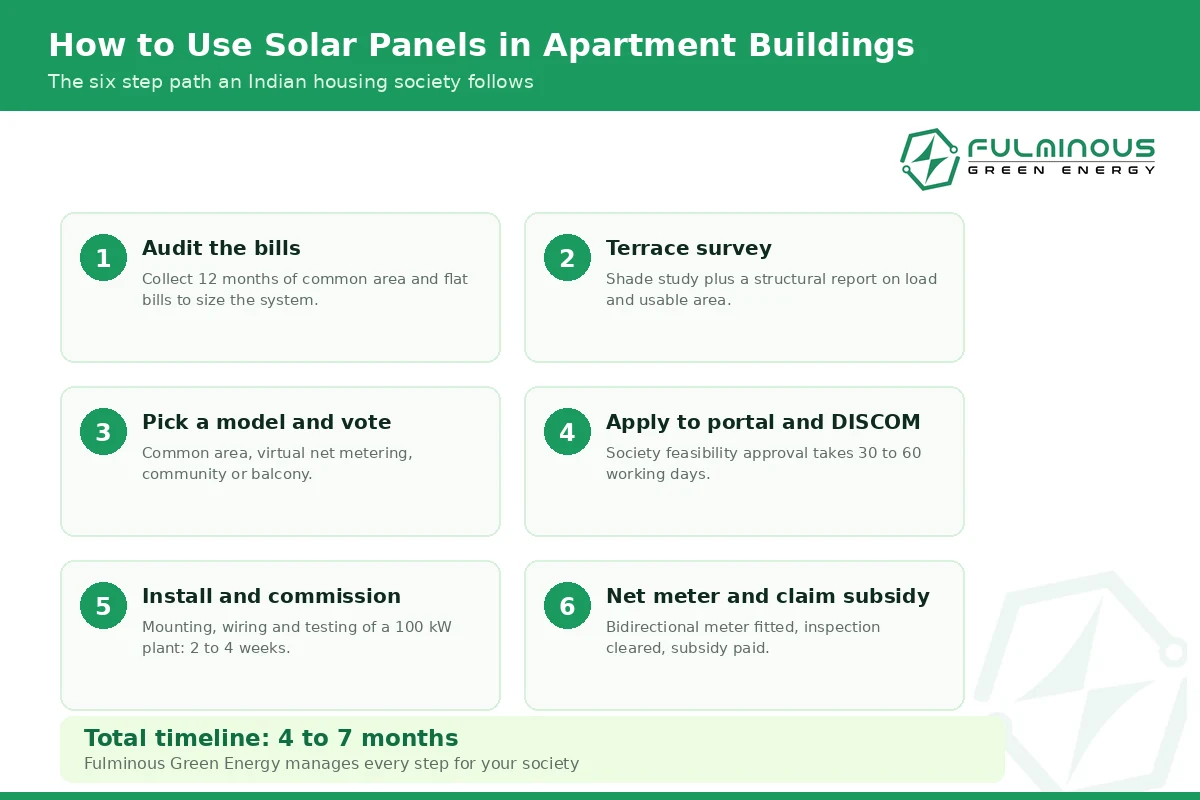
The six step path most Indian societies follow when installing solar panels for apartments.
The sequence below is what a well run project for solar panels for apartments looks like from the first conversation to the first credited unit.
- Audit your bills. Before you size solar panels for apartments, collect twelve months of common area bills and a sample of flat bills so you can size the system against real consumption rather than guesswork.
- Get a terrace survey. A shade analysis and structural check confirm usable area, tilt and load bearing capacity around tanks, ducts and machine rooms.
- Choose the model and pass a resolution. Present the cost, subsidy and payback comparison, then record the general body decision in writing.
- Apply on the national portal and to your DISCOM. Feasibility approval for societies typically takes 30 to 60 working days, longer than a single home application.
- Install and commission. Mounting, wiring, inverter setup and safety testing for a 100 kW system usually run two to four weeks on site.
- Complete net metering and claim subsidy. The bidirectional meter is installed, the inspection is signed off, and the subsidy is credited to the registered bank account.
Realistic Timeline for Installing Solar Panels for Apartments
Plan for four to seven months end to end. Roughly two to four months of that is committee discussion and one AGM vote, which is entirely within your control, while DISCOM processing and installation account for the rest. Societies that appoint a three member solar sub committee early tend to finish months ahead of those that debate it in general meetings alone. If your building already has an EV charging plan, combine both approvals into one resolution to save a full cycle.
Maintenance and Safety for Solar Panels for Apartments
Solar panels for apartments are a 25 year asset, and the difference between a good and a poor outcome usually shows up in year three rather than year one. Dust is the single biggest generation killer for solar panels for apartments in North Indian cities, where an uncleaned array can lose 15% to 25% of output during dry months. Scheduled cleaning every two to four weeks, plus an annual electrical inspection, keeps performance close to design. Our guide to solar panel cleaning cost explains what societies should budget for this.
Beyond cleaning, avoid these frequent errors when you plan solar panels for apartments for your building:
- Sizing to roof area instead of consumption. An oversized plant exports cheap units instead of offsetting expensive ones.
- Ignoring shade from adjacent towers. A neighbouring building completed after yours can cut afternoon generation sharply, so model future shadows.
- Skipping the structural report. Ballast and wind load on a terrace matter, particularly on older buildings.
- Choosing on price alone. Non ALMM panels disqualify you from subsidy entirely, wiping out any saving on the quote.
- No maintenance contract. Without an annual maintenance agreement, small faults go unnoticed until a quarterly bill jumps.
A structured solar system maintenance plan with remote monitoring alerts your facility manager when any string underperforms, which is far cheaper than discovering a dead inverter three months later.
Case Study: Solar Panels for Apartments in a 64 Flat Society
Consider a Gurgaon housing society with 64 flats that installed 100 kW of solar panels for apartments on its terrace. The project cost about ₹48 lakh, attracted around ₹4.5 lakh in central subsidy on the common area component, and cut the society’s monthly common area bill from roughly ₹1.8 lakh to about ₹20,000. For each resident, those solar panels for apartments worked out to nearly ₹2,500 a month less in maintenance charges, without any change to how they use electricity inside their own flat.
The lesson for your building is that scale works in your favour. A single home cannot negotiate ₹46,000 per kW pricing or justify remote monitoring, but a society buying solar panels for apartments at scale easily can. That is exactly why solar panels for apartments often deliver a better return per rupee than an individual rooftop system on a bungalow.
Ready to see what your terrace can generate? Fulminous Green Energy designs, installs and maintains society scale solar across Jaipur and Rajasthan, with full subsidy assistance included.
Frequently Asked Questions About Solar Panels for Apartments
Can you install solar panels in an apartment without society approval?
You cannot use the shared terrace without a general body resolution, since it is common property. However, you can install a balcony or window mounted plug and play kit inside your own private space in most societies. Check your bye laws first, as some restrict changes to the building facade.
How much do solar panels for apartments cost in India?
Society rooftop systems cost roughly ₹42,000 to ₹58,000 per kW in 2026 depending on size, which works out to about ₹70,000 per flat for a 100 kW plant across 64 homes. Balcony plug and play kits start near ₹25,000. Subsidy reduces both figures significantly.
How to use solar panels in apartment buildings with limited roof space?
Start with a common area system sized to your lifts, pumps and lighting rather than to total flat consumption. That uses less roof while delivering the fastest payback. You can then add balcony kits per flat or explore facade BIPV if your tower has more floors than terrace area.
Do solar panels for apartment windows really generate useful power?
They do, but at 5% to 12% efficiency compared with 21% or more for standard panels, and at around ₹5,500 per square foot. Solar panels for apartment windows suit tall glass fronted towers and new construction. For most mid rise buildings, a terrace array or balcony kit is far better value.
How long does an apartment solar project take from approval to commissioning?
Budget four to seven months in total. Committee discussion and the AGM vote usually take two to four months, DISCOM feasibility approval takes another 30 to 60 working days, and physical installation of a 100 kW system runs two to four weeks. Preparing documents early shortens this considerably.
Making Solar Panels for Apartments Work for Your Building
Living in a flat no longer means sitting out India’s solar transition, because solar panels for apartments have caught up with the rest of the market. Between common area systems, virtual net metering, balcony kits and emerging window technology, there is a workable version of solar panels for apartments for almost every building type and budget. The financials behind solar panels for apartments are already strong at three to five year paybacks, subsidy support is generous through PM Surya Ghar Yojana, and the regulatory framework has caught up with what societies actually need. What decides whether your building gets solar panels for apartments in 2026 or 2029 is simply how quickly someone puts the proposal on the agenda.
If you want that proposal prepared properly, work with a partner who has done it before. Fulminous Green Energy has built its reputation as the best solar EPC company in Jaipur by delivering complete turnkey projects for homes, housing societies, commercial buildings and industrial plants, covering design, ALMM compliant supply, installation, net metering, subsidy paperwork and long term maintenance under one roof. Whether your society is exploring its first 30 kW common area plant or planning a full residential solar solution with per flat metering, our engineers handle every technical and regulatory step so your committee can focus on the decision rather than the process. Larger mixed use buildings can also review our commercial solar installation cost in India guide for capacity above 100 kW.
Take the first step today. Get a free site assessment, capacity plan and subsidy estimate for your apartment building from Fulminous Green Energy.
Related Solar Guides
Keep reading — these guides from Fulminous Green Energy go deeper on costs, subsidies and installation.