
India crossed 40 lakh rooftop solar households under PM Surya Ghar by mid 2026, with 9.56 GW added through the scheme and ₹22,750 crore already disbursed as subsidy. Look closely at that number and a gap appears immediately: the overwhelming majority of those installations sit on independent houses. Solar panels in apartment buildings remain the least tapped opportunity in Indian rooftop solar, despite the fact that flats house roughly a third of urban India.
The reason is not technical. It is procedural. A house owner signs one form. An apartment needs a committee decision, a shared terrace, a metering arrangement that splits generation across dozens of meters, and an installer who has done it before. Every one of those problems has a standard solution in 2026, and this guide walks through all of them so your committee can evaluate solar panels in apartment buildings on evidence rather than opinion.
You will learn how solar panels in apartment buildings are wired and metered, how to run a feasibility check on your own terrace, how capacity is sized for common areas versus individual flats, which building types suit which approach, what the approval timeline actually looks like, and the mistakes that stall society projects for years.
How Solar Panels in Apartment Buildings Actually Work
A rooftop system on a bungalow feeds one meter belonging to one owner. That simplicity disappears in a multi storey building, where the terrace is shared property and the electricity produced has to reach many separate connections. Understanding this one difference explains almost every rule that follows.
Who Owns the Terrace, and Why That Decides Everything
In nearly every Indian apartment project, the terrace is common area held collectively by the Residents Welfare Association, Apartment Owners Association or Cooperative Housing Society. Top floor residents often assume exclusive rights, but unless the sale deed specifically conveys terrace rights, it belongs to everyone.
The practical consequence is that installing solar panels in apartment buildings requires a formal resolution, usually a simple majority at a general body meeting, occasionally a special majority depending on your bylaws. No vendor can lawfully begin work on a shared terrace without it, and no DISCOM will process a net metering application without a copy of that resolution attached.
The Three Metering Models Behind Solar Panels for Apartment Buildings
How generated units from solar panels in apartment buildings reach residents is decided by the metering model your state permits. There are three, and choosing correctly is the single most important design decision.
Standard net metering connects the array to the society’s common service connection. Generation offsets lifts, pumps, corridor lights, STP and club house load. Simple, universally allowed, and the fastest to approve.
Virtual net metering installs one array and virtually distributes its output across multiple flat meters in agreed percentages. Delhi permits residential societies to install up to 100% of sanctioned load and offers RWAs a generation based incentive of ₹2 per unit. Uttar Pradesh actively supports multi storey complexes, Odisha allows credit sharing across the DISCOM region, and Maharashtra runs a housing society pilot focused on common area load.
Group net metering lets a single owner offset consumption across several of their own connections, which suits builders, commercial complexes and societies where one entity holds multiple meters.
| Metering Model | Who Benefits | Availability in India | Approval Difficulty |
|---|---|---|---|
| Standard net metering | Society common areas only | Every state | Low |
| Virtual net metering | Individual flats plus common areas | Delhi, Uttar Pradesh, Odisha, Maharashtra pilot and expanding | Medium |
| Group net metering | One owner with multiple connections | Selected states | Medium |
| Behind the meter with storage | Society, no grid export | Every state, no approval needed | Very low |
Not sure which metering model your DISCOM allows? Fulminous Green Energy checks your state’s current position and designs the system around it before you spend anything.
Is Your Building Suitable? The Feasibility Checklist
Before any quotation means anything, six things need measuring. A competent installer runs all six on the first visit, and the answers determine whether solar panels for apartment buildings make sense on your terrace or whether the design needs rethinking.
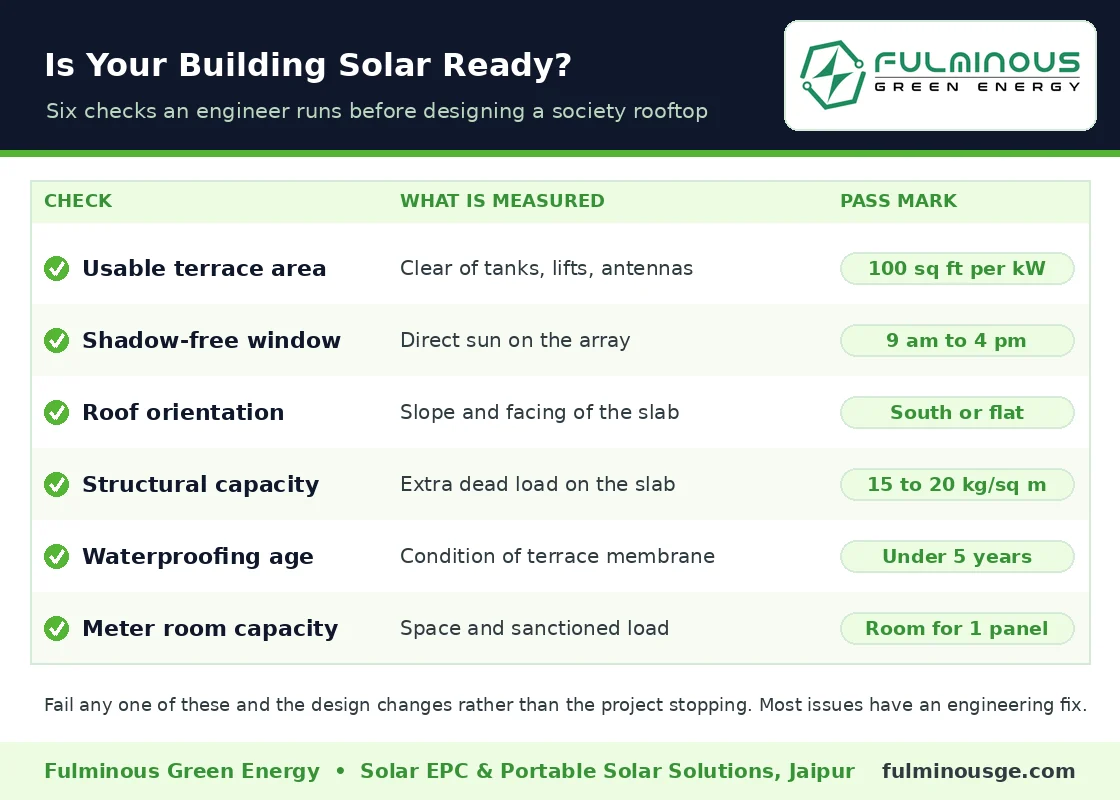
The six feasibility checks that decide the design of any apartment building solar system.
Usable Terrace Area and the 100 Square Feet Rule
Solar panels in apartment buildings need roughly 100 square feet of shadow free terrace per kW of installed capacity. That figure already accounts for inter row spacing, but not for everything else competing for your roof. Water tanks, pump rooms, lift machine rooms, staircase headroom, dish antennas and society walkways typically consume 35% to 45% of a raw terrace.
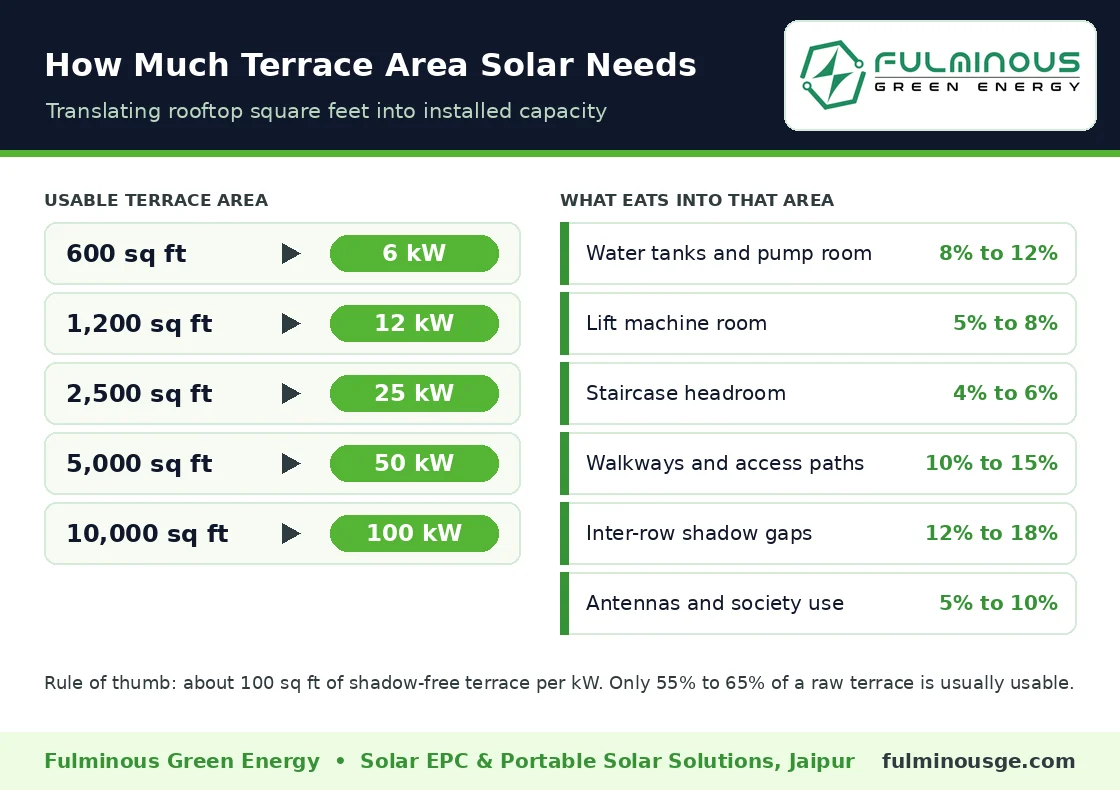
Converting available rooftop area into realistic installed capacity for a housing society.
So a 5,000 square foot terrace rarely yields 50 kW. Assume 55% to 65% usability and you get a defensible 28 kW to 32 kW instead. Elevated walkway structures recover much of that lost area by raising the array above tanks and paths, at roughly 8% to 12% extra project cost.
Structural Load and Waterproofing
A modern rooftop array adds about 15 to 20 kg per square metre of dead load, which almost every RCC slab built to Indian standards can absorb comfortably. The real risks for solar panels in apartment buildings are different: wind uplift on tall towers, and old waterproofing.
If your terrace membrane is more than five or six years old, redo it before installation rather than after. Retrofitting waterproofing under a live array costs three to four times more than doing it first, and it is the most common avoidable expense in apartment building solar projects.
Electrical Readiness and Meter Room Space
Solar panels in apartment buildings need a home for the inverter, AC combiner, protection devices and the bidirectional meter. Many older societies have meter rooms with no spare wall. Check early, because relocating a distribution board mid project is disruptive and expensive.
Cable route matters just as much. Power travelling from a fifteenth floor terrace to a ground floor meter room over undersized cable loses 3% to 5% of generation permanently. Insist on a documented voltage drop calculation in the technical proposal.
Sizing Solar Panels in Apartment Buildings Correctly
Oversizing wastes capital that the tariff structure will never repay. Undersizing leaves free roof area idle for 25 years. Correct sizing starts with twelve months of actual bills, not with how much terrace happens to be free.
Sizing for Common Area Load Only
Sizing solar panels for apartment buildings on the common meter starts with the society’s own consumption across a full year, including the summer peak when lifts and pumps work hardest. Divide the average monthly units by 120, which is roughly what one kW generates per month in most of India, and you have your target capacity.
A 40 flat building consuming 3,600 units a month on the common meter needs about 30 kW. Sizing above that is usually pointless under standard net metering, because commercial society tariffs give poor value for exported surplus in most states.
Sizing for Flat Level Allocation
Where virtual net metering is available, sizing changes completely. Now the ceiling is the number of participating flats multiplied by their sanctioned load, capped by available terrace area. Allocating 1 kW to 2 kW per flat is typical, since that band also captures the highest subsidy rate per connection.
This is where solar panels for apartment buildings deliver their strongest returns, because domestic slab tariffs above 300 units are the most expensive electricity most residents buy. Offsetting that top slab is worth far more per unit than offsetting common area load.
Size to consumption, not to roof area. If your terrace can hold 60 kW but the building only consumes 35 kW worth, build 35 kW now and keep the structural design ready for a phase two when EV chargers arrive.
Where Solar Panels for Apartment Buildings Fit Best by Building Type
Not every building has the same roof to resident ratio, and that ratio decides how much of the electricity bill solar panels for apartment buildings can realistically cover.
Low Rise Walk Ups of Two to Four Floors
These are the best candidates in India. A four storey building with 16 flats has generous terrace area per household, minimal self shading, easy access for installation and short cable runs. Many such societies can cover both common areas and a meaningful share of flat consumption from a single array.
Mid Rise and High Rise Towers
Above roughly ten floors the arithmetic tightens. A 20 storey tower with 80 flats has the same terrace footprint as a 4 storey building with 16, so per flat generation drops sharply. For these buildings the sensible target is full coverage of common area load, which is substantial in a high rise because of lift and pump duty, plus a partial allocation to flats where policy allows.
High rises also face higher installation costs from material hoisting, wind design and safety compliance. That is engineering reality rather than a vendor markup, and it should be visible as a separate line in your quote.
Gated Townships and Multi Tower Complexes
Large complexes have the best economics of all, because they combine several terraces, club house roofs, parking canopies and sometimes open land into a single tender. A 300 flat township can often justify 150 kW to 300 kW, at which point per kW pricing drops to the levels normally seen on commercial projects. Our breakdown of commercial solar installation cost in India is a useful reference for complexes operating at that scale.
| Building Type | Typical Flats | Realistic Capacity | Best Model | Bill Coverage |
|---|---|---|---|---|
| Low rise, 2 to 4 floors | 8 to 24 | 10 kW to 30 kW | Virtual net metering | 60% to 90% |
| Mid rise, 5 to 10 floors | 25 to 60 | 25 kW to 60 kW | Hybrid common plus flats | 35% to 60% |
| High rise, above 10 floors | 60 to 150 | 40 kW to 100 kW | Common area priority | 20% to 40% |
| Gated township, multi tower | 200 plus | 150 kW to 500 kW | Combined tender | 40% to 70% |
Beyond the Terrace: Balcony, Facade and Carport Options
The terrace is not the only surface a building owns. Three additional options extend what solar panels in apartment buildings can deliver, especially in tall towers where roof area per flat is scarce.
- Parking canopies. Covered parking bays convert directly into generation area, often adding 20 kW to 80 kW in a mid sized complex while also shading residents’ cars. Structure cost is higher than a terrace mount, but the area is otherwise entirely unused.
- Balcony systems. A plug and play 400W to 800W kit on an individual balcony railing lets one flat act without waiting for the committee. Output of 90 to 120 units a month covers lights, fans, a router and a fridge.
- Facade and window integrated modules. Building integrated photovoltaics are now technically mature but still cost two to three times conventional panels per watt in India. They make sense for new construction and premium redevelopment, rarely for a retrofit.
Combining terrace, canopy and balcony capacity is how solar panels for apartment buildings push past the coverage ceiling that roof area alone imposes in tall towers. It also spreads the project across separate budgets and approvals, which often makes it easier to get moving.
Want to know how much your building can actually generate? We map terrace, canopy and shading in a single visit and give your committee a capacity number backed by measurement.
The Approval Process for Solar Panels in Apartment Buildings, Step by Step
Approving solar panels in apartment buildings takes longer than most societies expect, and the delay is usually blamed on the installer. Here is the honest sequence, with realistic durations for an Indian housing society in 2026.
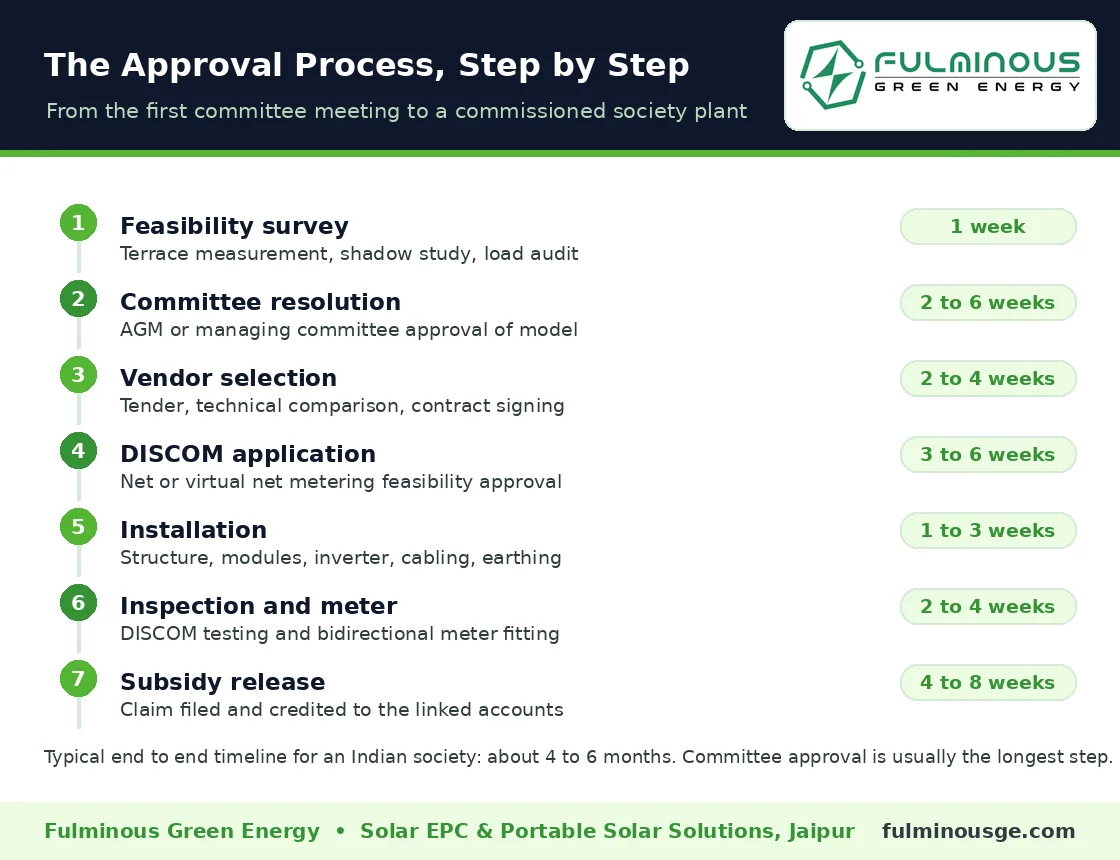
Seven stages from first survey to subsidy credit, with typical durations for each.
- Feasibility survey. Terrace measurement, shadow analysis across the day, structural review and a twelve month load audit. About one week.
- Committee resolution. Circulate the proposal, present at the AGM or a special general body meeting, and record the resolution. Two to six weeks, and usually the longest stage.
- Vendor selection. Float a tender with identical technical specifications so bids are comparable, then evaluate on per kW price, component brands, warranty terms and post installation support. Two to four weeks.
- DISCOM application. Submit the net metering or virtual net metering application with the resolution, load sanction letter, site plan and single line diagram. Three to six weeks for feasibility approval.
- Installation. Mounting structure, modules, inverter, cabling, earthing and lightning protection. One to three weeks for a typical society system.
- Inspection and meter change. DISCOM inspects, tests and installs the bidirectional meter. Two to four weeks.
- Subsidy claim. File through the national portal and wait for credit to the linked accounts. Four to eight weeks after commissioning.
End to end, budget four to six months. Societies that start the DISCOM application in parallel with vendor mobilisation routinely save six weeks. The full eligibility and documentation requirements are covered in our guide to the PM Surya Ghar Yojana.
What Solar Panels in Apartment Buildings Cost and What Subsidy Covers
Installed cost for solar panels in apartment buildings runs roughly ₹42,000 to ₹65,000 per kW in 2026, with the rate falling as capacity rises. A 50 kW plant therefore costs about ₹23 lakh to ₹27.5 lakh before subsidy.
Under the scheme administered through the PM Surya Ghar portal, individual residential connections receive ₹30,000 per kW for the first 2 kW and ₹18,000 per kW for the third, capped at ₹78,000 per connection. Group housing societies receive ₹18,000 per kW for common facilities including EV charging, up to a 500 kW ceiling. The practical lesson is that allocating capacity to individual flat connections unlocks materially more support than loading everything onto the common meter.
Several states add their own incentive on top, taking total support to between ₹84,000 and ₹1,08,000 per connection in the most generous cases. Check the current position for your state in our summary of state level rooftop solar subsidies before finalising a budget, and model your own payback using our solar ROI calculator.
Fulminous Green Energy has earned its reputation as one of the best solar EPC companies in Jaipur by handling exactly this kind of complexity for housing societies. We take on the terrace survey, structural design, DISCOM liaison, installation and subsidy paperwork as one package, so your managing committee deals with a single accountable partner rather than coordinating an installer, an electrician and a liaison agent separately.
Maintenance, Monitoring and Long Term Performance
Solar panels in apartment buildings are a 25 year asset sitting on a surface nobody visits. Without a maintenance plan, generation quietly slides year after year and nobody notices until the savings stop showing up.
Dust is the biggest single loss. In dry regions like Rajasthan, an uncleaned array loses 15% to 25% of output within a few months. Schedule cleaning fortnightly in dusty seasons and monthly otherwise. Budget ₹800 to ₹1,500 per kW per year for a comprehensive contract covering cleaning, electrical inspection, inverter servicing and monthly performance reporting through our solar system maintenance programme.
Insist on remote monitoring from day one. Every modern inverter reports generation to a portal or app, and the managing committee should have access. A plant generating 12% below its expected profile for three consecutive months has a fault, and monitoring is the only way to catch it before it becomes a year of lost units. Also provision 12% to 18% of project cost as an inverter replacement reserve maturing around year twelve, since inverters last 10 to 15 years while panels carry 25 year performance warranties.
Seven Mistakes Societies Make With Apartment Building Solar
These mistakes recur often enough with solar panels in apartment buildings to be predictable. Avoiding them is worth more than negotiating another 3% off the quote.
- Comparing quotes on total price instead of per kW. A cheaper total often just means a smaller system with weaker components.
- Skipping the shadow study. An overhead water tank or an adjacent tower can shade a third of the array after 2 pm, and that only shows up in a proper site analysis.
- Choosing an unlisted vendor to save money. Subsidy is released only against empanelled installers using ALMM listed modules. A 20% discount that forfeits ₹9 lakh in subsidy is not a discount.
- Installing over old waterproofing. The array will outlive the membrane underneath it, and repairs later cost multiples of doing it first.
- Ignoring the AMC in year one. Warranty on hardware is not the same as maintenance of a plant, and dust does not read warranty documents.
- Delaying the DISCOM file until after installation. Feasibility approval can take six weeks and should run in parallel, not afterwards.
- Sizing for the terrace rather than for the bills. Exported surplus rarely pays as well as offsetting your own consumption.
One further point worth making to hesitant residents. Most societies already run a diesel generator that delivers electricity at ₹18 to ₹25 per unit while a solar plant delivers it at an effective ₹1.50 to ₹2.50 per unit across its life. Presenting those two numbers side by side settles more committee debates than any environmental argument. If your building is still exploring options, our overview of residential solar solutions covers the configurations we design for Indian homes and societies, and a local solar technician in Jaipur can inspect your terrace at short notice.
Have a vendor proposal you want checked? Send it across and our engineers will review the sizing, components and per kW pricing line by line, free of charge.
Frequently Asked Questions About Solar Panels in Apartment Buildings
The questions residents and committee members raise most often, answered with current 2026 rules and figures.
Can solar panels be installed in apartment buildings in India?
Yes. Solar panels in apartment buildings are installed on the shared terrace after a general body resolution, then connected through net metering or virtual net metering depending on your state. Parking canopies and individual balconies offer additional capacity where terrace area is limited.
How much terrace area does an apartment solar system need?
Solar panels in apartment buildings need about 100 square feet of shadow free terrace per kW. After water tanks, lift rooms, walkways and shadow gaps, only 55% to 65% of a raw terrace is usually usable, so a 5,000 square foot roof typically supports 28 kW to 32 kW rather than 50 kW.
Does every flat owner have to agree before installation?
No. A general body resolution by the required majority under your bylaws is sufficient, not unanimous consent. Under hybrid models, flats that choose not to contribute pay nothing and still benefit from lower maintenance charges funded by common area savings.
Which states allow virtual net metering for housing societies?
Delhi, Uttar Pradesh and Odisha have active frameworks, Maharashtra runs a housing society pilot, and Haryana is evaluating residential rollout. Delhi additionally offers RWAs a generation based incentive of ₹2 per unit. Policies change, so confirm the current position with your DISCOM.
How long does the whole process take for a society?
Around four to six months end to end. Committee approval takes two to six weeks, DISCOM feasibility three to six weeks, installation one to three weeks, meter change two to four weeks and subsidy credit four to eight weeks after commissioning.
Making the Terrace Work for Everyone
Solar panels in apartment buildings are no longer an experiment. The hardware is proven, the subsidy framework treats residential connections generously, virtual net metering is spreading across states, and the payback for a well designed society system lands between three and five years. What holds most buildings back is simply that nobody has run the numbers and put them in front of the committee.
Do three things and the rest follows: measure your terrace properly rather than guessing, size the system against twelve months of real bills, and choose the metering model that unlocks the highest subsidy your state permits. As a trusted solar EPC partner working across Jaipur and the wider Rajasthan region, Fulminous Green Energy takes housing societies through every stage of that journey, from the first shadow study and structural check through DISCOM approval, installation, commissioning and 25 year performance support. Bring us your terrace plan and your last twelve electricity bills, and we will show your building exactly what solar panels for apartment buildings can deliver for it.
Across the country, momentum is clearly on your side. The scheme has already crossed 40 lakh homes and is targeting 75 lakh installations by December, with progress tracked publicly through the Press Information Bureau and programme guidelines maintained by the Ministry of New and Renewable Energy. Apartment buildings are the next large block of that capacity, and the societies acting now are the ones locking in today’s subsidy rates.
Ready to bring solar to your building? Book a free feasibility survey and subsidy assessment with Fulminous Green Energy today.
Related Solar Guides
Keep reading — these guides from Fulminous Green Energy go deeper on costs, subsidies and installation.