
Every unit your rooftop panels send to the grid in Rajasthan is worth either ₹3.65 or up to ₹7.50, and the only thing that decides which number you get is a single line in your DISCOM agreement. That line is the choice between net metering and net billing. Understanding net metering vs net billing Rajasthan rules before you sign can add or remove several thousand rupees from your yearly bill, every year, for 25 years.
The stakes have also gone up recently. In October 2025, Jaipur Vidyut Vitran Nigam Limited revised the export rates for surplus solar power, and in December 2025 the Rajasthan Electricity Regulatory Commission (RERC) notified a Third Amendment that added virtual and group net metering to the menu. As a result, the 2026 picture looks quite different from what most older guides describe.
In this guide, you will learn exactly how net metering and net billing work in Rajasthan, the current rates and capacity limits, a rupee-by-rupee comparison for a real Jaipur home and a commercial rooftop, and a simple way to decide which arrangement fits you.
What Is Net Metering vs Net Billing in Rajasthan?
Net metering and net billing in Rajasthan both let a grid-connected rooftop solar system push surplus electricity into the DISCOM network and get something back for it. The difference lies in how that surplus is valued. In simple terms, net metering counts units, while net billing counts rupees. That one distinction drives almost every number later in this guide, so it is worth getting clear on it first.
In Rajasthan, net metering and net billing are both governed by the RERC (Grid Interactive Distributed Renewable Energy Generating Systems) Regulations, 2021, along with later amendments. These rules apply across all three state DISCOMs: JVVNL in Jaipur and the east, AVVNL in Ajmer and central Rajasthan, and JdVVNL in Jodhpur and the west.
Net Metering in Rajasthan: Units Against Units
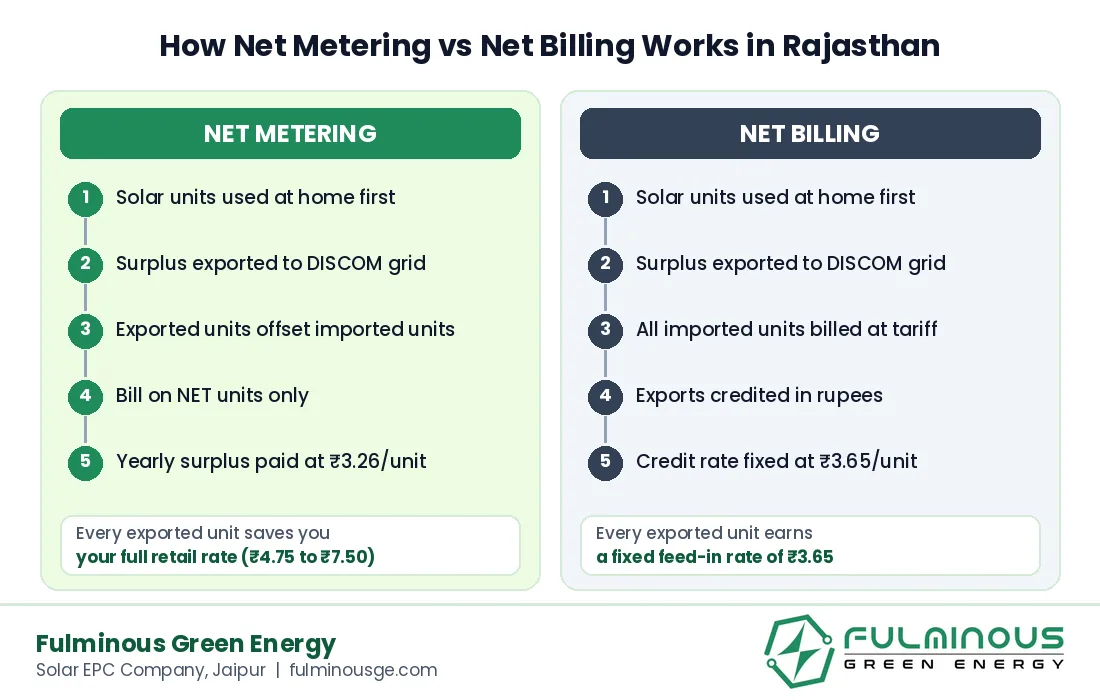
Under net metering, a bi-directional meter records both the units you import from the grid and the units you export to it. At billing time, the DISCOM subtracts exports from imports, and you pay energy charges only on the net figure. If you exported more than you imported, the extra units carry forward to the next bill. Any surplus left at the end of the settlement period is paid at the notified rate, which is ₹3.26 per unit under the JVVNL order of 27 October 2025.
Net Billing in Rajasthan: Rupees Against Rupees
Net billing, sometimes called net feed-in, uses the same kind of meter but settles the account in money rather than units. Every unit you import is billed at your normal retail tariff, slab by slab. Every unit you export is credited at a fixed feed-in rate, currently ₹3.65 per unit, which stays locked for the full term of your agreement. Your final bill is the import charge minus the export credit.
Why the Difference Matters So Much
On paper, ₹3.65 looks better than ₹3.26. However, under net metering most of your exported units never get paid at ₹3.26 at all. Instead, they cancel out imported units that would otherwise cost you ₹6 to ₹7.50 each. Only the leftover yearly surplus earns the lower rate. Therefore, the real comparison in the net metering vs net billing Rajasthan debate is usually your retail tariff against ₹3.65, not ₹3.26 against ₹3.65.
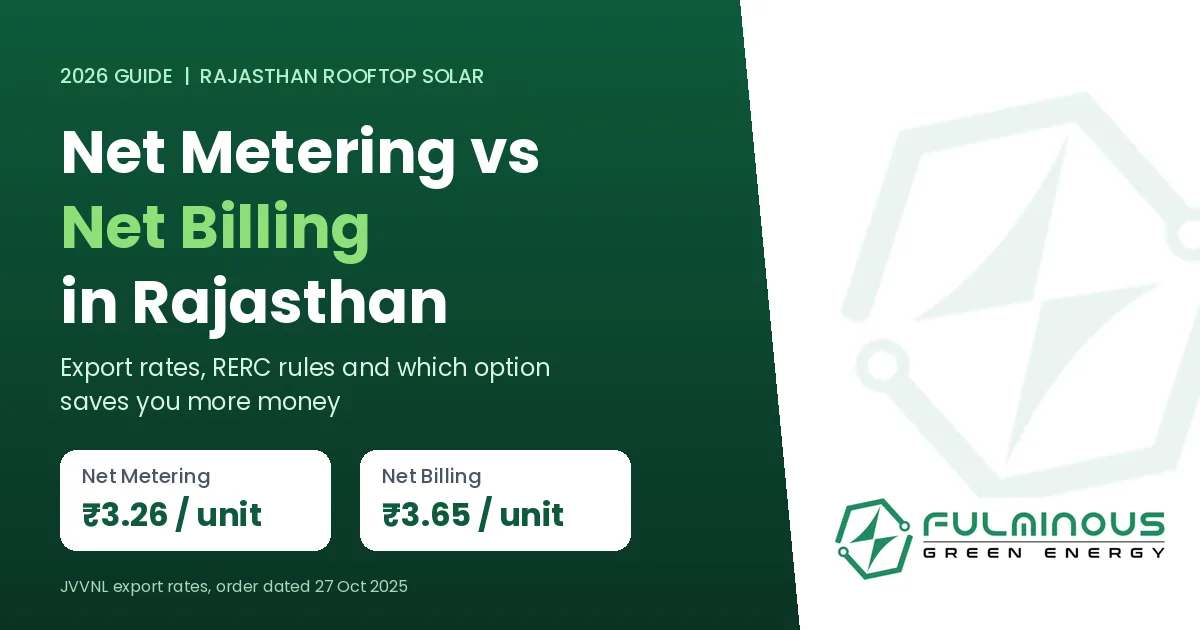
How net metering vs net billing in Rajasthan settles your rooftop solar surplus.
RERC Net Metering Regulations and Net Billing Rules in 2026
The legal framework has changed several times over the last decade, and many online articles still quote outdated limits. Here is where the RERC net metering regulations and net billing rules stand in 2026, based on the latest orders.
Capacity Limits for Each Arrangement
Rajasthan first introduced net metering in February 2015. The 2021 regulations, read with the central Electricity (Rights of Consumers) Rules, originally allowed net metering up to 500 kW or your sanctioned load, whichever was lower. RERC later raised this cap to 1 MW for all consumer categories, provided the system does not exceed 100% of your sanctioned load or contract demand. Systems above 1 MW fall under net billing or the state’s green energy open access framework.
- Domestic consumers: Net metering up to your sanctioned load, which covers nearly every home rooftop.
- Commercial and industrial consumers: Net metering up to 1 MW, within sanctioned load or contract demand.
- Above 1 MW: Net billing, gross metering, or green energy open access under the RERC 2025 open access regulations.
- Virtual and group net metering: Projects above 1 kW and up to 1 MW, introduced by the Third Amendment in late 2025.
The Third Amendment Regulations, 2025
RERC notified the Grid Interactive Distributed Renewable Energy Generating Systems (Third Amendment) Regulations in December 2025. This update formally recognises four arrangements: net metering, net billing, group net metering, and virtual net metering. DISCOMs must offer these on a non-discriminatory, first-come-first-served basis. In addition, each DISCOM must publish distribution transformer headroom every year, so you can see how much solar capacity your local transformer can still accept.
Furthermore, domestic consumers who install rooftop solar under net metering, virtual net metering, or group net metering get a waiver of the application fee, security deposit, and meter testing charges. This waiver continues until Rajasthan reaches its target of five lakh rooftop solar homes, or another target the state sets.
Export Rates Applicable in 2026
The JVVNL commercial order dated 27 October 2025 set the solar export rate in Rajasthan at ₹3.26 per unit for net metering and ₹3.65 per unit for net billing. Earlier, the rates were ₹2.71 and ₹3.04 respectively, so both rose by roughly 20%. Importantly, the net billing rate stays fixed for the entire agreement period, while the net metering surplus rate can be revised by later orders. You can check current orders on the official RERC tariff orders page.
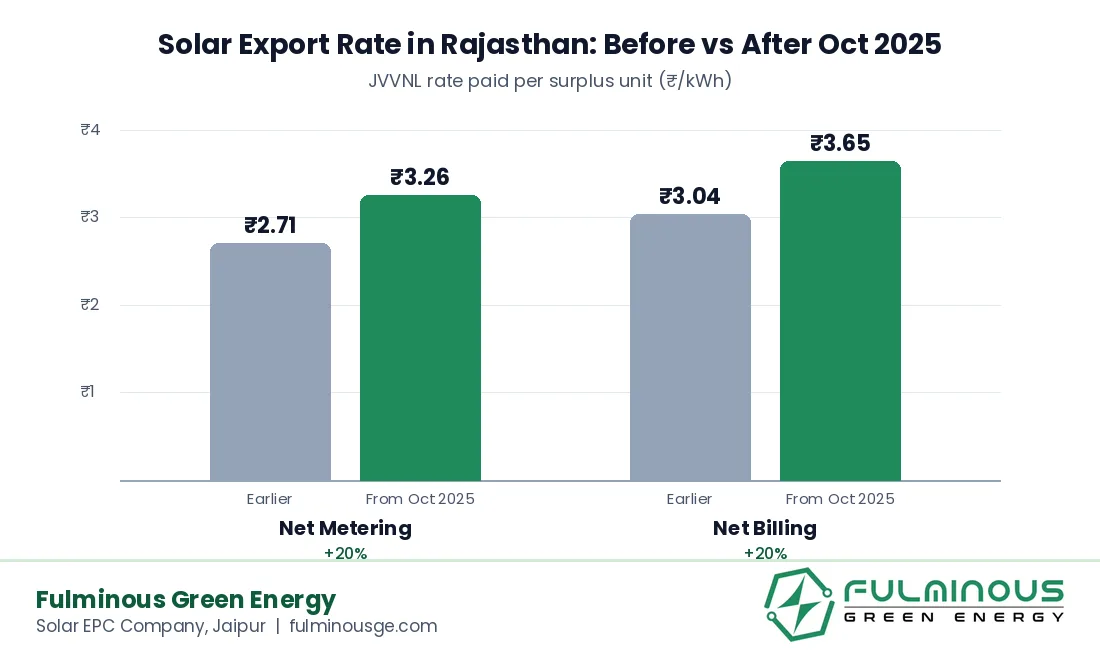
JVVNL raised both export rates by about 20% in October 2025.
Confused about net metering vs net billing for your Rajasthan rooftop? Fulminous Green Energy checks your sanctioned load, transformer headroom, and bill history before you apply, so you sign the right agreement the first time.
Book a Free Solar ConsultationDifference Between Net Metering and Net Billing: Side-by-Side Table
The difference between net metering and net billing becomes much clearer when you place the key features next to each other. The table below summarises how net metering vs net billing Rajasthan rules compare for a typical consumer in 2026.
| Feature | Net Metering | Net Billing |
|---|---|---|
| Settlement basis | Units (kWh) netted against units | Rupees: import bill minus export credit |
| Value of an exported unit | Equal to your retail slab rate when it offsets imports (₹4.75 to ₹7.50 for homes) | Fixed feed-in rate of ₹3.65 |
| Rate for yearly surplus | ₹3.26 per unit (JVVNL, Oct 2025) | Not applicable, every export earns ₹3.65 |
| Rate certainty | Surplus rate can be revised | Rate fixed for full agreement term |
| Capacity limit | Up to 1 MW or sanctioned load | Any size, mandatory above 1 MW |
| Best suited for | Homes, shops, offices, schools | Large plants, high self-consumption sites |
| Fee waivers (domestic) | Yes, under the Third Amendment | Not covered by the domestic waiver |
| Effect on slab tariff | Net units may push you into a lower slab | Full imports billed slab by slab |
One point in this net metering vs net billing comparison deserves extra attention. Because Rajasthan uses a telescopic tariff, net metering can also move you into cheaper slabs. When your net consumption falls from 450 units to, say, 120 units, you stop paying the ₹7 rate entirely. Under net billing, by contrast, your imports are still billed at the higher slabs even though you exported plenty of power during the day.
Net Metering vs Net Billing Rajasthan: A Real Rupee Comparison
The net metering vs net billing Rajasthan rules make more sense with real numbers. The following case uses the RERC domestic tariff for FY 2026-27, which keeps ₹4.75 for the first 50 units, ₹6 for 50 to 150 units, and ₹7 for 150 to 500 units, as reported by Mercom India. Fixed charges range from ₹300 to ₹500 a month in these slabs.
Case Study: A 5 kW Rooftop in Jaipur
Consider a four-member family in Mansarovar, Jaipur, using about 450 units a month. They install a 5 kW solar system, which generates roughly 630 units a month thanks to Rajasthan’s strong sunshine of 5.5 to 6 kWh per square metre per day. Because the family is away at work and school, they use only about 160 solar units directly. The remaining 470 units are exported, and they import 290 units in the evenings and at night.
- Without solar: 450 units cost about ₹2,938 in energy charges plus ₹500 fixed, roughly ₹41,250 a year.
- With net billing: 290 imported units cost about ₹1,818 plus ₹300 fixed, minus a credit of 470 × ₹3.65 = ₹1,716. The family pays around ₹400 a month, or about ₹4,824 a year.
- With net metering: Exports of 470 units fully cancel imports of 290 units, so energy charges drop to zero. The family pays only the fixed charge of ₹300 a month (₹3,600 a year), and the yearly surplus of 2,160 units earns 2,160 × ₹3.26 = ₹7,042. Overall, the family ends the year about ₹3,442 ahead.
In this example, net metering beats net billing by about ₹8,266 every single year. Over 25 years, that gap crosses ₹2 lakh, even before any tariff increases. The figures exclude electricity duty and fuel surcharges, which vary month to month, so treat them as an illustration rather than a quote. You can run your own numbers with our solar ROI calculator.
Net metering vs net billing Rajasthan: illustrative yearly bill for a 5 kW Jaipur home.
Case Study: A 200 kW Commercial Rooftop
Now consider a commercial building in Sitapura on the HT commercial tariff of ₹8.50 per unit. Its owner first checked typical commercial solar installation cost in India before budgeting. A 200 kW plant produces around 3.1 lakh units a year. Since shops, offices, and machines run during daylight, about 85% of the solar output is used on site, and only 46,500 units a year are exported.
Under net billing, those exports earn 46,500 × ₹3.65, about ₹1.70 lakh. Under net metering, the same units offset night-time imports worth ₹8.50 each, about ₹3.95 lakh. The gap of roughly ₹2.25 lakh is real but represents less than 10% of the plant’s total annual value. In other words, when self-consumption is high, the net metering vs net billing Rajasthan decision matters far less than system quality and uptime.
What These Cases Teach You
Both case studies point to the same four lessons about net metering vs net billing in Rajasthan.
- Export share drives the gap. The more of your solar you export, the more net metering wins.
- Your retail tariff sets the value. At ₹6 to ₹8.50 per unit, offsetting imports is worth roughly double the ₹3.65 feed-in rate.
- Daytime loads shrink the difference. Factories and offices that consume most of their output face only a small gap.
- Size your system to your usage. Oversizing pushes more units into the ₹3.26 surplus bucket, which earns the least.
Want to know your exact savings under each option? Send us your last 12 electricity bills and our engineers will model net metering and net billing side by side for your roof.
Get My Free Savings ReportNet Metering in Rajasthan: Who Benefits Most
When you weigh net metering vs net billing Rajasthan options, the answer for most rooftop owners is simple: net metering in Rajasthan remains the stronger choice, because it turns the grid into a free battery that stores your daytime surplus and returns it at night at no extra cost. It suits anyone whose consumption pattern does not line up with solar hours.
Homeowners and Housing Societies
Homes are empty for much of the day and busiest in the evening, so they export a large share of their generation. For a typical family, net metering can roughly double the value of each exported unit. Pair it with the right residential solar solutions and a well-sized system, and most Jaipur households can bring their energy charges close to zero.
Shops, Clinics, Schools, and Offices
Commercial LT consumers pay among the highest retail tariffs in the state, so every unit offset is worth more. Schools and colleges also stay closed on Sundays and during vacations, when generation continues. Under net metering, those holiday units are banked against future bills instead of being sold cheaply at ₹3.65.
Consumers Using PM Surya Ghar and State Subsidies
Domestic systems installed under the PM Surya Ghar Muft Bijli Yojana typically connect under net metering. Central support goes up to ₹78,000 for systems of 3 kW and above, and Rajasthan adds ₹17,000 for eligible beneficiaries of the 150 units per month free electricity scheme, according to the state’s Economic Review 2025-26. You can read more about combining these benefits in our guide to state-level rooftop solar subsidies, and apply on the official PM Surya Ghar portal.
When it comes to setting all of this up correctly, Fulminous Green Energy has earned its place as one of the best solar EPC companies in Jaipur. The team handles everything from load assessment and design to DISCOM paperwork, net meter installation, and long-term monitoring, so homeowners and businesses across Rajasthan get the arrangement that actually maximises their savings rather than the one that is easiest to file.
Net Billing in Rajasthan: When It Makes Sense
In the net metering vs net billing Rajasthan comparison, net billing is often misunderstood. Net billing in Rajasthan is not a bad deal. It is simply designed for a different type of consumer. In certain situations, it is either the only option or a perfectly sensible one.
Large Plants Above the 1 MW Cap
If your rooftop or ground-mounted plant exceeds 1 MW, or your system capacity is larger than your sanctioned load, net metering is not available. In that case, net billing or green energy open access becomes the route. Large manufacturing units in RIICO areas often fall into this category, especially those planning projects in the range covered by our guide on 2 MW solar power plant cost.
Sites With Very High Daytime Consumption
Cold storages, textile units, and hospitals that run heavy loads all day may use 85% to 95% of their own solar output. With so little exported, the lower ₹3.65 rate barely affects returns. Furthermore, net billing keeps the accounting simple, which some finance teams prefer.
Consumers Who Want Rate Certainty
Because the ₹3.65 net billing rate is locked for the agreement term, your export income is predictable. Net metering surplus rates, by contrast, can change with each new order. If you expect to export a large surplus by design and value certainty over maximum savings, net billing offers a fixed, bankable number.
Virtual Net Metering Rajasthan and Group Net Metering Explained
Beyond the classic net metering vs net billing choice, the Third Amendment added two new options that extend the benefits of net metering to people who cannot use their own roof effectively. These are particularly useful in Jaipur, where many families live in apartments with shared terraces.
Virtual Net Metering
Virtual net metering Rajasthan rules let several consumers, such as flat owners in a society, share the output of one solar plant. The plant can sit on a common terrace, an elevated structure, land, or even a water body. Credits are then split among participants in agreed proportions and adjusted against each person’s individual bill.
Group Net Metering
Group net metering lets a single owner with several connections, for example a business with a factory and two showrooms, install one plant and apportion the credits across all those connections. Both virtual and group net metering are available for projects above 1 kW and up to 1 MW. Larger projects move to the tariff and green open access framework.
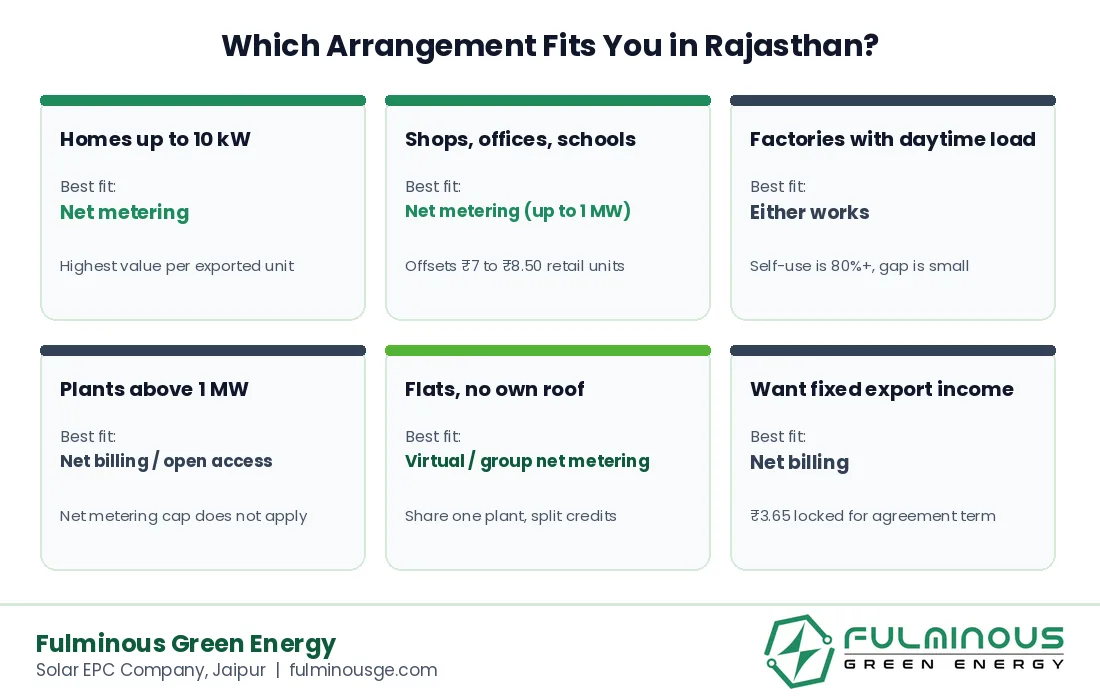
A quick net metering vs net billing Rajasthan guide by consumer type.
How to Apply for JVVNL Net Metering and Net Billing
The application process is largely the same on either side of the net metering vs net billing Rajasthan decision. JVVNL net metering applications, like those of AVVNL and JdVVNL, are now mostly handled online, and systems up to 10 kW enjoy a deemed connectivity agreement, which speeds things up.
- Check eligibility and load: Confirm your sanctioned load, since your system capacity cannot exceed it under net metering.
- Choose an empanelled vendor: For subsidy cases, the installer must be registered on the PM Surya Ghar portal.
- Apply online: Submit your application through the national portal or your DISCOM portal, with your bill, ID, and property documents.
- Technical feasibility: The DISCOM checks transformer headroom and approves the capacity.
- Installation: Your EPC partner installs panels, inverter, earthing, and protection devices to RERC and CEA standards.
- Meter replacement and inspection: The DISCOM installs and tests the bi-directional meter and commissions the system.
- Subsidy release: For eligible homes, the central subsidy is credited to your bank account after commissioning.
Once your system is live under net metering or net billing, regular care protects both generation and savings. Dust in Rajasthan can cut output sharply, so a planned solar system maintenance schedule is worth budgeting for from day one.
Let us handle the DISCOM paperwork for you. From application to net meter commissioning, Fulminous Green Energy manages every step for homes and businesses across Jaipur and Rajasthan.
Start My Solar ApplicationCommon Mistakes to Avoid With Net Metering vs Net Billing in Rajasthan
Many rooftop owners comparing net metering vs net billing in Rajasthan lose money not because they chose the wrong arrangement, but because of small errors along the way. Watch out for these common pitfalls.
- Comparing ₹3.26 with ₹3.65 directly: This ignores the retail value of units that offset imports, which is usually far higher.
- Oversizing the system: Extra capacity mostly lands in the yearly surplus bucket at the lowest rate.
- Ignoring sanctioned load: Installing more capacity than your sanctioned load can block net metering approval. Apply for a load increase first if needed.
- Skipping bill analysis: Without 12 months of data, you cannot estimate your real export share.
- Choosing an unregistered installer: This can cost you the PM Surya Ghar subsidy and delay your connection.
This is exactly where an experienced local partner pays for itself. Fulminous Green Energy, widely regarded as one of the best solar EPC companies in Jaipur, studies your bills, sizes the system to your real usage, and recommends net metering, net billing, or virtual net metering based on numbers rather than guesswork. Its certified team then installs, commissions, and maintains the plant, so your savings stay on track for the long run. You can learn more about our team and the projects we deliver across the state.
Frequently Asked Questions About Net Metering vs Net Billing Rajasthan
What is the solar export rate in Rajasthan in 2026?
As per the JVVNL order dated 27 October 2025, surplus solar power earns ₹3.26 per unit under net metering and ₹3.65 per unit under net billing. The net billing rate stays fixed for your whole agreement period, while the net metering surplus rate can be revised by future DISCOM or RERC orders.
Which is better in Rajasthan, net metering or net billing?
For most homes and small businesses, net metering is better, because exported units offset imports worth ₹4.75 to ₹8.50 each instead of earning just ₹3.65. Net billing makes sense mainly for plants above 1 MW or sites that use almost all of their solar power during the day.
What is the net metering limit in Rajasthan?
RERC allows net metering for systems up to 1 MW, provided capacity does not exceed your sanctioned load or contract demand. Domestic consumers can usually install up to their sanctioned load. Systems larger than 1 MW must use net billing, gross metering, or the state’s green energy open access framework.
Is virtual net metering allowed in Rajasthan?
Yes. The RERC Third Amendment Regulations, notified in December 2025, introduced virtual net metering and group net metering for projects above 1 kW and up to 1 MW. Apartment residents can share one solar plant and split credits, while businesses can spread credits across multiple connections they own.
Do I still pay fixed charges after installing solar under net metering?
Yes. Net metering reduces or removes your energy charges, but the monthly fixed charge for your connection still applies, along with any applicable duties and surcharges. For a typical Jaipur home, this means your bill can fall to a few hundred rupees a month instead of several thousand.
Conclusion: Choosing Between Net Metering vs Net Billing in Rajasthan
The net metering vs net billing Rajasthan choice comes down to one question: how much of your solar power will you export? If you are a homeowner, shopkeeper, or school that exports a good share of its generation, net metering wins clearly, often by ₹8,000 or more a year for a 5 kW home. If you run a plant above 1 MW, or a site that consumes almost everything it produces, net billing at ₹3.65 per unit is a fair and predictable option.
Whichever side of the net metering vs net billing Rajasthan question you land on, the best results come from sizing your system around real bill data, picking an empanelled installer, and keeping the plant clean and monitored for 25 years. With higher export rates, new virtual and group net metering options, and generous subsidies, 2026 is one of the best years yet to go solar in Rajasthan.
Ready to pick the right arrangement and start saving? Talk to Fulminous Green Energy for a free site survey, a side-by-side savings report, and end-to-end installation across Jaipur and Rajasthan.
Contact Fulminous Green Energy Today