
What if your electricity bill could drop to almost zero, and the power came from your own roof? That is exactly the promise behind 150 unit free electricity solar Rajasthan, the state’s upgraded free power model that links the Mukhyamantri Nishulk Bijli Yojana with rooftop solar. Instead of handing out free units from the grid, Rajasthan now helps your household produce those units itself through a 1.1 kW solar plant.
The numbers behind this shift are big. The earlier scheme covered about 1.04 crore registered domestic consumers, and the new model aims to move as many of them as possible onto solar. In this guide, you will learn how the 150 unit free electricity scheme works in 2026, who is eligible, how much subsidy you get, how to register on Bijli Mitra, and how to make sure your plant actually delivers 150 units every month.
Rooftop solar is now the main route to free electricity for Rajasthan households.
What Is the 150 Unit Free Electricity Solar Rajasthan Scheme?
The 150 unit free electricity solar Rajasthan scheme is an expansion of the Chief Minister’s Free Electricity Scheme. It was announced by Finance Minister Diya Kumari in the Rajasthan Budget 2025-26. Under it, eligible domestic consumers get up to 150 units of electricity free every month, but only after a rooftop solar plant is connected to their home or they are linked to a community solar plant.
In simple words, the government no longer wants to pay for your free units out of its power purchase budget. Instead, it pays once to set up solar on your roof. After that, the sun produces your free units for the next 25 years. As a result, the discom saves money, you save money, and the state adds clean energy capacity.
From 100 Units to 150 Units
Before this change, registered households received up to 100 units of free electricity a month directly through their bills. The new model raises the free limit to 150 units, which is 50 extra units each month. However, the condition is that the benefit is now tied to solar generation. According to state announcements, households that receive the ₹17,000 state solar support move out of the old 100 unit arrangement and into the new 150 unit solar arrangement.
Why the State Linked Free Power to Solar
Rajasthan receives some of the strongest sunlight in India, with more than 300 clear days in most districts. Furthermore, the state’s green energy mission goals are ambitious. The Rajasthan Renewable Energy Policy 2023 targets 90 GW of renewable capacity by 2029-30, including 65 GW of solar. Putting small plants on lakhs of rooftops helps reach that target while cutting the long-term subsidy burden on discoms.
How the Rajasthan 150 Unit Free Bijli Yojana Works
The Rajasthan 150 unit free bijli yojana runs on top of the central PM Surya Ghar Yojana. The central scheme provides the main subsidy, while the state adds its own support and the free unit benefit. All three discoms, Jaipur (JVVNL), Ajmer (AVVNL) and Jodhpur (JdVVNL), implement it in their areas.
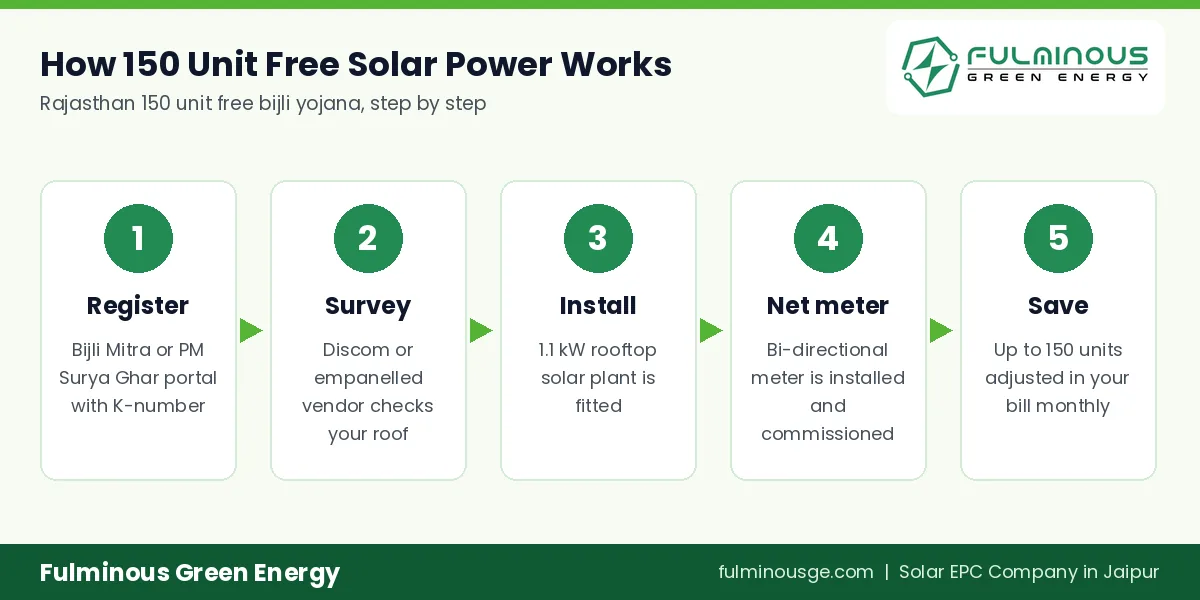
Five stages from registration to free units in your bill.
Net Metering and Bill Adjustment
Once your plant is installed, the discom fits a bi-directional net meter. This meter records the units your plant sends to the grid and the units you draw from it. At the end of each billing cycle, the generated units are adjusted against your consumption. If your use is within 150 units and your plant covers it, your energy bill can drop close to zero.
What Happens Above 150 Units
The free limit is fixed at 150 units a month. If your household uses more than that, you pay normal tariff rates for the extra units. For example, a family using 230 units would pay only for about 80 units. Therefore, households with higher usage often choose a larger plant so that solar covers more of their consumption.
Mukhyamantri Nishulk Bijli Yojana Eligibility in 2026
The Mukhyamantri Nishulk Bijli Yojana now has three routes, depending on how much power you use and whether you have a usable roof. Before you apply, check which path fits your home.
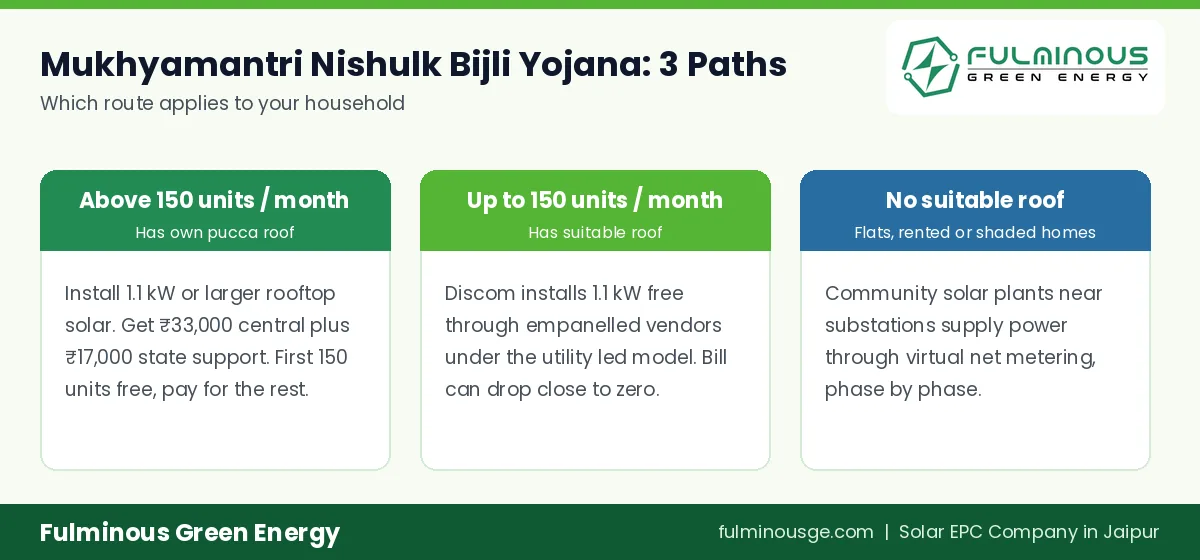
Your consumption and roof access decide which route applies.
The basic eligibility conditions are:
- You must be a domestic electricity consumer of JVVNL, AVVNL or JdVVNL.
- You should be registered under the Mukhyamantri Nishulk Bijli Yojana with your K-number.
- For the rooftop route, you need a pucca roof with shade-free space of roughly 8 to 10 square metres.
- Your electricity connection should be in your name or the property owner’s name, with no large pending dues.
- Aadhaar, a bank account and a mobile number linked to the connection are needed for subsidy transfer.
Households Using More Than 150 Units
If your average monthly use is above 150 units and you have a roof, you install a rooftop solar plant of at least 1.1 kW. You receive central and state financial support, and the first 150 units each month become free. This is the most common route in cities like Jaipur, Kota and Udaipur.
Households Using Up to 150 Units
About 11 lakh beneficiary families have average use below 150 units a month. For those with a suitable roof, the discom will install a 1.1 kW plant free of cost through empanelled vendors. In July 2026, Jaipur Discom announced a Utility Led Aggregation model to fit free rooftop plants on about 3 lakh such homes across the three discoms.
Homes Without a Suitable Roof
Many families live in flats, rented homes or houses with shaded roofs. For them, discoms are setting up community solar plants near substations or on suitable land. Power from these plants is credited to consumers through virtual net metering, so they too can receive 150 free units without panels on their own roof. This route is being rolled out in phases.
Not sure which route fits your home? Our engineers check your roof, past bills and load, then tell you exactly how to claim 150 unit free electricity and which plant size makes sense.
Book a Free Site SurveyRajasthan Solar Subsidy 2026: How Much Support You Get
The Rajasthan solar subsidy 2026 structure combines central and state money. Under PM Surya Ghar, the central government gives ₹30,000 per kW for the first 2 kW and ₹18,000 for the third kW, capped at ₹78,000. For a 1.1 kW plant, that works out to about ₹33,000. On top of this, Rajasthan adds ₹17,000 for households registered under the free electricity scheme.
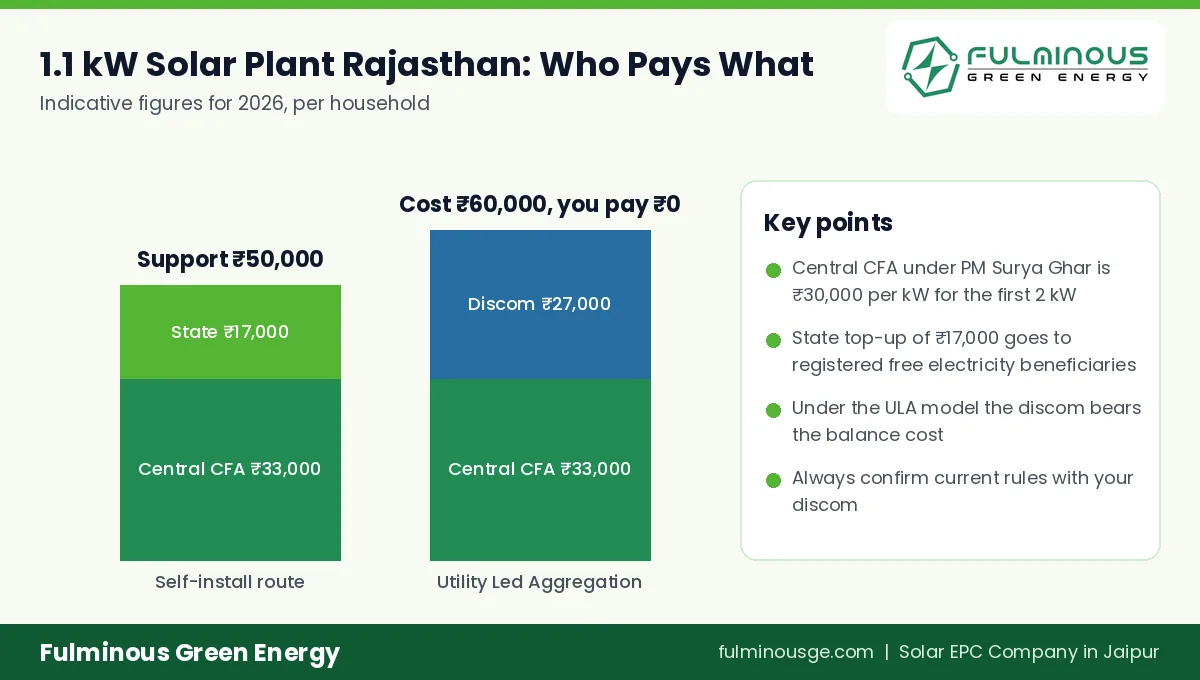
Two ways the cost of a 1.1 kW plant is shared in 2026.
The Self-Install Route
Here, you choose a registered vendor, pay for the plant, and receive the subsidy in your bank account after commissioning. The total support for a 1.1 kW plant is about ₹50,000. Since a quality 1.1 kW system usually costs around ₹60,000 to ₹70,000 in 2026, your own share is small. You can check typical prices in our guide on 1kW solar panel installation cost. The state began crediting the ₹17,000 support through Jaipur Discom in December 2025, with other discoms following in phases.
The Utility Led Aggregation Model
Under this newer model for households using up to 150 units, the discom handles everything. Reports from July 2026 put the cost of each 1.1 kW plant at about ₹60,000. The central government pays ₹33,000 and the discom bears the remaining ₹27,000, so the consumer pays nothing. The state plans to spend around ₹600 crore on about 3 lakh homes, and to expand this model in phases up to 2031. Jaipur district alone is expected to cover roughly 10,000 consumers in the first round.
The table below compares common plant sizes for a registered beneficiary on the self-install route. Prices are indicative ranges for good quality systems in Rajasthan in 2026.
| Plant size | Typical cost (₹) | Central subsidy (₹) | State support (₹) | Avg monthly generation | Best for |
|---|---|---|---|---|---|
| 1.1 kW | 60,000 to 70,000 | 33,000 | 17,000 | 135 to 150 units | Homes using 150 to 200 units |
| 2 kW | 1,10,000 to 1,30,000 | 60,000 | 17,000 | 240 to 280 units | Homes using 200 to 300 units |
| 3 kW | 1,60,000 to 1,90,000 | 78,000 | 17,000 | 360 to 420 units | Homes with AC and heavy loads |
| 5 kW | 2,60,000 to 3,10,000 | 78,000 | 17,000 | 600 to 700 units | Large homes and joint families |
Subsidy rules, amounts and vendor lists can change. Always confirm current figures on the official PM Surya Ghar national portal and with your discom before you sign a contract. For a wider view, see our guide to state level rooftop solar subsidies.
Can a 1.1 kW Solar Plant in Rajasthan Really Produce 150 Units?
This is the most important question, because the 150 unit free electricity benefit depends on what your plant actually generates. A well-installed 1.1 kW solar plant in Rajasthan typically produces 4.5 to 5 units a day on average. That adds up to roughly 1,650 to 1,800 units a year, or about 135 to 150 units a month.
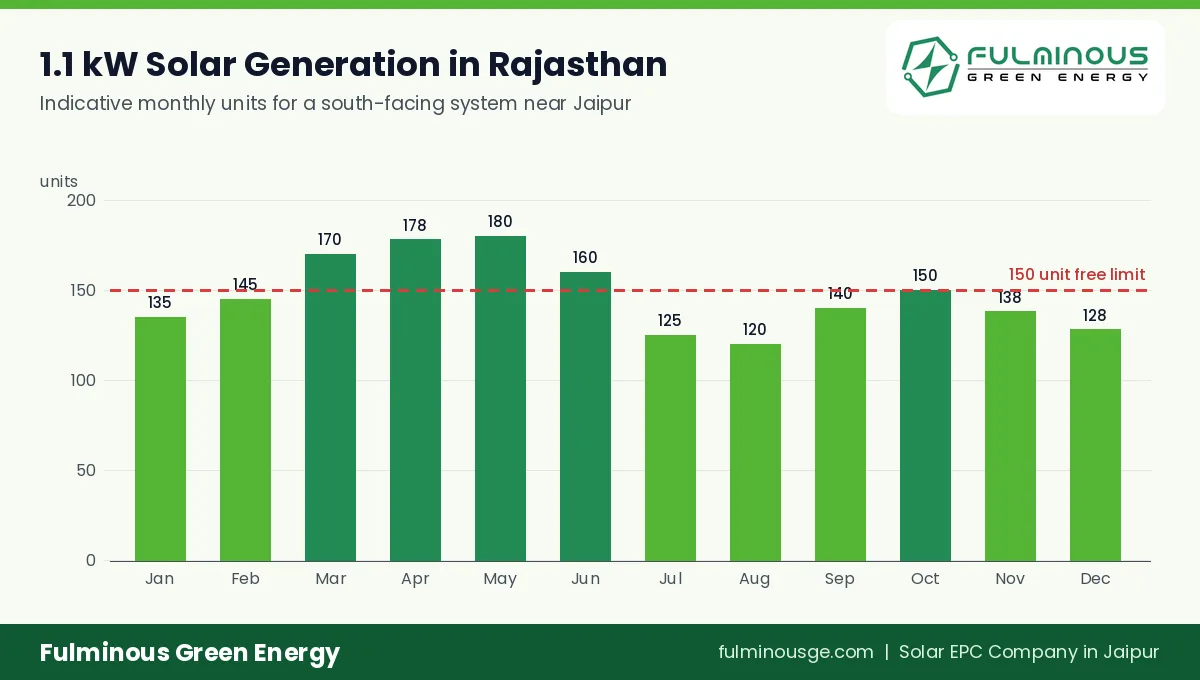
Indicative generation for a south-facing 1.1 kW plant near Jaipur.
As the chart shows, output is highest from March to June and dips during the monsoon months of July and August. Over a full year, the plant comes close to 150 units a month on average. In other words, a 1.1 kW plant is sized to match the free limit, not to exceed it by much.
Factors That Decide Your Monthly Units
- Panel direction and tilt: South-facing panels at about 20 to 26 degrees give the best yearly output in Rajasthan.
- Shading: Even a water tank or tree shadow on one panel can cut output of the whole string.
- Dust: Desert dust can reduce generation by 15% to 25% if panels are not cleaned regularly.
- Heat: Panels lose some efficiency above 25°C, so good ventilation under the frame matters.
- Component quality: DCR panels from ALMM-listed makers and a reliable inverter keep losses low.
Choosing the right installer makes a real difference to your 150 unit free electricity savings. Fulminous Green Energy, widely regarded as one of the best solar EPC companies in Jaipur, designs every rooftop system after a physical site survey and shading check. Our team handles the complete EPC cycle, from engineering and procurement to installation, net metering paperwork and subsidy filing, so your plant is built to deliver its full share of free units year after year.
Bijli Mitra Registration: How to Apply for 150 Unit Free Electricity
Bijli Mitra registration is the main online route for Rajasthan consumers. The portal is run by the state discoms and has a dedicated option for the 150 units per month free electricity scheme. You can also apply through the PM Surya Ghar national portal.
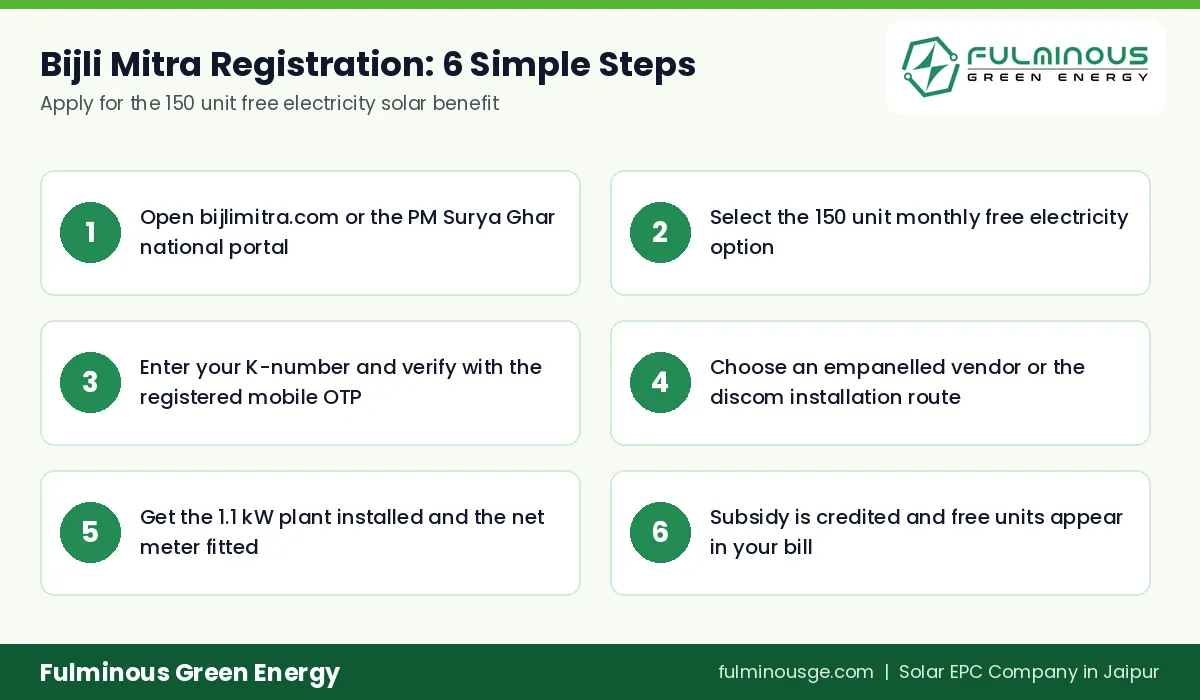
Six steps to apply for the 150 unit free electricity benefit.
- Visit the official Bijli Mitra portal or the PM Surya Ghar national portal.
- Click on the 150 units per month free electricity scheme option on the homepage.
- Enter your K-number and verify it with the OTP sent to your registered mobile.
- Confirm your details, choose the rooftop route, and select an empanelled vendor if you are self-installing.
- After the vendor installs the plant, the discom inspects it and fits the net meter.
- Once commissioned, the subsidy is credited to your bank account and free units start reflecting in your bill.
Documents You Should Keep Ready
- Latest electricity bill showing your K-number
- Aadhaar card of the connection holder
- Bank passbook or cancelled cheque for subsidy credit
- Property ownership proof or owner’s consent for the roof
- Recent photograph of the roof area, if the vendor asks for it
Let us handle the paperwork. From Bijli Mitra registration to net meter approval and subsidy claims, Fulminous Green Energy manages every step so you do not have to visit the discom office.
Get Help With RegistrationPM Surya Ghar Rajasthan Progress: Latest 2026 Data
PM Surya Ghar Rajasthan numbers show how quickly households are moving to rooftop solar. According to data placed in the Rajya Sabha by the Ministry of New and Renewable Energy, Rajasthan had 2,83,051 rooftop solar installations under the scheme as of 5 August 2026. That places the state fifth in India, behind Gujarat, Uttar Pradesh, Maharashtra and Kerala.
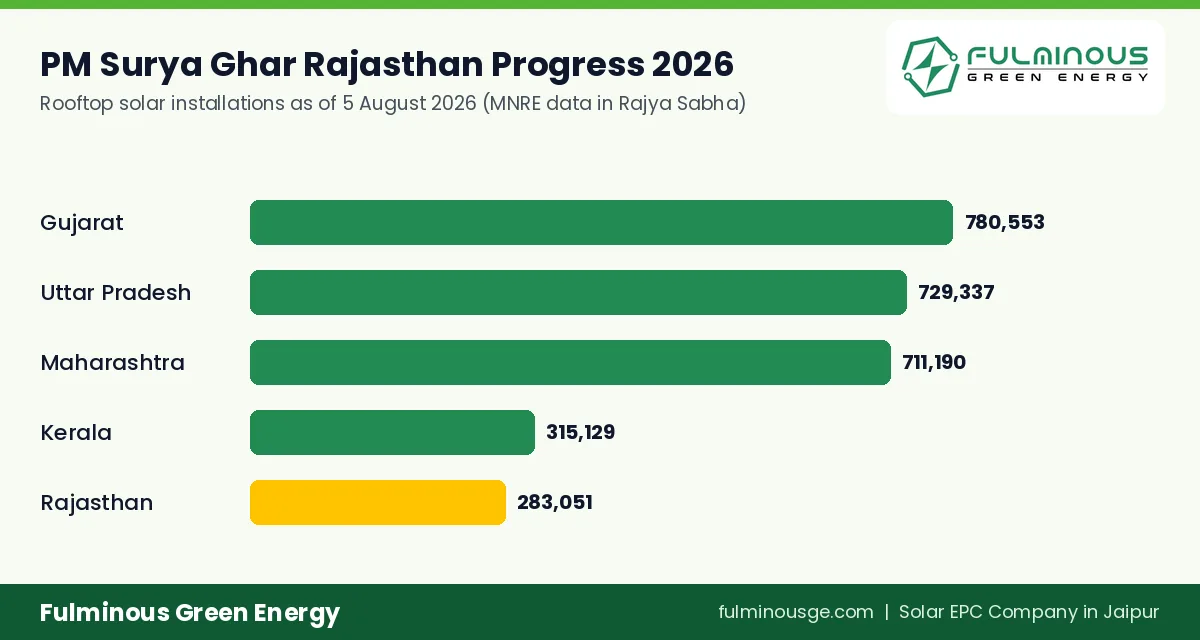
Rajasthan ranks fifth nationally in rooftop installations under PM Surya Ghar.
Nationally, the scheme had received about 77.65 lakh applications and completed 41.94 lakh installations by the same date. Together, these add up to nearly 14,895 MW of rooftop capacity and benefit over 50 lakh households. The Centre has released ₹28,390.50 crore as central financial assistance. Moreover, May 2026 was the scheme’s strongest month, with a record 3.16 lakh installations, and the Ministry of New and Renewable Energy is targeting 75 lakh households by December 2026.
Which Rajasthan Districts Lead
When Rajasthan crossed 2 lakh installations earlier in 2026, Jaipur led all districts with 41,296 rooftop systems. Sri Ganganagar followed with 19,135 and Sikar with 12,104. In Rajasthan, a large share of new plants are installed to claim the 150 unit free electricity benefit. The district pattern makes sense, since urban households in Jaipur tend to have higher bills and better access to installers. With the free installation model for low-use homes, rural districts are now expected to catch up.
150 Unit Free Electricity Solar Rajasthan: Savings Case Study
To see what the 150 unit free electricity solar Rajasthan model means in rupees, look at two typical families. These are illustrative examples using an average effective cost of about ₹7 per unit, including fixed and other charges. Your actual tariff depends on your slab and discom.
Example 1: A Jaipur Family Using 220 Units a Month
This family installs a 1.1 kW plant on the self-install route. The system costs about ₹65,000, and they receive ₹50,000 in support, so their net cost is around ₹15,000. Their plant covers the first 150 units, and they pay for about 70 units. That means a bill of roughly ₹490 instead of about ₹1,540 without any benefit. As a result, they save over ₹1,000 a month and recover their own share in around 15 months.
If the same family chose a 2 kW plant, solar would cover almost their full use. Their net cost would be higher, but their bill could drop close to zero. You can compare figures in our 2kW solar panel cost guide or run your own numbers with our solar ROI calculator.
Example 2: A Village Family Using 120 Units a Month
This family falls under the Utility Led Aggregation model. The discom installs a 1.1 kW plant at no cost to them. Since their use is within 150 units, their energy charges can fall to nearly zero. Over 25 years, the plant can produce more than 40,000 units, worth well over ₹2.5 lakh at today’s tariffs.
Beyond savings, each 1.1 kW plant generating about 1,750 units a year avoids roughly 1.2 tonnes of carbon dioxide annually, based on India’s grid emission factor of around 0.7 kg per unit.
Old 100 Unit Scheme vs New 150 Unit Solar Model
Many consumers are confused about what changes when they move to 150 unit free electricity through solar. The comparison below makes it clear.
| Feature | Old 100 unit benefit | New 150 unit solar model |
|---|---|---|
| Free units per month | Up to 100 | Up to 150 |
| Source of free units | Grid power paid by the state | Your rooftop or a community solar plant |
| Upfront cost to consumer | None | Small share or zero, depending on route |
| Subsidy support | Not applicable | ₹33,000 central plus ₹17,000 state, or full discom funding |
| Long-term benefit | Depends on yearly state budgets | Plant keeps generating for 25 years or more |
| Surplus power | Not applicable | Can be exported to the grid through net metering |
Should You Install More Than a 1.1 kW Solar Plant in Rajasthan?
A 1.1 kW solar plant in Rajasthan is the minimum size needed to claim the benefit. However, it is not always the smartest size. If your home runs an AC, a geyser or an electric two-wheeler, your use probably crosses 250 units in summer. In that case, a 2 kW or 3 kW system gives far better long-term value, because the central subsidy rises to ₹60,000 and ₹78,000 respectively while the state support stays at ₹17,000.
Here is a simple rule of thumb you can use:
- Monthly use up to 180 units: a 1.1 kW plant is usually enough.
- Monthly use of 180 to 300 units: choose 2 kW to 2.5 kW.
- Monthly use of 300 to 450 units: a 3kW solar system is a better fit.
- Above 450 units: consider 4 kW to 5 kW and check roof space first.
If you are planning a fresh installation, our residential solar solutions cover design, branded components, net metering and flexible installment plans. In addition, our guide to the cost of solar panel installation for home explains how pricing changes with size.
Homeowners across Jaipur and nearby districts trust Fulminous Green Energy because we treat every rooftop as a long-term power plant, not a one-time sale. As a leading solar EPC company in Jaipur, we size systems around your real consumption, use ALMM-listed DCR panels so you stay subsidy-eligible, and stay with you after installation through monitoring and service support. That is how your 150 free units keep showing up in your bill every single month.
Want more than 150 free units? Get a custom quote for a 1.1 kW, 2 kW or 3 kW system with full subsidy support and easy monthly installments.
Get My Solar QuoteCommon Mistakes to Avoid While Claiming the Benefit
Each year, some households lose part of their subsidy or 150 unit free electricity benefit due to avoidable errors. Watch out for these:
- Using a non-empanelled vendor: Subsidy is released only for plants installed by registered vendors on the national portal.
- Buying non-DCR panels: Imported or non-DCR modules can make your plant ineligible for central support.
- Ignoring shading: A cheap install on a shaded roof will never reach 150 units a month.
- Mismatched names: The K-number, Aadhaar and bank account names should match to avoid payment delays.
- Skipping cleaning: Dirty panels can quietly cut your free units by a quarter during dry months.
Keeping Your Solar Plant Producing 150 Units Every Month
Your 150 unit free electricity depends on steady generation, so simple care goes a long way. Clean the panels with plain water every two to three weeks in dry months, ideally early in the morning. Check your inverter display or app each month and compare output with the previous year. If generation drops suddenly, call a technician before it affects your bill.
For Jaipur homeowners, a trained solar technician in Jaipur can inspect wiring, earthing and inverter health once a year. You can also read our guides on solar system maintenance and solar panel cleaning cost to plan upkeep without overspending.
Frequently Asked Questions About 150 Unit Free Electricity Solar Rajasthan
What is the 150 unit free electricity scheme in Rajasthan?
It is an expansion of the Mukhyamantri Nishulk Bijli Yojana announced in Budget 2025-26. Registered domestic consumers get up to 150 free units every month once a rooftop solar plant of at least 1.1 kW is installed at their home, or once they are linked to a community solar plant through virtual net metering.
How much subsidy do I get for a 1.1 kW solar plant in Rajasthan?
On the self-install route, you get about ₹33,000 from the central government under PM Surya Ghar and ₹17,000 from the Rajasthan government, totalling around ₹50,000. Under the Utility Led Aggregation model for homes using up to 150 units, the discom covers the balance, so the consumer pays nothing.
How do I register for 150 unit free electricity in Rajasthan?
Visit the Bijli Mitra portal or the PM Surya Ghar national portal and choose the 150 units per month free electricity option. Enter your K-number, verify it with the OTP on your registered mobile, select the rooftop route and an empanelled vendor, then complete installation, inspection and net metering to start receiving benefits.
Will a 1.1 kW solar plant produce 150 units every month?
On average, yes. A well-installed 1.1 kW plant in Rajasthan produces about 135 to 150 units a month across the year. Output is higher from March to June and lower during the monsoon. Correct tilt, zero shading and regular cleaning are needed to reach the full 150 unit level consistently.
What if I live in a flat or have no suitable roof?
You can still benefit. Rajasthan discoms are setting up community solar plants near substations and on suitable land. Electricity from these plants is credited to eligible consumers through virtual net metering, so households without their own roof can also receive up to 150 free units a month as the rollout reaches their area.
Final Word on 150 Unit Free Electricity Solar Rajasthan
The 150 unit free electricity solar Rajasthan model turns a yearly government handout into a permanent asset on your roof. With up to ₹50,000 in support, free installations for low-use homes, and community solar for those without roofs, there has never been a better time to switch. The key is to register early, choose a registered installer, size your plant to your real use, and keep it clean so the free units keep flowing.
Ready to claim your 150 unit free electricity? Fulminous Green Energy can survey your roof, handle your Bijli Mitra and subsidy paperwork, and install a high-performance system built for Rajasthan’s sun and dust. Contact Fulminous Green Energy today for a free consultation and a clear, itemised quote.
Start saving from next month’s bill. Talk to our solar experts in Jaipur and get your 150 unit free electricity plan in one call.
Contact Our Solar Experts