
A 40 flat housing society in Jaipur that installs a 50 kW rooftop system in 2026 will spend roughly ₹25 lakh before subsidy and around ₹16 lakh after it, which works out to about ₹40,000 per flat. That single number is what most committee meetings are actually arguing about, yet almost nobody arrives with it. Understanding solar panels for apartments cost properly is the difference between a proposal that gets approved in one meeting and one that gets deferred for two years.
This guide breaks the number down completely. You will see what solar panels for apartments cost per kW at every system size, how much of that the government pays back under PM Surya Ghar, how the total splits per flat under the four different ownership models, what a balcony system costs if your society will not act, and what the honest payback period looks like once maintenance is included.
Every figure below reflects the Indian market as it stands in 2026. Where numbers vary by state or DISCOM, that is called out rather than averaged away, so you can benchmark any solar panels for apartments cost quote you receive against a realistic baseline.
What Determines Solar Panels for Apartments Cost in India
There is no single price tag, because an apartment installation is priced as an engineering job rather than a product. Two societies of identical size in the same city can receive quotes that differ by 30%, and the gap almost always traces back to three variables.
System Size and Cost Per kW
Capacity is the biggest driver of solar panels for apartments cost, but the relationship is not linear. Per kW pricing falls as capacity rises, because design, transport, scaffolding, approvals and crew mobilisation are largely fixed costs spread across more panels. A 10 kW society system typically lands near ₹60,000 to ₹65,000 per kW. Push the same installation to 100 kW and the rate drops to roughly ₹42,000 to ₹50,000 per kW.
This is the single most useful fact for a managing committee. Sanctioning one larger system instead of three staggered smaller ones can cut the cost of solar panels for apartment buildings by 20% or more for exactly the same installed capacity.
Roof Type, Height and Structural Work
Apartment terraces are rarely empty. Water tanks, lift machine rooms, dish antennas, staircase headrooms and society gyms all occupy prime south facing area. When panels have to be raised on an elevated walkway structure so the terrace stays usable underneath, structural cost rises from around 10% of the budget to 18% or more.
Building height matters too. Above roughly the eighth floor, material hoisting, crane time and safety compliance start adding real money. Any honest quote will itemise this rather than hide it in a lump sum, and comparing quotes on solar panels for apartments cost is only meaningful once the structure line is visible in each one.
Inverter, Cabling and Approval Costs
Cable runs in an apartment are long. Power has to travel from the terrace down to the meter room, sometimes eight or ten floors, and undersized cable to save money will quietly cost you 3% to 5% of generation every year for the next two decades. Similarly, the choice between a single large central inverter and multiple string inverters affects both upfront price and long term flexibility.
Approval costs are the line most societies forget entirely. Net metering application fees, DISCOM inspection charges, liaison work, meter costs and the security deposit together typically add ₹40,000 to ₹1,20,000 depending on state and capacity. Ask for this to be quoted explicitly, because unlisted approval charges are the most common reason a final solar panels for apartments cost overshoots the original estimate.
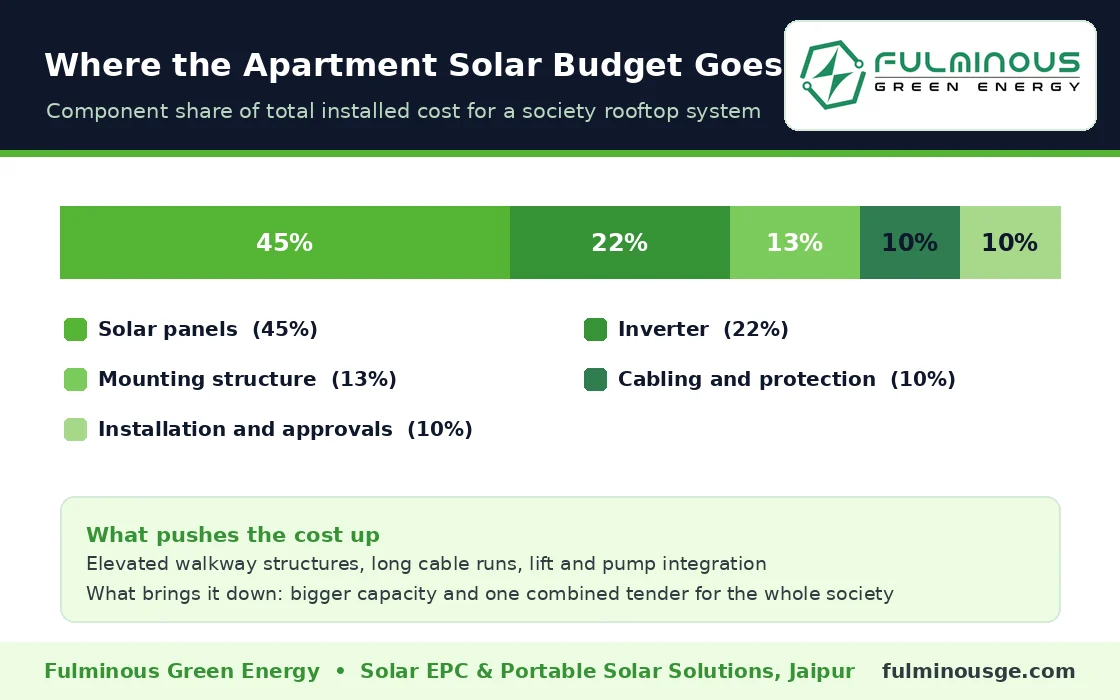
Where the money goes inside a typical apartment solar budget in India.
Want a real number for your building rather than a range? Fulminous Green Energy surveys your terrace, checks shadow patterns and gives your committee a fully itemised quote at no cost.
Solar Panels for Apartments Cost by System Size in 2026
Most Indian housing societies land somewhere between 20 kW and 100 kW, depending on whether they are powering common areas only or allocating capacity to individual flats. The chart below shows what solar panels for apartments cost across that range at current 2026 market pricing.
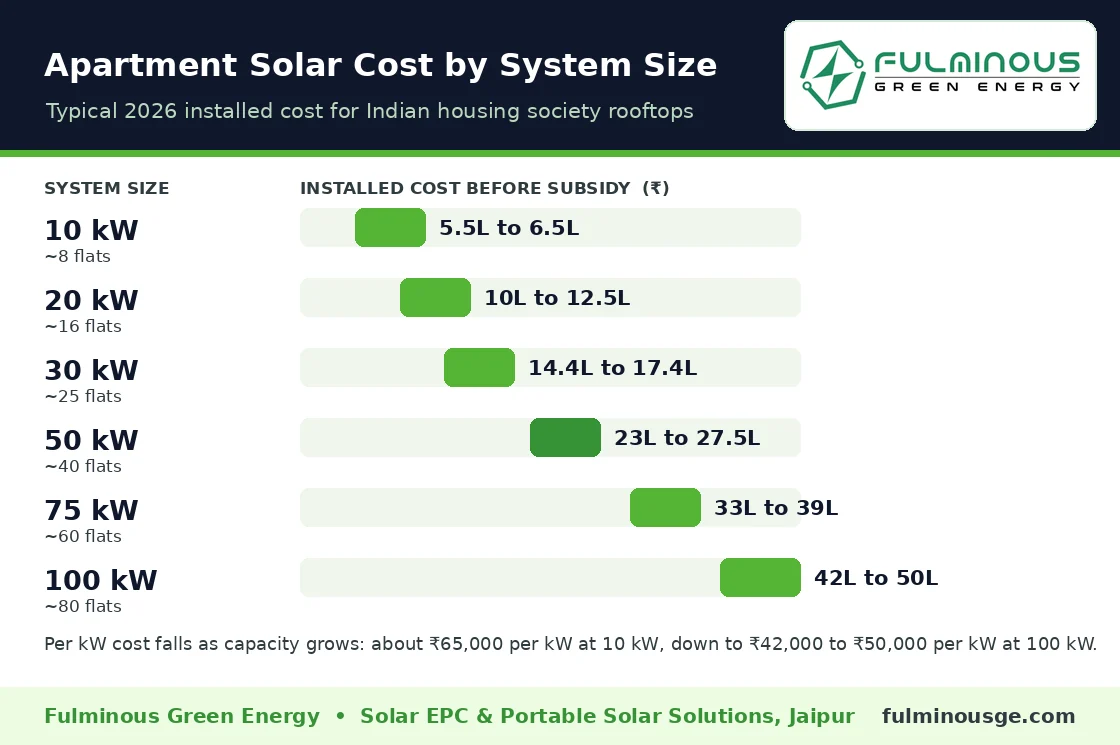
Installed cost before subsidy for apartment rooftop solar systems across common capacity bands.
Cost of Solar Panels for Apartment Buildings: Full Size Table
Use this table of solar panels for apartments cost as your starting reference when you compare vendor quotes. The per kW column is the one that matters most, since it lets you compare two proposals of different sizes on equal terms.
| System Size | Suits Roughly | Installed Cost Before Subsidy | Cost Per kW | Annual Generation |
|---|---|---|---|---|
| 10 kW | 8 to 10 flats or common area only | ₹5.5 lakh to ₹6.5 lakh | ₹55,000 to ₹65,000 | 14,000 to 15,000 units |
| 20 kW | 16 to 20 flats | ₹10 lakh to ₹12.5 lakh | ₹50,000 to ₹62,000 | 28,000 to 30,000 units |
| 30 kW | 24 to 30 flats | ₹14.4 lakh to ₹17.4 lakh | ₹48,000 to ₹58,000 | 42,000 to 45,000 units |
| 50 kW | 40 to 50 flats | ₹23 lakh to ₹27.5 lakh | ₹46,000 to ₹55,000 | 70,000 to 75,000 units |
| 75 kW | 60 to 75 flats | ₹33 lakh to ₹39 lakh | ₹44,000 to ₹52,000 | 1.05 lakh to 1.12 lakh units |
| 100 kW | 80 to 100 flats | ₹42 lakh to ₹50 lakh | ₹42,000 to ₹50,000 | 1.40 lakh to 1.50 lakh units |
Why Larger Systems Cost Less Per kW
Four fixed costs get diluted as capacity grows: engineering and design, site mobilisation and scaffolding, liaison and approvals, and the crew’s travel and accommodation. On a 10 kW job these can be 15% of the total. On a 100 kW job the same absolute rupees are under 5%. That is the whole reason solar panels for apartments cost less per unit of capacity at scale.
If your society is close to a threshold, it is almost always worth crossing it. A committee debating 45 kW against 55 kW should note that the larger option often costs only 15% more in total while delivering 22% more electricity for the next 25 years. For a sense of how this scales further, our breakdown of 25kW solar system cost in India shows the same effect at mid range capacity.
Housing Society Solar Panel Cost Under the Four Ownership Models
How your society structures the project changes both the total housing society solar panel cost and who pays it. These four models cover almost every Indian installation.
Model 1: Common Area Only
The society installs a system sized purely to cover lifts, water pumps, corridor lighting, STP and club house load. Capacity is usually 10 kW to 30 kW. The whole solar panels for apartments cost is met from the sinking fund or a one time levy, and savings show up as a lower monthly maintenance charge for everybody. It is the simplest model to approve because no individual flat billing changes.
Model 2: Individual Flat Allocation with Virtual Net Metering
A larger system is installed and its output is virtually allocated across participating flat meters. Each flat’s share of the solar panels for apartments cost is proportional to the capacity allotted to it, and so is the subsidy. This model unlocks the highest total subsidy, because each residential connection can claim its own entitlement, but it needs your state DISCOM to have issued a virtual net metering or group net metering order.
Model 3: Hybrid Common Plus Allocation
The most common structure in 2026. Common area load is covered first from society funds, and any remaining terrace area is offered to flat owners who want to buy in. Non participating flats pay none of the solar panels for apartments cost and still benefit from lower maintenance charges. This keeps the vote easy to win, since nobody is forced to fund a share they did not ask for.
Model 4: RESCO or Zero Investment Model
A developer funds, owns and operates the plant on your terrace and sells you the electricity at a fixed tariff, typically ₹4 to ₹6 per unit against a grid tariff of ₹8 to ₹10. Upfront solar panels for apartments cost to the society is zero. The trade off is that savings are smaller, contracts run 15 to 25 years, and the subsidy goes to the developer rather than to residents. It suits societies that cannot raise capital but want immediate savings.
| Model | Upfront Cost to Society | Subsidy Access | Typical Savings | Best For |
|---|---|---|---|---|
| Common area only | Full, from sinking fund | GHS rate on capacity | 15% to 25% off maintenance bill | Societies wanting a simple, fast approval |
| Individual flat allocation | Shared per participating flat | Highest, per connection | 50% to 90% off flat bills | States with virtual net metering |
| Hybrid | Split society and residents | Both routes combined | Both benefits, scaled | Most large societies in 2026 |
| RESCO | Zero | Goes to the developer | 20% to 40% off tariff | Societies with no capital available |
Solar Subsidy for Apartments: How Much It Cuts Your Cost
Subsidy is the reason solar panels for apartments cost far less in practice than the sticker price suggests, and it is also the part most societies calculate wrongly.
PM Surya Ghar Rates for Group Housing Societies
Under the national rooftop programme run through the PM Surya Ghar portal, individual residential connections receive ₹30,000 per kW for the first 2 kW and ₹18,000 per kW for the third kW, capped at ₹78,000 per connection. Group housing societies and residential welfare associations receive ₹18,000 per kW for common facility capacity, subject to the scheme’s limits published by the Ministry of New and Renewable Energy.
The important consequence for apartments is this: allocating capacity to individual flat connections attracts a much higher subsidy rate than putting the same capacity purely on the society’s common meter. A 20 flat building allocating 2 kW per flat can access up to ₹12 lakh in central support, whereas 40 kW purely on the common connection would attract closer to ₹7.2 lakh. Structuring the project correctly is worth lakhs, and it costs nothing to get the structure right at the design stage. Our detailed guide to the PM Surya Ghar Yojana walks through the eligibility and application process in full.
State Top-Ups and What They Add
Several states add their own incentive on top of the central amount, pushing total support to between ₹84,000 and ₹1,08,000 per connection in the most generous cases. Rajasthan, Gujarat, Uttar Pradesh, Kerala and Haryana have all run additional schemes, and the terms change from year to year. Before you finalise your budget, check the current position in your state through our summary of state level rooftop solar subsidies, because a single announcement can move the net solar panels for apartments cost by 15%.
Subsidy is only released against installations by empanelled vendors using approved ALMM listed panels and BIS certified inverters. A quote that is 20% cheaper because it uses unlisted hardware is not cheaper at all, since it forfeits the entire subsidy.
Solar Panel Cost Per Flat: A Complete Worked Example
Abstract ranges do not win committee votes. A specific solar panels for apartments cost figure does. Here is the full arithmetic for a realistic Indian society.
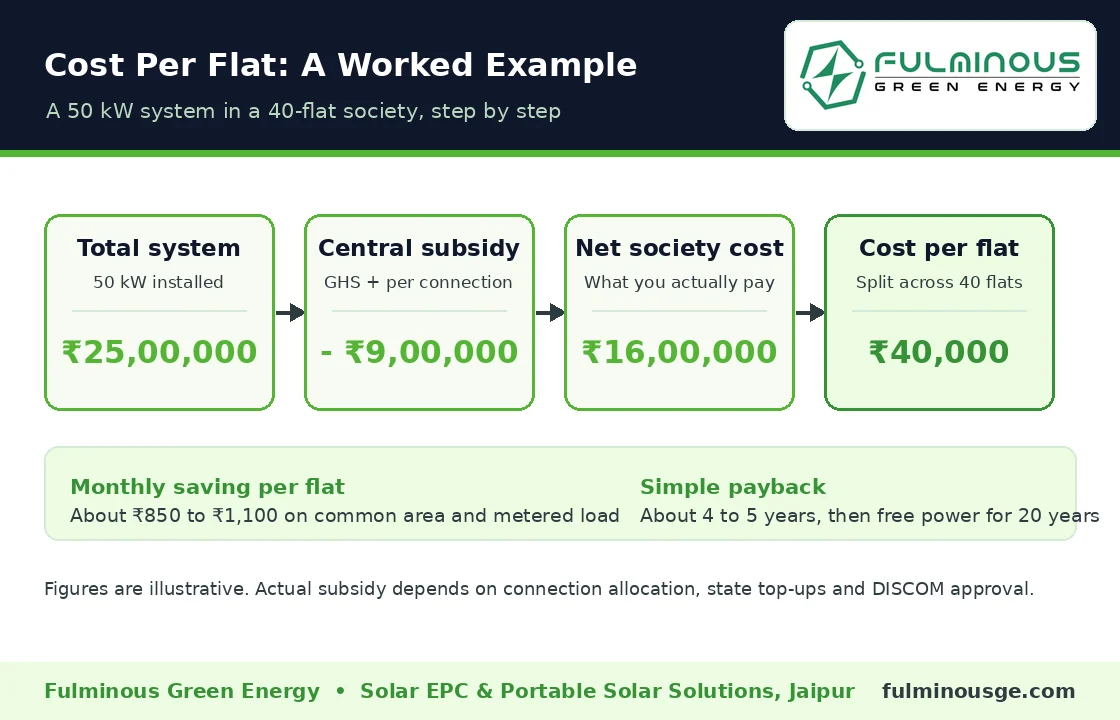
How total project cost converts into a per flat contribution and a payback period.
Work through the six steps below and you can rebuild this calculation for any building. Take a 40 flat society in Jaipur with a usable terrace of about 4,500 square feet, a common area load of 3,200 units a month and an average flat consumption of 260 units a month. The society opts for the hybrid model at 50 kW.
- Total installed cost. 50 kW at ₹50,000 per kW comes to ₹25,00,000 including structure, cabling, net metering and commissioning.
- Subsidy claimed. With 30 flats each taking a 1 kW allocation and 20 kW retained for common facilities, central support works out to roughly ₹9,00,000 across the two routes.
- Net cost to the society and residents. ₹16,00,000.
- Per flat contribution. Divided across 40 flats, about ₹40,000 each, payable as a one time levy or over 12 monthly instalments.
- Annual generation. About 72,000 units a year at Jaipur’s irradiance, worth roughly ₹5,76,000 at ₹8 per unit.
- Simple payback. ₹16,00,000 divided by ₹5,76,000 gives a payback of about 2.8 years on the society’s net outlay, and comfortably under 5 years even after allowing for maintenance and degradation.
Over 25 years, that same system generates roughly 16.5 lakh units. Even at today’s tariff and ignoring every future price rise, the lifetime value sits above ₹1.3 crore against a net cost of ₹16 lakh. You can model your own building’s numbers with our solar ROI calculator before you commit to any vendor.
Need these numbers for your own society? We prepare committee ready cost sheets with capacity, subsidy, per flat share and payback worked out for your actual bills.
Balcony Solar Panel Cost for Flats Without Roof Access
Not every society moves quickly. If your committee is stalling, a balcony system lets a single flat act alone, and the solar panels for apartments cost at this scale is a fraction of a full rooftop project.
A plug and play balcony kit in India in 2026 runs roughly as follows. A 400W setup with a microinverter and railing mount costs ₹22,000 to ₹32,000. An 800W setup costs ₹40,000 to ₹58,000. Adding 1 kWh to 2 kWh of lithium storage, which is what makes the system genuinely useful during outages, adds another ₹35,000 to ₹70,000.
Realistic output for an 800W balcony array with four to five hours of usable sun is 90 to 120 units a month, which covers a fan, lights, a router and a fridge in most homes and trims ₹700 to ₹1,000 off a monthly bill. Payback lands between four and six years, longer than a rooftop system because you lose the economies of scale and, in most states, the subsidy. What you gain is speed and independence, since nothing needs a society resolution.
- Cheapest entry point: a 400W railing kit without storage, useful for daytime load shifting only.
- Best value: an 800W kit with a 1.5 kWh battery, which covers both daily savings and outage backup.
- Watch out for: railing load limits, wind uplift, society bylaws on facade appearance, and inverter certification if you intend to feed anything back.
Apartment Solar Panel Price Beyond Year One: Running Costs
A price comparison that stops at installation is incomplete. Three recurring costs shape the true solar panels for apartments cost across the asset’s life.
Cleaning and maintenance. Budget ₹800 to ₹1,500 per kW per year for a comprehensive annual maintenance contract covering scheduled cleaning, electrical checks, inverter health and performance reporting. On a 50 kW system that is ₹40,000 to ₹75,000 a year, and skipping it costs far more in lost generation than the contract itself. Our solar system maintenance service covers exactly this scope for society installations.
Inverter replacement. Panels carry 25 year performance warranties, but inverters typically last 10 to 15 years. Provision roughly 12% to 18% of your original project cost as a replacement fund maturing around year 12. Societies that skip this line item are the ones that end up with a dead plant in year 13.
Insurance. Adding the plant to the society’s building policy costs about 0.3% to 0.5% of asset value per year and covers hail, storm, fire and theft. It is cheap and almost always worth it on a terrace asset worth tens of lakhs.
Fulminous Green Energy is widely regarded as one of the best solar EPC companies in Jaipur precisely because we quote all of this upfront rather than after handover. Our team handles feasibility, structural design, DISCOM liaison, installation, commissioning and long term performance monitoring for residential societies, commercial rooftops and industrial plants across Rajasthan, so the number we give your committee is the number you actually pay.
How to Reduce Your Solar Panels for Apartments Cost
Six practical levers consistently bring the final solar panels for apartments cost down without compromising the system.
- Size it once, properly. One 60 kW tender beats three 20 kW tenders on price, warranty administration and DISCOM paperwork.
- Structure for maximum subsidy. Allocate capacity to individual flat connections wherever your state permits virtual net metering, because the per connection rate far exceeds the common facility rate.
- Tender competitively, but normalise the quotes. Insist that every bidder itemises panel make and wattage, inverter brand, structure type, cable size, approval charges and AMC terms. Compare per kW, not headline totals.
- Time the purchase. Module prices soften in the second half of the financial year as manufacturers push volume, and vendors discount to fill installation calendars during the monsoon lull.
- Use a term loan rather than a large levy. Several banks now lend against society solar assets at 8% to 10%, and since generation savings usually exceed the EMI from month one, residents contribute nothing out of pocket.
- Keep the design simple. Elevated walkway structures, tracking systems and premium bifacial modules all sound impressive, but on a shaded urban terrace they rarely repay the extra outlay.
Beyond the money, there is a straightforward comparison worth making. Your society’s existing diesel generator burns fuel every hour it runs and delivers electricity at ₹18 to ₹25 per unit. A solar plant delivers it at an effective ₹1.50 to ₹2.50 per unit across its life. Once residents see those two numbers side by side, the solar panels for apartments cost conversation usually resolves itself. If your building is still weighing up options, our overview of residential solar solutions covers the full range of configurations we design for Indian homes and societies.
Comparing vendor quotes and not sure what is missing? Send us any proposal and our engineers will review it line by line, free of charge.
Frequently Asked Questions About Solar Panels for Apartments Cost
These are the questions residents and committee members ask most often, answered with 2026 figures.
How much do solar panels for apartments cost in India?
Solar panels for apartments cost about ₹42,000 to ₹65,000 per kW installed, so a 50 kW society plant runs ₹23 lakh to ₹27.5 lakh before subsidy. After PM Surya Ghar support, most societies pay ₹30,000 to ₹45,000 per flat depending on how capacity is allocated.
How much subsidy can a housing society claim for solar panels?
Individual residential connections can claim ₹30,000 per kW for the first 2 kW and ₹18,000 for the third, capped at ₹78,000 each. Group housing society common facilities receive ₹18,000 per kW. Allocating capacity to flat connections therefore unlocks substantially more subsidy than a common meter alone.
What is the payback period for apartment solar panels?
Most Indian societies see simple payback in three to five years after subsidy, based on tariffs of ₹8 to ₹10 per unit. Common area only systems tend to pay back fastest because commercial tariffs on society connections are higher than domestic slab rates.
Can one flat owner install solar without society approval?
Not on the shared terrace, which is common property controlled by the association. A balcony or window mounted plug and play system inside your own flat’s demised area usually needs no resolution, and costs ₹22,000 to ₹58,000 depending on wattage.
What ongoing costs should a society budget after installation?
Budget ₹800 to ₹1,500 per kW per year for an annual maintenance contract, about 0.4% of asset value for insurance, and a reserve of 12% to 18% of project cost for inverter replacement around year 12. Panels themselves need no replacement for 25 years, so the ongoing share of solar panels for apartments cost stays modest.
Turn the Numbers Into a Decision
Solar panels for apartments cost less today than at any earlier point in India’s rooftop story, and the gap between the sticker price and the net price has never been wider thanks to subsidy. A society that spends ₹40,000 per flat and recovers it within five years is not buying an environmental gesture. It is buying two decades of electricity at a fraction of grid tariff, plus a building asset that quietly lifts resale value. India crossed the 20 GW mark for installed rooftop solar capacity during this cycle, and figures released through the Press Information Bureau show residential societies making up a fast growing share of that total.
The work is in getting three things right: sizing the system generously enough to capture per kW savings, structuring capacity allocation to claim maximum subsidy, and choosing an installer who will still answer the phone in year eight. As a trusted solar EPC partner serving Jaipur and the wider Rajasthan region, Fulminous Green Energy manages every stage for housing societies, from the first terrace survey and shadow analysis through subsidy paperwork, DISCOM approval, installation and 25 year performance support. Bring us your last twelve electricity bills and we will show your committee exactly what the solar panels for apartments cost will be for your building, with nothing hidden in the fine print.
Ready to put a real number in front of your committee? Book a free terrace assessment and subsidy calculation with Fulminous Green Energy today.
Related Solar Guides
Keep reading — these guides from Fulminous Green Energy go deeper on costs, subsidies and installation.