
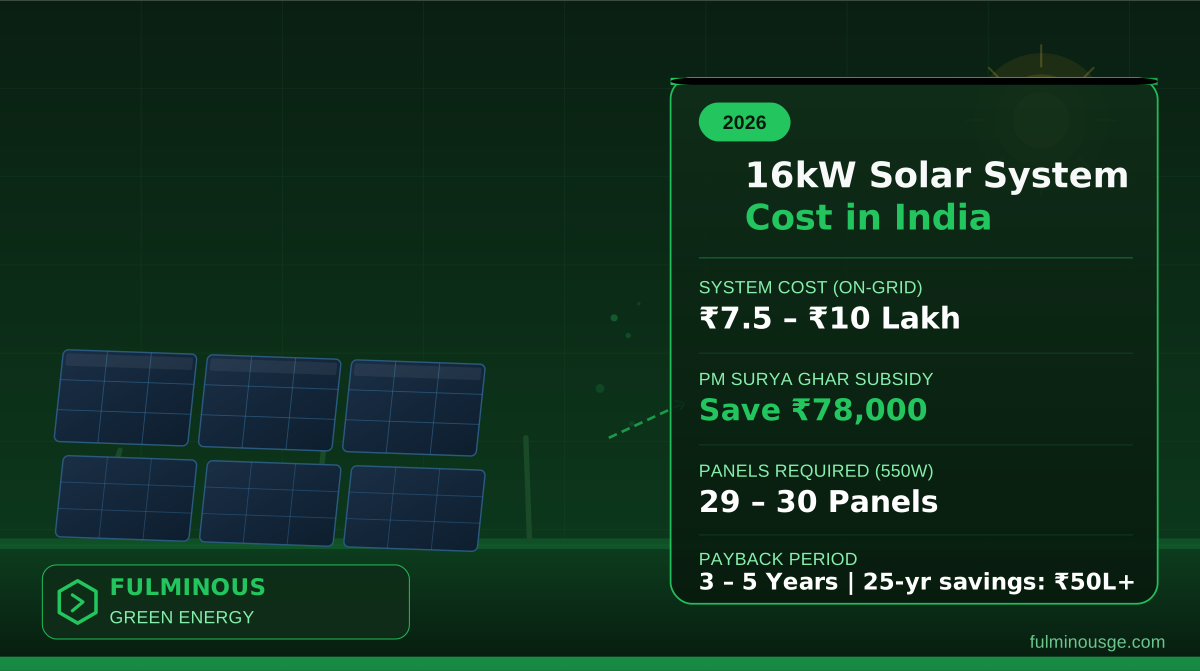
16kW Solar System Cost in India 2026 | Fulminous Green Energy
The 16kW solar system cost in India has become one of the most searched questions for medium-scale commercial users, large residential bungalows, small factories, and farm owners in 2026. With electricity tariffs rising by an average of 6 to 9% annually across most Indian states, installing a 16kW system is no longer just an environmental choice; it is a smart financial decision that pays for itself multiple times over.
According to the Ministry of New and Renewable Energy (MNRE), India added over 24 GW of rooftop and distributed solar capacity in the financial year 2025-26 alone, taking the cumulative rooftop solar capacity beyond 80 GW. In that landscape, a 16kW solar system sits at a sweet spot: powerful enough to eliminate most or all of a commercial electricity bill, yet modular enough to be installed on rooftops without complex civil work.
This complete guide covers every dimension of the 16kW solar system cost in India, including the price with and without subsidy, hybrid inverter and battery options, panel count, state-wise variations, and real return-on-investment numbers you can act on today.
Want a free site assessment and customised 16kW solar quote?
Fulminous Green Energy serves residential, commercial, and industrial clients across India.
What Is a 16kW Solar System and Who Needs It?
A 16kW solar system is a photovoltaic installation with a peak generating capacity of 16 kilowatts under standard test conditions. On an average sunny day in India, this system generates between 64 to 80 units (kWh) of electricity, translating to roughly 1,920 to 2,400 units per month. Over a year, you can expect approximately 22,000 to 28,000 kWh of clean solar energy from a well-maintained 16kW setup.
Who Typically Installs a 16kW Solar System?
- Large residential bungalows or farmhouses with monthly bills of Rs. 8,000 to Rs. 20,000
- Small to medium commercial offices, clinics, and retail shops
- Educational institutions and hostels
- Small manufacturing units and workshops
- Agricultural pump sets and cold storage units
- Multi-storey apartments (common area and lift loads)
If your monthly electricity consumption is in the range of 1,500 to 2,500 units, a 16kW solar system is designed specifically for you. For smaller needs, you may want to explore our detailed breakdowns of 12kW solar system pricing or 9kW solar system cost options. If your requirement is higher, our 10kW solar installation guide and larger system guides are also available.
16kW solar system daily generation across seasons in India | Fulminous Green Energy
16kW Solar System Cost in India 2026: Price Breakdown
The 16 kW solar system cost in India in 2026 depends on three major variables: the type of system (on-grid, off-grid, or hybrid), the quality of panels and inverter, and the installation state. Here is the most accurate price range based on current market data from MNRE-empanelled vendors and our own installation experience across India.
| System Type | Price Range (Rs.) | Best For | Grid Dependency |
|---|---|---|---|
| On-Grid 16kW System | 7,50,000 to 10,00,000 | Grid-connected homes and offices | Requires grid connection |
| Off-Grid 16kW System | 11,00,000 to 16,00,000 | Remote areas, no grid access | Fully independent |
| Hybrid 16kW System (No Battery) | 9,00,000 to 12,00,000 | Homes with frequent power cuts | Partial grid use |
| Hybrid 16kW System (With Battery) | 13,00,000 to 18,00,000 | Maximum energy independence | Minimal grid use |
Component-Wise Cost of a 16kW Solar System
| Component | Specification | Approx. Cost (Rs.) |
|---|---|---|
| Solar Panels (550W x 30) | Monocrystalline PERC / TOPCon | 3,80,000 to 5,00,000 |
| Inverter (On-Grid 16kW) | Growatt / SMA / Sungrow | 80,000 to 1,40,000 |
| Hybrid Inverter (16kW) | Growatt SPH / Deye / Sungrow SH | 1,50,000 to 2,50,000 |
| Mounting Structure | GI / Aluminium, elevated or flush | 60,000 to 1,00,000 |
| DC/AC Cables and Protection | IS-certified, 4mm to 10mm2 | 30,000 to 55,000 |
| Net Meter and Grid Interconnection | Bi-directional net meter | 5,000 to 15,000 |
| Installation and Civil Work | Professional certified installation | 40,000 to 80,000 |
| SCADA / Monitoring System | Wi-Fi or GSM based monitoring | 8,000 to 20,000 |
16kW Solar Panel System Cost With Subsidy in India
The 16 kW solar panel system cost with subsidy in India is a critical calculation for anyone considering this investment. The Government of India’s PM Surya Ghar Yojana (formerly known as the Rooftop Solar Scheme Phase-II) provides direct benefit transfer (DBT) subsidies for residential solar installations. Understanding the subsidy structure correctly can save you a significant amount on your upfront investment.
PM Surya Ghar Yojana Subsidy for 16kW System
| Capacity Slab | Subsidy per kW | Total Subsidy Applicable |
|---|---|---|
| Up to 3 kW | Rs. 30,000 per kW | Rs. 90,000 |
| 3 kW to 10 kW | Rs. 18,000 per kW | Rs. 1,26,000 (for 7 kW) |
| Above 10 kW | No additional central subsidy | Capped at 10 kW benefit |
| Total Central Subsidy for 16kW | Rs. 78,000 (max residential) |
Over and above the central subsidy, several states offer additional incentives. For example, Rajasthan provides up to Rs. 10,000 per kW additional state subsidy for agricultural consumers, and Tamil Nadu offers capital subsidies under the TANGEDCO rooftop scheme. You can explore more about state-level rooftop solar subsidies and the PM Surya Ghar Yojana eligibility criteria on our dedicated pages.
Not sure which subsidy applies to your property type?
Our solar experts at Fulminous Green Energy will check eligibility and handle all subsidy paperwork for you.
16kW Solar Hybrid Inverter With Battery: Cost and Options
One of the most popular configurations for a 16kW system in 2026 is the 16kW solar hybrid inverter with battery setup. A hybrid inverter allows you to simultaneously charge a battery bank, power your loads, and export surplus energy to the grid. This configuration is ideal for locations that experience frequent power outages or for users who want maximum energy independence.
How a 16kW Hybrid Solar System Works
- Solar panels generate DC electricity from sunlight throughout the day.
- The hybrid inverter converts DC to AC and simultaneously manages three tasks: powering your home or business loads, charging the battery bank, and exporting surplus power to the grid.
- During grid failure or at night, the inverter draws from the battery to keep your critical loads running without interruption.
- The monitoring system tracks generation, consumption, battery state, and grid export in real time via a mobile app.
Top 16kW Hybrid Inverter Brands and Prices in India 2026
| Brand | Model | Features | Price Range (Rs.) |
|---|---|---|---|
| Growatt | SPH 15000TL3-BH | Three-phase, 15kW battery ready, MPPT dual | 1,60,000 to 1,90,000 |
| Sungrow | SH15RT | Three-phase hybrid, EMS, 20-year lifespan | 1,80,000 to 2,20,000 |
| Deye | SUN-15K-SG04LP3 | Low-voltage battery compatible, 3-phase | 1,50,000 to 1,80,000 |
| SolarEdge | SE16K-RWS | Module-level optimization, rapid shutdown | 2,30,000 to 2,80,000 |
| Luminous | NXI 15000 Hybrid | India-specific grid support, Hindi monitoring | 1,30,000 to 1,60,000 |
Battery Options for 16kW Hybrid System
The battery choice for your 16kW solar hybrid system has the biggest impact on the overall budget and your daily energy independence. Here are the practical options for 2026:
- Lithium Iron Phosphate (LFP) Batteries: The most popular choice in 2026 due to 6,000 to 10,000 cycle life, 10-year+ warranty, and deep discharge capability. Typical cost: Rs. 25,000 to Rs. 40,000 per kWh of storage capacity. For 20 kWh storage, budget Rs. 5 to 8 lakh.
- Lead-Acid VRLA Batteries: Lower upfront cost but 5 to 7 year life and only 50% usable depth of discharge. Suitable for budget-sensitive projects. Typical cost: Rs. 10,000 to Rs. 18,000 per kWh.
- OEM Battery Bundles (Growatt ARK, Sungrow SBR): Factory-paired to specific hybrid inverters, plug-and-play installation. Best for minimal integration hassle. Cost: Rs. 35,000 to 50,000 per kWh.
16kW solar hybrid system energy flow diagram | Fulminous Green Energy
How Many Solar Panels Do You Need for a 16kW System?
The number of solar panels required for a 16kW solar system depends on the wattage of individual panels you choose. In 2026, the most common and cost-effective option is the 550W monocrystalline TOPCon panel, which gives you superior performance in low-light conditions and high temperatures typical across Indian states.
| Panel Wattage | Panels Required for 16kW | Approx. Rooftop Area Needed | Cost of Panels (Rs.) |
|---|---|---|---|
| 400W Panels | 40 panels | 250 to 280 sq. ft. | 3,20,000 to 4,00,000 |
| 450W Panels | 36 panels | 230 to 260 sq. ft. | 3,40,000 to 4,20,000 |
| 550W Panels (Recommended) | 29 to 30 panels | 180 to 220 sq. ft. | 3,80,000 to 5,00,000 |
| 600W Bifacial Panels | 27 panels | 170 to 200 sq. ft. | 4,20,000 to 5,50,000 |
What is 16.5kW for Solar Panels?
You may have seen the specification 16.5 kW for solar panels in product listings and quotations. This refers to a system that uses panels slightly above 16kW to compensate for real-world performance losses such as temperature derating (panels lose 0.3% to 0.4% output per degree Celsius above 25°C), shading losses, wiring losses, and inverter efficiency. For a 16kW inverter, installers commonly use 16.5kW to 17kW worth of panels to ensure the system reliably delivers its rated output throughout the year. In practical terms, 30 panels of 550W = 16.5kW peak panel capacity, which pairs perfectly with a 16kW inverter.
Cheapest Solar Panels for 16kW With Subsidy in India 2026
Finding the cheapest solar panels for 16kW with subsidy does not mean compromising on quality. Under the PM Surya Ghar Yojana, only panels manufactured by MNRE-approved domestic manufacturers qualify for subsidy. This ensures that the panels installed in your home or business meet Indian Standards (IS 14286) and come with performance warranties.
Most Cost-Effective MNRE-Approved Panel Brands
- Waaree Energies: India’s largest solar manufacturer; 550W panels at Rs. 18 to 22 per watt. Strong after-sales service network across India.
- Adani Solar: 550W N-type TOPCon panels at Rs. 20 to 24 per watt. Excellent temperature coefficient performance for hot climates.
- Vikram Solar: 540W to 565W PERC panels at Rs. 19 to 23 per watt. ISO-certified manufacturing and 30-year linear power warranty.
- Renewsys: Budget-friendly option at Rs. 17 to 21 per watt. Good choice if cost is the primary constraint.
- Goldi Green: 550W panels at Rs. 18 to 22 per watt. BIS-certified and MNRE-listed for subsidy eligibility.
For agricultural users and farmers, the KUSUM Solar Scheme offers an entirely different subsidy structure that can cover up to 60% of the capital cost. If you are a farmer or if your 16kW system is for irrigation pumps, exploring KUSUM may be significantly more beneficial than the PM Surya Ghar residential subsidy. We also offer dedicated residential solar solutions with flexible EMI plans to make the investment accessible.
Looking for the cheapest 16kW solar installation in your area?
Fulminous Green Energy offers competitive prices with MNRE-approved panels and full subsidy assistance.
How Many Solar Plants Can You Install for 16kW?
This is a common question, especially from commercial and industrial users who may want to distribute their solar installation across multiple buildings, floors, or rooftops. Let us clarify both the technical and policy aspects.
Single System vs. Multiple Arrays
Technically, a 16kW solar plant is usually installed as a single system with one inverter (or two 8kW inverters in parallel) and all panels connected through a combiner box. However, if your rooftop is spread across multiple structures or has obstructions like water tanks or staircases that create shading, your installer may design two or three separate sub-arrays connected to a multi-string inverter. This is still considered a single 16kW system for billing and subsidy purposes.
Multiple Connections on One Property
Under CERC (Central Electricity Regulatory Commission) regulations and most state DISCOM policies in 2026, a single electricity connection can have only one net-metered solar system. However, if your commercial property has separate electricity connections (for example, a factory with separate industrial and office connections), you can install independent solar systems on each connection. In that case, two 8kW systems (one per connection) is equivalent to your 16kW requirement and may actually qualify each for individual subsidy calculations.
16kW System in a Housing Society
If you are considering a 16kW system for the common areas of a residential society or apartment complex, group captive and group net metering regulations apply. Many states including Maharashtra, Karnataka, Rajasthan, and Tamil Nadu have progressive group net metering policies. Contact us for a customised feasibility study for your society.
State-Wise 16kW Solar System Cost Variation in India 2026
The 16kW solar system cost varies across states due to differences in state subsidies, labour costs, logistics, DISCOM policies, and solar irradiation levels. Here is a comparative overview for 2026:
| State | On-Grid 16kW Cost (Approx.) | Additional State Incentive | Net Metering Policy |
|---|---|---|---|
| Rajasthan | Rs. 7.2 to 9.5 lakh | Agri subsidy up to Rs. 10,000/kW | Progressive, active |
| Gujarat | Rs. 7.5 to 9.8 lakh | State subsidy for below-poverty households | Excellent, fast approval |
| Maharashtra | Rs. 7.8 to 10.5 lakh | Group net metering supported | Available, varies by DISCOM |
| Karnataka | Rs. 8.0 to 10.8 lakh | BESCOM solar subsidy program | Active, bidirectional meter |
| Tamil Nadu | Rs. 7.5 to 10.2 lakh | TANGEDCO capital subsidy | Available |
| Uttar Pradesh | Rs. 8.0 to 11.0 lakh | UPNEDA scheme benefits | Active since 2024 |
| Delhi | Rs. 8.5 to 11.5 lakh | Delhi solar subsidy scheme | Active, net metering billing |
| Haryana | Rs. 7.8 to 10.2 lakh | Haryana renewable energy policy | Available |
Return on Investment and Savings From a 16kW Solar System
Understanding the financial return of your 16kW solar system is as important as knowing the upfront cost. In 2026, with commercial electricity tariffs in the range of Rs. 7 to Rs. 12 per unit and industrial tariffs going up to Rs. 15 per unit in some states, the savings are substantial.
Monthly and Annual Savings Estimate
| Parameter | Residential (Rs. 8/unit) | Commercial (Rs. 10/unit) | Industrial (Rs. 12/unit) |
|---|---|---|---|
| Monthly Generation (kWh) | 2,000 | 2,000 | 2,000 |
| Monthly Savings | Rs. 16,000 | Rs. 20,000 | Rs. 24,000 |
| Annual Savings | Rs. 1,92,000 | Rs. 2,40,000 | Rs. 2,88,000 |
| System Cost (Net of Subsidy) | Rs. 8,22,000 | Rs. 8,22,000 | Rs. 8,22,000 |
| Payback Period | 4.3 years | 3.4 years | 2.9 years |
| 25-Year Total Savings | Rs. 48 lakh+ | Rs. 60 lakh+ | Rs. 72 lakh+ |
These numbers do not account for the annual escalation of electricity tariffs (historically 6 to 9% per year), which means actual savings will be even higher. Additionally, solar panels today carry a 25-year linear power output warranty with a minimum 80% output at year 25, so your system continues generating returns well beyond the payback period.
Income Tax and Depreciation Benefits for Businesses
If you are installing a 16kW solar system for a business, you are eligible for accelerated depreciation under Section 32 of the Income Tax Act at the rate of 40% in the first year. This significantly reduces the effective capital cost for companies in the 25% to 30% tax bracket, shortening the payback period further.
For ongoing performance and maximum savings, we recommend enrolling in a professional solar system maintenance plan to ensure your 16kW system operates at peak efficiency year after year.
16kW vs. Smaller and Larger Systems: When to Choose 16kW
Choosing the right system size is crucial for financial optimisation. Installing too small means you still pay high electricity bills. Installing too large means unused generation that may be exported at lower net-metering rates. Here is a quick comparison to help you decide if the 16kW solar system cost is the right investment for your situation:
| System Size | Best Monthly Consumption | Approx. Cost (On-Grid) | Monthly Units Generated |
|---|---|---|---|
| 12kW | 1,200 to 1,800 units | Rs. 5.5 to 7.5 lakh | 1,440 to 1,800 kWh |
| 16kW (This Guide) | 1,800 to 2,400 units | Rs. 7.5 to 10 lakh | 1,920 to 2,400 kWh |
| 20kW | 2,400 to 3,000 units | Rs. 10 to 14 lakh | 2,400 to 3,000 kWh |
| 25kW | 3,000 to 3,800 units | Rs. 12.5 to 18 lakh | 3,000 to 3,750 kWh |
If you are currently consuming between 1,500 and 2,500 units per month and want full offset of your electricity bill, the 16kW solar system is the ideal choice. You can also compare our guides for 7.5kW solar system cost and 8kW solar system cost if your consumption is lower.
16kW solar system key financial metrics and ROI summary 2026 | Fulminous Green Energy
Installation Process for a 16kW Solar System: Step-by-Step
Installing a 16kW solar system is a professional process that involves multiple regulatory steps in India. Here is what the installation journey looks like when you work with a certified solar company like Fulminous Green Energy:
- Site Survey and Load Assessment: Our engineers visit your site to assess rooftop condition, shading analysis, structural load-bearing capacity, and your actual electricity consumption pattern. This usually takes 1 to 2 days.
- System Design and Proposal: Based on the survey, we design the optimal system layout, panel orientation, string configuration, and inverter sizing. We provide a detailed cost proposal with ROI projections.
- DISCOM Application and Net Metering Approval: We file the net metering application with your state DISCOM on your behalf. This step typically takes 15 to 45 days depending on the state.
- Subsidy Registration: For residential customers, we register your installation on the PM Surya Ghar portal and ensure all MNRE compliance documents are submitted correctly.
- Civil and Mounting Work: Rooftop mounting structures are installed and checked for wind load compliance (as per IS 875 Part 3).
- Panel and Inverter Installation: Panels are mounted, wired in strings, and connected to the inverter. All DC and AC wiring is done as per IS 14286 and IE Rules.
- Commissioning and Testing: The system is powered on, all parameters are verified, and the monitoring system is configured on your smartphone.
- Bi-Directional Meter Installation: DISCOM installs the net meter (usually within 30 days of commissioning approval). From this date, your electricity bill starts reflecting solar credits.
Why Choose Fulminous Green Energy for Your 16kW Solar Installation?
At Fulminous Green Energy, we have designed, installed, and maintained solar systems for hundreds of residential, commercial, and industrial customers across India. Here is what sets us apart in the 16kW solar segment:
- MNRE-Empanelled Installer: We are registered with the Ministry of New and Renewable Energy, making us eligible to handle subsidised installations under PM Surya Ghar Yojana.
- End-to-End Project Management: From the first site visit to the final net meter connection, we manage everything, including all DISCOM paperwork and subsidy applications.
- Only ALMM-Listed Panels: We source panels exclusively from the MNRE Approved List of Models and Manufacturers, ensuring subsidy eligibility and genuine quality.
- Flexible EMI Plans: We offer residential EMI options starting from Rs. 8,000 per month through partnerships with leading banks and NBFCs.
- Comprehensive AMC Plans: Our post-installation maintenance contracts cover annual cleaning, performance health checks, inverter firmware updates, and warranty claim support.
- Experienced Solar Technicians: Our field teams are CRISIL-verified and trained in electrical safety, CEIG compliance, and DISCOM interface procedures.
- Solar ROI Calculator – Estimate Your Solar Savings
Whether you are looking at a pure on-grid system to cut bills, a hybrid setup for power backup, or an off-grid installation for a remote property, our team has the expertise to deliver. Learn more about Fulminous Green Energy’s mission and team, or explore our full range of solar energy solutions on our homepage.
Ready to go solar with a trusted partner?
Get a customised 16kW solar system quote including subsidy calculation, ROI projection, and zero-obligation site assessment.
Frequently Asked Questions About 16kW Solar System Cost
What is the total 16kW solar system cost in India in 2026?
The 16kW solar system cost in India in 2026 typically ranges from Rs. 7.5 lakh to Rs. 10 lakh for an on-grid setup, depending on the brand, panel type, and location. With a hybrid inverter and battery storage, the cost can go up to Rs. 14 to 18 lakh. After applying the PM Surya Ghar Yojana subsidy of Rs. 78,000, the net residential cost for an on-grid 16kW system comes to approximately Rs. 6.7 to 9.2 lakh.
How much subsidy is available on a 16kW solar system in India?
Under the PM Surya Ghar Yojana, residential solar systems qualify for Rs. 30,000 per kW for the first 3 kW and Rs. 18,000 per kW for 3 to 10 kW capacity. For systems above 10 kW, the central subsidy is capped at the 10 kW limit, making the maximum central subsidy Rs. 78,000 for a 16kW residential system. Additional state-level subsidies may apply depending on your state.
How many solar panels are needed for a 16kW solar system?
For a 16kW solar system using 550W panels, you need approximately 29 to 30 solar panels, requiring around 180 to 220 square feet of shadow-free rooftop area. If using 400W panels, the count rises to 40 panels, needing 250 to 280 square feet. The 550W monocrystalline TOPCon option is the most popular and space-efficient choice in 2026.
What is the best 16kW solar hybrid inverter with battery option in India?
Top 16kW solar hybrid inverter brands in India include Growatt, Sungrow, Deye, SolarEdge, and Luminous. A 16kW hybrid system with lithium iron phosphate battery storage of 20 kWh capacity typically costs Rs. 5 to 8 lakh extra over the base on-grid system cost. Growatt and Sungrow hybrid inverters offer the best combination of reliability, monitoring features, and after-sales support in the Indian market.
What is the payback period for a 16kW solar system in India?
A 16kW solar system in India typically pays back in 3 to 5 years for commercial users (paying Rs. 10 to 12 per unit) and 4.5 to 7 years for residential users (paying Rs. 6 to 8 per unit). Over 25 years, the system can generate total savings of Rs. 48 to 72 lakh depending on the electricity tariff and annual escalation. Commercial users additionally benefit from 40% accelerated depreciation in the first year under the Income Tax Act.
Conclusion: Is a 16kW Solar System Worth It in 2026?
The answer is a clear yes for most medium-scale users. The 16kW solar system cost in India has dropped by over 30% in the last five years, while electricity tariffs have increased by 40 to 60% across states. That combination creates an exceptionally favourable investment environment for anyone consuming 1,500 to 2,500 units of electricity per month.
With the PM Surya Ghar Yojana subsidy reducing your upfront cost, a payback period as short as 3 years for commercial users, and a 25-year system life that generates over Rs. 50 lakh in savings, a 16kW solar system is one of the highest-return investments available to Indian homeowners and business owners today.
Whether you choose an on-grid system for maximum simplicity, a hybrid setup with battery for power backup, or are exploring KUSUM or commercial solar incentives for an agricultural or business application, Fulminous Green Energy is ready to guide you through every step of the process.
Our team of certified solar engineers, MNRE-empanelled installers, and dedicated customer support staff ensures that your 16kW solar system is designed correctly, installed safely, and maintained professionally for decades to come.
Take the first step toward energy independence today.
Contact Fulminous Green Energy for a free, no-obligation 16kW solar system consultation and detailed cost estimate for your specific location and consumption profile.
Related Solar Guides
Keep reading — these guides from Fulminous Green Energy go deeper on costs, subsidies and installation.