
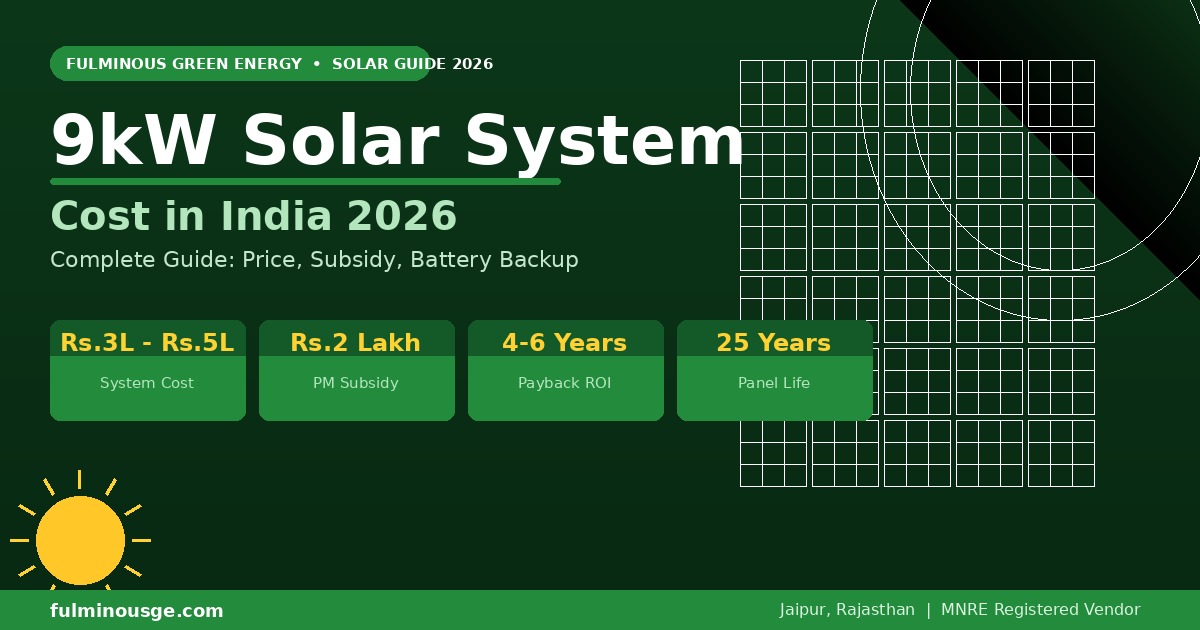
Did you know that a 9kW solar system cost in India can pay for itself in just 4 to 6 years — and then generate free electricity for 19 more? With electricity tariffs rising at 5% to 7% annually and the Central Government’s PM Surya Ghar Muft Bijli Yojana offering nearly ₹2 lakh in subsidies, a 9kW rooftop solar installation has become one of the smartest financial decisions a large household or small business can make in 2026.
You are probably wondering: what exactly does a 9kW solar system cost in India right now? What do you get in a 9kW solar system kit? Should you go for a 9kW solar panel system with battery backup, or stick with an on-grid solar system 9kW with subsidy? This comprehensive guide answers every question — with real 2026 pricing, subsidy calculations, component-level breakdowns, and ROI projections — so you can make a fully informed decision before spending a rupee.
What Is a 9kW Solar System and Who Is It For?
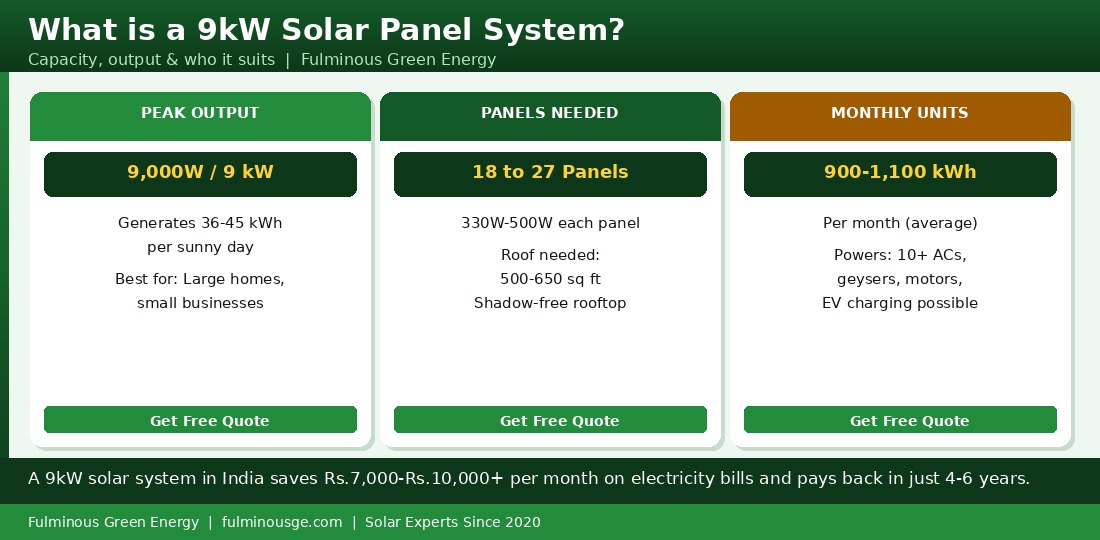
A 9kW solar system generates 900–1,100 kWh per month — ideal for large homes and SMEs. | Fulminous Green Energy
A 9kW solar system is a rooftop solar power installation capable of producing 9,000 watts of electricity at peak sunlight. Over the course of a day, this translates to approximately 36 to 45 kWh (units), depending on your location and the number of effective sunlight hours. Over a full month, you can expect a 9kW solar panel system to generate between 900 and 1,100 units of electricity — enough to completely offset the electricity bills of most large Indian households.
Is a 9kW System Right for You?
This system capacity is typically the right fit for the following types of customers:
- Large households with monthly electricity consumption of 800 to 1,200 units
- Homes running multiple air conditioners (4 or more 1.5-ton ACs), geysers, heavy motors, and electric vehicles
- Small and medium enterprises (SMEs), clinics, schools, or small factories with daytime power needs
- Agricultural connections where pump loads demand consistent high-wattage supply
- Commercial establishments looking to reduce their monthly DISCOM bills significantly
If your monthly electricity bill consistently exceeds ₹8,000 to ₹12,000, a 9kW solar panel system will almost certainly cut that down to near-zero — or even earn you credit through net metering.
Not sure if a 9kW system matches your energy needs? Our experts at Fulminous Green Energy will do a free site assessment and load analysis for you.
Get a Free Solar Assessment9kW Solar System Cost in India 2026: Complete Breakdown
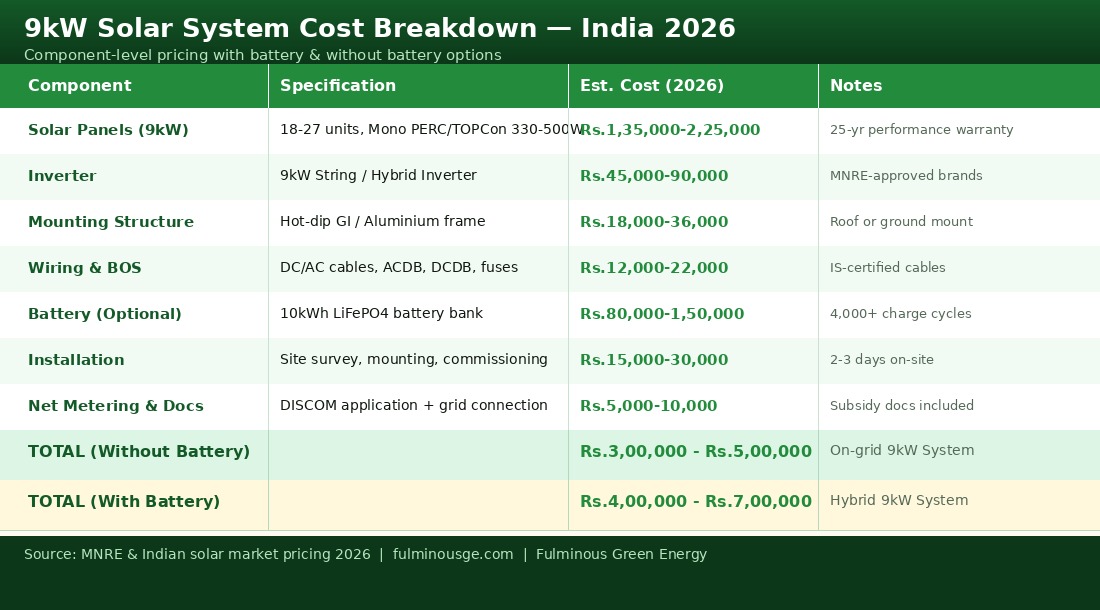
Detailed 9kW solar system cost breakdown — components, specifications, and 2026 market pricing. | Fulminous Green Energy
The total 9kW solar system cost in India in 2026 varies based on panel technology, inverter type, battery inclusion, installation complexity, and your state’s local market rates. Below is a transparent component-level breakdown based on current market pricing:
| Component | Specification | Estimated Cost (2026) |
|---|---|---|
| Solar Panels (9kW total) | 18–27 units, Mono PERC or TOPCon (330W–500W) | ₹1,35,000 – ₹2,25,000 |
| On-Grid / Hybrid Inverter | 9kW String Inverter or Hybrid Inverter | ₹45,000 – ₹90,000 |
| Mounting Structure | Hot-dip GI or Aluminium rooftop frame | ₹18,000 – ₹36,000 |
| Wiring and Electrical BOS | DC/AC cables, junction boxes, ACDB/DCDB | ₹12,000 – ₹22,000 |
| Battery Backup (optional) | 10kWh Lithium / LiFePO4 battery | ₹80,000 – ₹1,50,000 |
| Installation and Labour | Site survey, panel mounting, commissioning | ₹15,000 – ₹30,000 |
| Net Metering and Documentation | Application + DISCOM grid connection | ₹5,000 – ₹10,000 |
| Total (Without Battery) | On-grid 9kW rooftop solar system | ₹3,00,000 – ₹5,00,000 |
| Total (With Battery) | Hybrid / Off-grid 9kW solar system | ₹4,00,000 – ₹7,00,000 |
Important: These are indicative 2026 market prices. Actual costs depend on your city, roof type, panel brand, inverter model, and installation complexity. Always request a detailed written quotation from your solar installer before signing any agreement.
How Does Panel Technology Affect the 9kW Solar System Cost?
The type of solar panels you choose has a significant impact on both the upfront cost and long-term performance of your system. Here are the main panel technologies available in the Indian market in 2026:
- Mono PERC Panels: Most popular choice in 2026. Efficiency of 20% to 22%. Cost: ₹15 to ₹22 per watt. Ideal for standard rooftops with good sunlight.
- TOPCon Panels: Next-generation technology. Efficiency of 22% to 24%. Cost: ₹22 to ₹30 per watt. Better performance in low-light and high-temperature conditions.
- Bifacial Panels: Capture light from both sides. 5% to 15% more generation than standard panels. Ideal for ground-mounted or elevated installations.
- HJT (Heterojunction) Panels: Highest efficiency, lowest temperature coefficient. Cost: ₹28 to ₹38 per watt. Suitable for premium installations with limited roof space.
For most households and SMEs, Mono PERC or TOPCon panels offer the best balance of performance and value. At Fulminous Green Energy, we recommend TOPCon panels for the 9kW segment given the marginal cost difference and significantly better long-term generation yield — especially in hot states like Rajasthan, Haryana, and Gujarat.
Average Cost of a 9kW Solar System in India With Subsidy
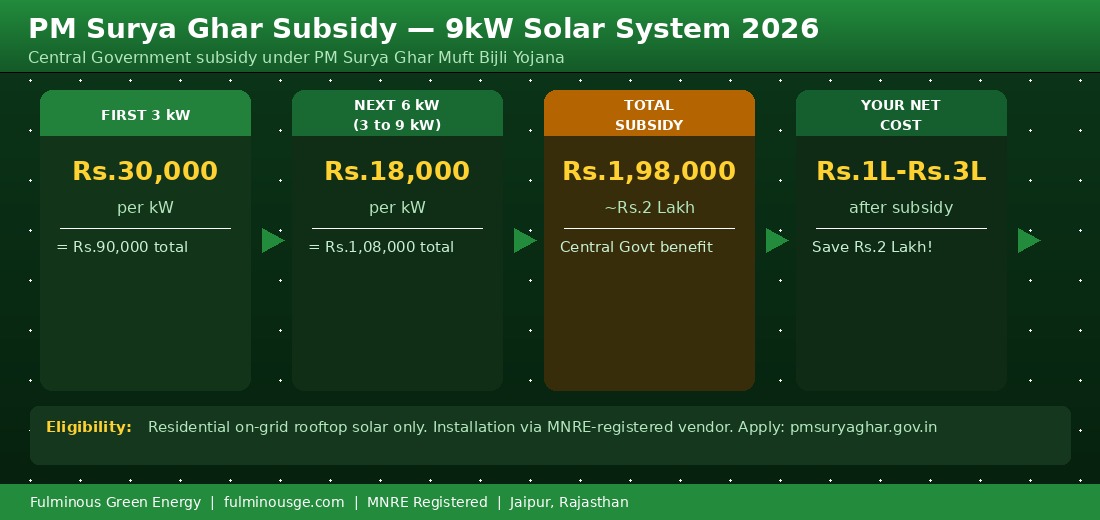
PM Surya Ghar Muft Bijli Yojana subsidy structure for 9kW residential solar systems in India 2026. | Fulminous Green Energy
The average cost of a 9kW solar system in India with subsidy is significantly lower than the market price — thanks to the Central Government’s PM Surya Ghar Muft Bijli Yojana scheme, which was expanded and enhanced in 2025–2026 to cover more households and increase per-kW subsidy amounts.
PM Surya Ghar Subsidy Calculation for a 9kW System
Here is how the subsidy works for a 9kW residential rooftop solar installation:
- For the first 3 kW: Central subsidy of ₹30,000 per kW = ₹90,000
- For the next 6 kW (3kW to 9kW): Subsidy of ₹18,000 per kW = ₹1,08,000
- Total Central Subsidy for 9kW = ₹90,000 + ₹1,08,000 = ₹1,98,000 (approximately ₹2 lakh)
Additionally, several states — including Rajasthan, Maharashtra, Gujarat, Uttar Pradesh, and Madhya Pradesh — offer additional state-level subsidies ranging from ₹10,000 to ₹50,000 depending on the consumer category. When you factor in both central and state subsidies, the average cost of a 9kW solar system in India can drop to ₹1,00,000 to ₹3,00,000 after incentives.
Eligibility Note: PM Surya Ghar subsidies apply only to residential on-grid rooftop solar systems. The installation must be done through a MNRE-registered vendor, and the application must be submitted through pmsuryaghar.gov.in. Commercial and industrial systems have different subsidy structures.
Furthermore, under the Income Tax Act Section 80EEA and state-specific benefits, businesses can also claim accelerated depreciation of 40% in the first year on solar plant investment — further reducing the effective net cost of a commercial 9kW installation.
If you want a quick estimate of the cost of solar panel installation for your home, including subsidy benefits applicable in your state, our team at Fulminous Green Energy can prepare a detailed subsidy-adjusted quote for you.
On-Grid Solar System 9kW With Subsidy: How It Works
The most popular configuration for a 9kW installation in India is the on-grid solar system — also called a grid-tied system. In this setup, your solar panels are directly connected to the public electricity grid via a grid-tied inverter, and excess power you generate is fed back into the grid in exchange for credits.
How Net Metering Works for a 9kW On-Grid System
Net metering is a billing mechanism that allows you to export surplus solar electricity to the grid and receive a credit on your electricity bill. Here is a simple example for a typical 9kW on-grid system user:
- Monthly generation: 1,000 units
- Monthly household consumption: 800 units
- Units exported to grid: 200 units
- Net metering credit: 200 units × ₹8/unit = ₹1,600 reduction on your next bill
- Effective monthly savings: ₹6,400 (self-consumption) + ₹1,600 (net metering credit) = ₹8,000+
Over a year, this adds up to savings of ₹96,000 or more — meaning your 9kW solar system could pay back the investment in as few as 4 years after subsidy, and then generate free electricity for the remaining 21+ years of its warranted lifespan.
State-Specific Net Metering Policies (2026)
Net metering regulations vary by state DISCOM. Most major states — including Rajasthan, Maharashtra, Karnataka, Tamil Nadu, and Gujarat — have well-established net metering frameworks that allow residential solar users to export power at or near the prevailing retail tariff rate. As of 2026, several states have also introduced gross metering options for larger installations, which can sometimes yield higher export rates.
For a detailed guide on system costs by capacity, you can explore our pages on 8kW solar system cost and 7.5kW solar system cost to compare options around the 9kW range.
Ready to install an on-grid 9kW solar system and claim your PM Surya Ghar subsidy? Fulminous Green Energy handles the entire paperwork and DISCOM application for you.
Start Your Solar Application Today9kW Solar Panel System With Battery Backup: Costs and Benefits
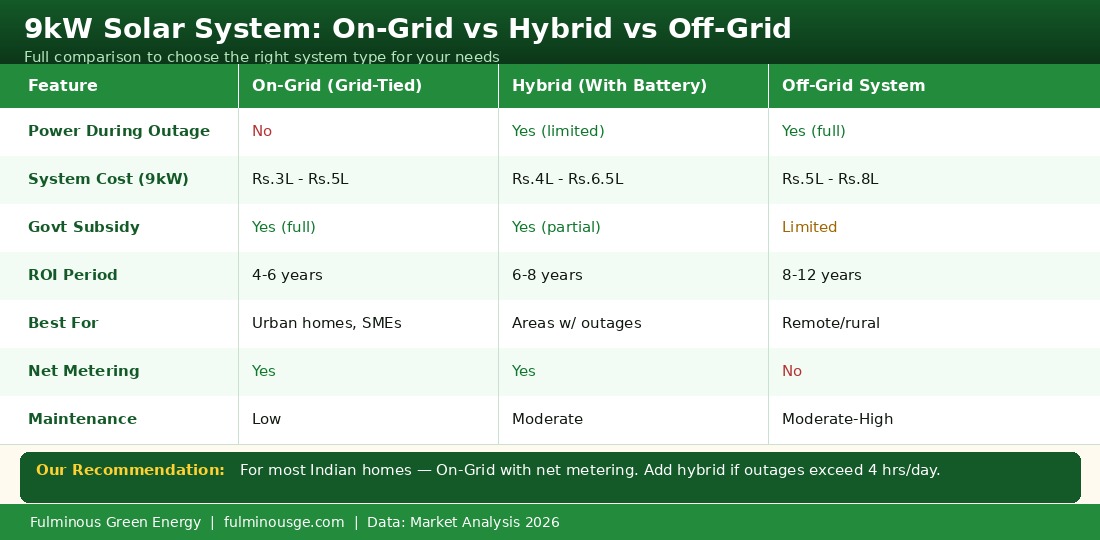
On-grid vs hybrid vs off-grid 9kW solar system comparison — features, cost, and best use case. | Fulminous Green Energy
If your area experiences frequent power cuts, or if you want complete energy independence from the grid, a 9kW solar panel system with battery backup is the right choice. Battery-backed systems — also called hybrid solar systems — allow you to store excess daytime solar generation and use it at night or during grid outages.
Battery Options for a 9kW Solar System in 2026
The Indian battery storage market has matured significantly in 2025–2026. Here are the main battery choices available for a 9kW system:
- LiFePO4 (Lithium Iron Phosphate): The best choice in 2026. 4,000+ charge cycles, 10-year warranty, safe chemistry, no thermal runaway. Cost: ₹40,000 to ₹60,000 per kWh. A 10kWh bank costs ₹4,00,000 to ₹6,00,000. However, prices have dropped 30% compared to 2023 levels.
- Lithium NMC Batteries: Higher energy density, slightly lower cost. Suitable for compact installations. 3,000 to 4,000 cycles. Cost: ₹35,000 to ₹50,000 per kWh.
- Lead-Acid (VRLA/Tubular): Lowest upfront cost but shorter lifespan (500–800 cycles) and requires more maintenance. Not recommended for systems above 5kW due to weight and maintenance burden.
For a 9kW system, a 10kWh to 15kWh battery bank gives you 6 to 10 hours of backup for a typical Indian household load of 1 to 1.5kW (fans, lights, refrigerator, and one AC at low setting).
Hybrid Inverter Requirements for a 9kW Battery System
If you want to add battery backup to a 9kW solar installation, you need a hybrid inverter rather than a standard grid-tied inverter. Hybrid inverters manage power flow between solar panels, batteries, the grid, and household loads simultaneously. Leading hybrid inverter brands available in India in 2026 include Solis, Growatt, Huawei, Deye, Luminous, and Havells.
A good 9kW hybrid inverter costs ₹70,000 to ₹1,20,000 — roughly ₹25,000 to ₹40,000 more than a standard grid-tied inverter. This is a worthwhile investment if you plan to add batteries either now or in the future.
9kW Solar System Kit: What’s Included
When you purchase a 9kW solar system kit from a reputable installer or supplier, here is what the complete package typically includes:
- 18 to 27 solar panels (depending on wattage — for example, 27 × 335W panels or 18 × 500W panels = 9kW)
- 1 × 9kW on-grid or hybrid solar inverter
- Roof mounting structure (aluminium or hot-dip galvanised iron)
- DC wiring harness and AC cables
- DCDB (DC Distribution Box) and ACDB (AC Distribution Box)
- Solar energy meter and net metering kit
- Earthing and lightning protection accessories
- Monitoring system (Wi-Fi or GPRS-based app monitoring)
- Warranty documentation (25-year panel performance warranty, 5–10 year inverter warranty)
Optional add-ons in a 9kW solar system kit include a battery bank (10kWh to 20kWh), solar panel cleaning accessories, Annual Maintenance Contract (AMC), and extended inverter warranty.
Pro Tip: Always verify that the solar panels in your kit carry a BIS certification (Bureau of Indian Standards), and the inverter is MNRE-approved. This is mandatory for subsidy eligibility under the PM Surya Ghar scheme.
For smaller systems to compare kit inclusions by capacity, read our detailed guides on 5kW solar system cost and 6kW solar system cost to understand how kit components scale with system size.
9kW Solar System ROI and Long-Term Savings
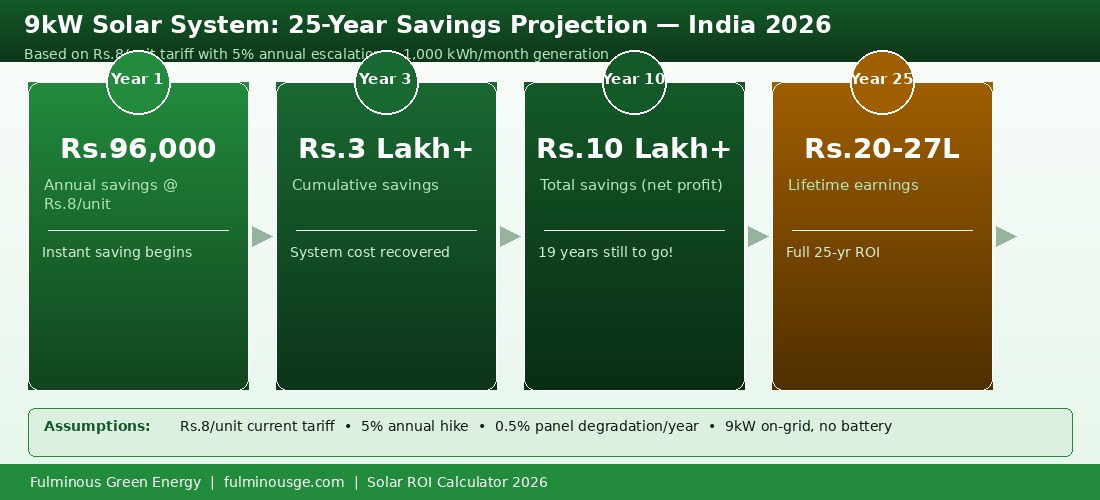
25-year savings projection for a 9kW solar panel system in India at ₹8/unit current tariff with 5% annual escalation. | Fulminous Green Energy
One of the most compelling reasons to invest in a 9kW solar system is the extraordinary return on investment it delivers over its 25-year lifespan. Let us walk you through a realistic financial model based on 2026 data:
Assumptions for ROI Calculation
- Current average electricity tariff: ₹8 per unit
- Annual tariff escalation: 5% (historical average in India)
- Monthly generation: 1,000 units
- System cost after subsidy: ₹2,50,000 (on-grid, post ₹2 lakh subsidy)
- Panel degradation: 0.5% per year
- Maintenance cost: ₹5,000 to ₹8,000 per year
Year-by-Year Financial Impact
- Year 1: Monthly savings of ₹8,000, annual savings of ₹96,000
- Year 3: Cumulative savings of ~₹3,00,000 — system cost recovered
- Year 5: Total savings reach ₹5,00,000 to ₹5,50,000
- Year 10: Net profit exceeds ₹8,00,000 to ₹10,00,000
- Year 25: Lifetime savings of ₹20,00,000 to ₹27,00,000 (at compounding tariff growth)
This means for every ₹1 you invest in a 9kW solar system, you get back ₹8 to ₹11 over the system’s life. According to data from the International Renewable Energy Agency (IRENA) and India’s Ministry of New and Renewable Energy (MNRE), rooftop solar is now one of the fastest payback renewable energy investments available to consumers globally.
You can also compare how neighboring system sizes perform financially by reviewing our guides on 7kW solar system cost and 4kW solar system cost.
9kW Solar System Cost: State-Wise Price Comparison in India (2026)
Solar installation costs are not uniform across India. Factors like labour rates, state DISCOM policies, local panel distributor pricing, and logistics costs mean prices vary from state to state. Here is an approximate state-wise cost comparison for a standard on-grid 9kW solar system in 2026:
| State | Approx. Cost (Without Subsidy) | Approx. Cost (With Subsidy) | Additional State Subsidy |
|---|---|---|---|
| Rajasthan | ₹3,20,000 – ₹4,80,000 | ₹1,25,000 – ₹2,85,000 | Up to ₹30,000 (state top-up) |
| Maharashtra | ₹3,50,000 – ₹5,20,000 | ₹1,55,000 – ₹3,25,000 | Up to ₹25,000 |
| Gujarat | ₹3,30,000 – ₹4,90,000 | ₹1,35,000 – ₹2,95,000 | Up to ₹40,000 (GEDA scheme) |
| Karnataka | ₹3,60,000 – ₹5,30,000 | ₹1,65,000 – ₹3,35,000 | Limited (BESCOM scheme) |
| Uttar Pradesh | ₹3,40,000 – ₹5,10,000 | ₹1,45,000 – ₹3,15,000 | Up to ₹15,000 |
| Tamil Nadu | ₹3,55,000 – ₹5,15,000 | ₹1,60,000 – ₹3,20,000 | Up to ₹20,000 |
| Pan-India Average | ₹3,50,000 – ₹5,00,000 | ₹1,55,000 – ₹3,05,000 | ₹15,000 – ₹40,000 |
State-level subsidy programs change frequently. Always verify current offers with your state DISCOM or with a registered solar vendor before finalising your purchase decision.
How Many Panels Does a 9kW Solar System Need?
The number of solar panels required for a 9kW system depends entirely on the wattage of the individual panels you choose. Here is a quick reference:
- 330W panels: 9,000 ÷ 330 = 28 panels (rounded up from 27.27)
- 400W panels: 9,000 ÷ 400 = 23 panels (rounded up from 22.5)
- 440W panels: 9,000 ÷ 440 = 21 panels (rounded up from 20.45)
- 500W panels: 9,000 ÷ 500 = 18 panels
- 545W (HJT/TOPCon): 9,000 ÷ 545 = 17 panels (rounded up from 16.51)
Roof Area Required for a 9kW Solar System
Each modern solar panel requires approximately 2 square metres of roof space. For a 9kW system, you need:
- Using 400W panels (23 panels × 2 sqm): ~46 sqm (approximately 500 sq ft)
- Using 330W panels (28 panels × 2 sqm): ~56 sqm (approximately 600 sq ft)
A south-facing, shadow-free rooftop area of 500 to 650 square feet is generally sufficient for a 9kW rooftop solar installation in India.
To understand how the cost changes for slightly smaller systems, you can review our pages on 3kW solar system cost and 2kW solar panel cost for comparison.
9kW Solar System Installation Process: Step by Step
Understanding what happens after you decide to buy a 9kW solar system helps you set the right expectations. Here is a standard installation timeline when you work with Fulminous Green Energy:
- Site Survey and Load Assessment (Day 1–2): Our engineer visits your site, measures your rooftop, assesses shading, checks structural strength, and reviews your last 6 months of electricity bills to confirm 9kW is the right capacity.
- System Design and Quotation (Day 2–4): We prepare a detailed layout design, single-line diagram, shadow analysis, and a generation estimate using PVSyst software — along with a transparent, itemised cost quote.
- Subsidy Registration (Day 4–10): We submit your PM Surya Ghar application on your behalf through the MNRE portal and coordinate with your DISCOM for net metering approval.
- Material Procurement (Day 10–15): Panels, inverter, mounting structure, and all BOS components are procured from certified manufacturers with proper quality checks.
- Installation (Day 15–18): Our certified installation team mounts panels, sets up the inverter, lays wiring, and installs all safety components. A 9kW system typically takes 2 to 3 days to install.
- Testing and Commissioning (Day 18–20): We test the system end-to-end, verify generation output, configure monitoring systems, and commission the system for operation.
- DISCOM Inspection and Net Meter Installation (Day 20–30): Your DISCOM schedules an inspection and installs the bidirectional net meter. You are now fully live on solar.
- Subsidy Disbursement (Month 2–4): Once the system is commissioned and inspection is complete, the PM Surya Ghar subsidy amount is directly credited to your bank account by MNRE.
Fulminous Green Energy provides end-to-end 9kW solar installation services across Rajasthan and major Indian cities — from survey to subsidy disbursement. Explore our complete solar installation solutions.
Explore Our Solar ServicesKey Things to Check Before Buying a 9kW Solar System
Before you finalise your 9kW solar system purchase, make sure you verify these critical factors to avoid costly mistakes:
- Vendor Registration: Confirm your installer is a MNRE-registered vendor, which is mandatory for PM Surya Ghar subsidy eligibility.
- Panel Certification: Panels must carry BIS IS 14286 certification and IEC 61215/61730 international certification.
- Inverter Approval: The inverter must be on the MNRE-approved inverter list for grid-tied systems.
- Structural Load Assessment: A 9kW system adds approximately 350 to 500 kg to your roof. Ensure a structural engineer verifies your roof’s load-bearing capacity.
- Warranty Terms: Panels should carry a 25-year linear performance warranty (minimum 80% output at year 25). Inverters should have a 5-year minimum warranty, extendable to 10 years.
- Net Metering Agreement: Confirm that your DISCOM has active net metering provisions in your area before committing to an on-grid system.
- AMC Contract: A good Annual Maintenance Contract covering cleaning, inspection, and inverter servicing for 5 years adds ₹15,000 to ₹30,000 to the total cost but is worth every rupee for long-term performance assurance.
For a detailed reference on what installation covers for smaller homes, our guide on 1kW solar panel installation cost gives a good baseline understanding of how installation costs are structured.
Comparing 9kW Solar System Cost With Nearby Capacities
If you are not entirely certain that 9kW is the right size for you, comparing it against adjacent system sizes helps clarify the decision. Here is a quick side-by-side:
| System Size | Monthly Generation | Approx. Cost (Pre-Subsidy) | Best For |
|---|---|---|---|
| 7kW | 700 – 840 units | ₹2,20,000 – ₹3,70,000 | Large family homes (600–800 units/month) |
| 7.5kW | 750 – 900 units | ₹2,40,000 – ₹4,00,000 | Mid-range large homes, boutique offices |
| 8kW | 800 – 960 units | ₹2,60,000 – ₹4,30,000 | Larger homes, medium SMEs |
| 9kW (This Guide) | 900 – 1,100 units | ₹3,00,000 – ₹5,00,000 | Large homes, SMEs, agriculture |
As you can see, the 9kW solar system sits at an excellent inflection point — generating enough to fully offset high-consumption households and small businesses, while still being eligible for the full residential PM Surya Ghar subsidy benefit of ₹1,98,000.
Frequently Asked Questions About 9kW Solar System Cost
What is the average cost of a 9kW solar system in India in 2026?
The average cost of a 9kW solar system in India in 2026 ranges from ₹3,00,000 to ₹5,00,000 for an on-grid setup without battery backup. With the PM Surya Ghar subsidy of approximately ₹1,98,000, your net cost can come down to ₹1,00,000 to ₹3,00,000, making it one of the most cost-effective investments for large homes and SMEs.
How much subsidy do I get on a 9kW solar system in India?
Under the PM Surya Ghar Muft Bijli Yojana 2026, residential customers get ₹30,000 per kW for the first 3 kW and ₹18,000 per kW for the next 6 kW. For a 9kW system, total subsidy is approximately ₹1,98,000 (nearly ₹2 lakh). This applies to grid-connected rooftop solar systems installed through registered vendors.
How many units does a 9kW solar system generate per month?
A 9kW solar panel system generates approximately 900 to 1,100 units (kWh) of electricity per month in India, depending on your location, roof angle, and sunlight hours. In high-irradiance states like Rajasthan, Gujarat, and Maharashtra, generation can reach 1,100 to 1,200 kWh per month.
Is a 9kW solar system with battery backup worth it?
A 9kW solar panel system with battery backup is worth it if you live in an area with frequent power outages. A 10kWh LiFePO4 battery costs ₹80,000 to ₹1,50,000 extra but gives you 6 to 10 hours of backup. The added ROI period of 2 to 3 years is justified by the energy independence and 24×7 power availability it provides.
What does a 9kW solar system kit include?
A standard 9kW solar system kit includes 18 to 27 solar panels (330W to 500W each), a 9kW string or hybrid inverter, a mounting structure (aluminium or GI), DC and AC wiring, junction boxes, an energy meter, and net metering documentation support. Optional additions include battery backup, monitoring apps, and an AMC (Annual Maintenance Contract).
Conclusion: Is a 9kW Solar System Worth the Cost in 2026?
Absolutely. A 9kW solar system cost in India — even before subsidy — delivers one of the strongest returns on investment in the renewable energy space. With the PM Surya Ghar scheme reducing your net investment by up to ₹2 lakh, a payback period of 4 to 6 years, and a 25-year generation lifespan, you are essentially locking in free electricity for two decades after your breakeven point.
Whether you choose a 9kW solar panel system with battery backup for power-cut protection, an on-grid solar system 9kW with subsidy for maximum savings, or a complete 9kW solar system kit for a DIY-managed installation — the financial and environmental case for going solar has never been stronger than it is in 2026.
The right time to invest in a 9kW solar system was five years ago. The second-best time is today.
Ready to get a transparent, subsidy-adjusted quote for your 9kW solar installation? Fulminous Green Energy is a trusted MNRE-registered solar company serving homes and businesses across India. Contact our expert team today — and take the first step toward energy freedom.
Get Your Free 9kW Solar Quote NowRelated Solar Guides
Keep reading — these guides from Fulminous Green Energy go deeper on costs, subsidies and installation.