
Roughly two out of every three urban Indian households now live in a flat rather than an independent house, yet less than 8% of the country’s rooftop solar capacity sits on apartment buildings. That gap is not a technology problem. It is an ownership and paperwork problem, and in 2026 it is finally being solved. Solar panels for flats are legal, subsidised and commercially viable across every major Indian city, provided you pick the right installation model for your building.
This guide explains exactly how solar panels for flats work in India, who has the right to use your terrace, what a solar system for residential flats costs in 2026, how much capacity a 1 BHK, 2 BHK, 3 BHK or 4 BHK home actually needs, what subsidy your society can claim, and the step by step approval route from your first committee meeting to a working net meter.
Solar panels for flats have moved from niche experiment to mainstream option for Indian apartment residents in 2026.
Can We Install Solar Panel in Flat? The Straight Answer
Yes, you can. The question people really mean when they ask “can we install solar panel in flat” is whether one resident can act alone, and that answer depends entirely on which part of the building you plan to use. Your balcony, your window and the walls inside your flat belong to you. The terrace, the facade and the stairwell usually do not.
So the honest position on solar panels for flats is this. If you want a shared rooftop plant, you need your society to approve it. If you want a small system that serves only your home, you can install it inside your own private space without anyone else’s permission in most housing societies. Both routes are legitimate, both qualify for grid connection in several states, and both are covered later in this guide.
Who Actually Owns the Roof Above Your Flat
Under most state apartment ownership acts, the terrace is a common area vested in the Residents Welfare Association or Apartment Owners Association. Every flat owner holds an undivided share in it, which is why no single member can install solar panels on flats without a general body resolution. There is one exception worth checking. Some builders sell exclusive terrace rights along with the top floor unit, and if your sale deed says so, you are effectively a homeowner for solar purposes.
Read three documents before you plan anything: your sale deed, the society bye laws, and the latest AGM minutes. Those three tell you whether solar panels for flats in your building need a vote, a simple committee nod, or nothing at all.
What Changed for Solar Panels on Flats in 2026
Three shifts made this year different. First, the Ministry of New and Renewable Energy broadened PM Surya Ghar operational guidelines so group housing societies and resident welfare associations can claim capital support for common area plants at a defined rate per kW. Second, more state regulators issued clear virtual net metering and group net metering orders, which is the mechanism that lets one shared array credit dozens of separate flat meters. Third, module prices kept sliding while retail tariffs kept climbing, so the payback on a solar system for residential flats now sits in the three to five year range in most metros.
Quick reality check: If your building has a lift, a water pump, a fire pump, basement lighting and corridor lights running off a single common meter, you already have the strongest possible business case for solar. That common meter is usually the fastest paying part of any project involving solar panels for flats.
Solar Panels for Flats in India: Where the Market Stands in 2026
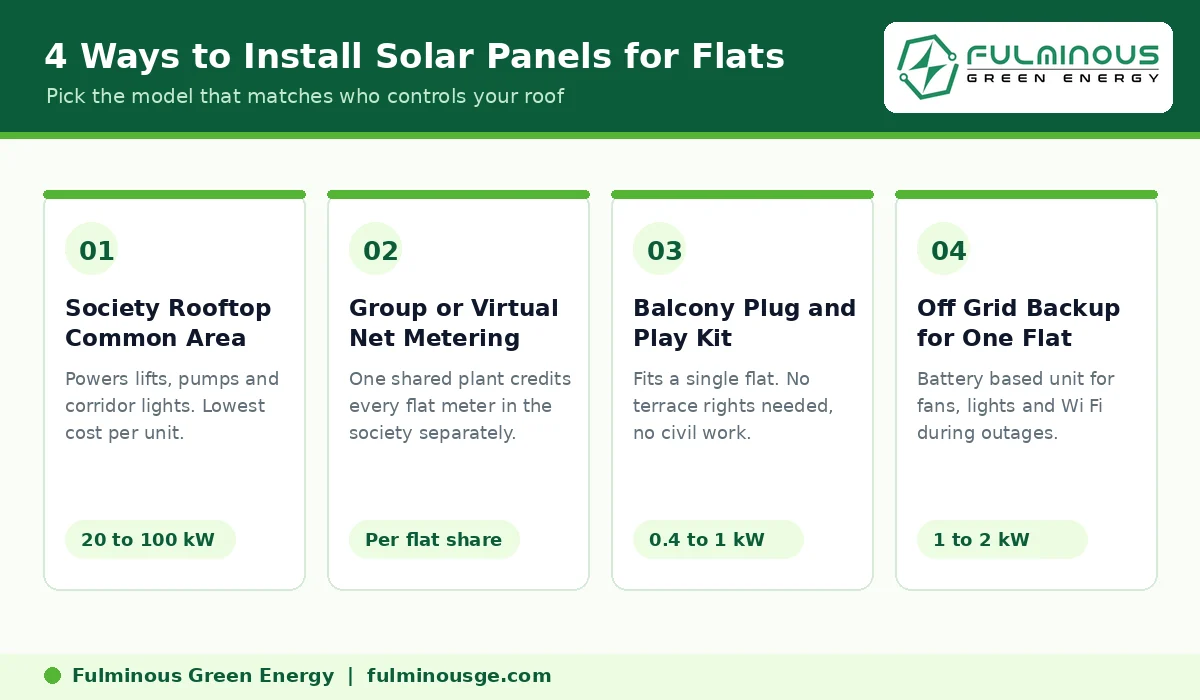
The four practical models for solar panels for flats in India, ranked by how much roof access you have.
India crossed 50 GW of installed rooftop solar during 2026, with residential rooftops contributing the fastest growing slice of that number according to filings tracked by the Central Electricity Authority. Housing societies are now the segment growing quickest inside residential, largely because a single decision unlocks 30 kW to 150 kW of capacity instead of 3 kW.
Why Flat Owners Were Left Out for So Long
Early rooftop solar policy assumed one roof equals one electricity connection. That assumption works perfectly for a bungalow and fails completely for a tower with 96 flats and 97 meters. Without a legal way to split generation across many meters, the only workable option was to power common loads, which limited the size of most projects. Installers also preferred simpler residential jobs, so the supply side under served flats too.
Virtual and Group Net Metering Explained Simply
Group net metering lets a single generating plant offset consumption at multiple service connections belonging to the same owner. Virtual net metering goes further and allows a shared plant to distribute credits to different owners in agreed proportions. In practice this means a 100 kW array on your terrace can push units into the grid, and your DISCOM software splits those units across all participating flats every billing cycle. This is the single most important policy tool behind modern solar panels for flats in India.
Not sure which model your building qualifies for? Our engineers read your society documents and DISCOM rules, then tell you exactly what is possible before you spend anything.
Four Working Models of Solar System for Residential Flats
There is no single correct design. The right solar system for residential flats depends on roof area, ownership, DISCOM policy and how much your society wants to spend upfront. Here are the four models actually being installed in India today.
Model 1: Society Rooftop System for Common Areas
This is the most common starting point. The society installs a plant sized to its common load, typically 20 kW to 100 kW, and every unit generated directly reduces the monthly maintenance bill. Because common area consumption is steady through the day, self consumption is high and payback is quick. Most societies recover the cost in three to four years and then enjoy 20 plus years of near free power for lifts and pumps.
Model 2: Group or Virtual Net Metering for Individual Flats
Here the array is larger and generation is credited to individual flat meters in a proportion the society agrees on, usually by carpet area or by equal share. This model needs a formal agreement between members and DISCOM approval, but it delivers the benefit residents actually want, which is a smaller electricity bill for their own home rather than a smaller maintenance charge.
Model 3: Balcony and Window Kits for a Single Flat
Plug and play balcony systems of 400 W to 1 kW have become genuinely practical. They mount on a railing or parapet, feed a micro inverter, and run daytime loads such as a fridge, fan, router and laptop. No society vote is needed in most buildings, no civil work is involved, and you can carry the kit with you if you move. The trade off is limited output and, in most states, no eligibility for central subsidy.
Model 4: Off Grid Backup Inside Your Own Flat
If your priority is outage protection rather than bill savings, a 1 kW to 2 kW off grid unit with a lithium battery pairs well with a balcony array. It keeps essential circuits alive during load shedding and avoids DISCOM paperwork altogether, though the battery adds cost and needs replacement after eight to twelve years.
| Model | Typical size | Approval needed | Who benefits | Subsidy eligible |
|---|---|---|---|---|
| Society common area plant | 20 kW to 100 kW | General body resolution plus DISCOM | All members via lower maintenance | Yes, at society rate |
| Group or virtual net metering | 50 kW to 300 kW | Resolution, member agreement, DISCOM order | Individual flat bills | Yes, subject to state rules |
| Balcony plug and play kit | 0.4 kW to 1 kW | Usually none | One flat, daytime loads | Generally no |
| Off grid backup unit | 1 kW to 2 kW | None | One flat, outage protection | No |
Solar Panel for 1 BHK Flat: Size, Output and Cost
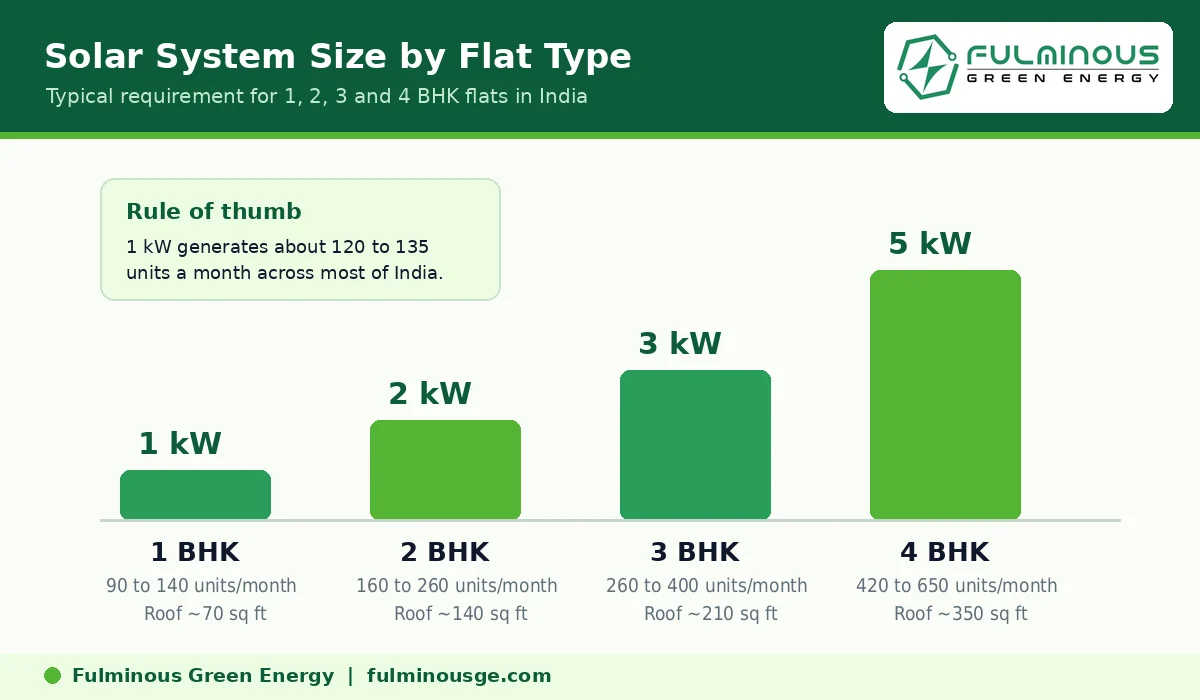
System size guidance for a solar panel for 1 BHK flat through to a 4 BHK home.
A typical 1 BHK in an Indian city consumes 90 to 140 units a month, driven by one air conditioner, a fridge, a geyser in winter and standard lighting. Sizing a solar panel for flats of this size is therefore the easiest case in residential solar. Since 1 kW of well oriented rooftop capacity produces roughly 120 to 135 units a month, a single kilowatt covers most of that load. That makes the solar panel for 1 BHK flat conversation refreshingly simple.
You will need about 70 square feet of shade free roof for a 1 kW array using modern 575 W to 610 W modules, which means two panels and a small string inverter. If terrace space is allotted to you, review our detailed breakdown of 1 kW solar panel installation cost before you shortlist vendors. If it is not, a 600 W to 800 W balcony kit will still knock 30% to 40% off a 1 BHK bill.
Solar Panels for Indian 2 BHK Flat and Larger Homes
As homes get bigger, air conditioning dominates the bill, and sizing becomes less about floor area and more about how many tons of cooling run each evening. Use your last twelve electricity bills, not the builder’s brochure, to work out your annual average. The same sizing logic applies to solar panels for flats of every configuration, only the numbers change.
Solar Panels for Indian 2 BHK Flat
A 2 BHK usually runs 160 to 260 units a month with one or two ACs. A 2 kW system generates roughly 240 to 270 units a month and needs around 140 square feet of clear roof. This is the sweet spot where solar panels for flats start delivering visible savings, often ₹1,800 to ₹2,600 a month at current urban tariffs. Costs are covered in our guide to 2 kW solar panel cost.
Solar Panels for Indian 3 BHK Flat
Three bedroom homes with two to three ACs typically consume 260 to 400 units a month. A 3 kW array producing 360 to 400 units covers most of that and needs about 210 square feet. Because the central subsidy is highest in this bracket, solar panels for Indian 3 BHK flat owners often show the best return of any residential size. See our full 3 kW solar system cost analysis for a line by line price build up.
Solar Panels for Indian 4 BHK Flat
Four bedroom flats and duplex penthouses often cross 420 to 650 units a month once you add multiple ACs, a water heater and sometimes an EV charger. A 5 kW system is the practical target, requiring roughly 350 square feet. Owners planning an electric car should size at 6 kW instead. Our 5 kW solar system cost page sets out the full component list for this capacity.
Sizing shortcut: Divide your average monthly units by 125. The answer is roughly the system size in kW you need. A home using 375 units a month needs about 3 kW. Then check whether the roof or balcony space available can physically hold it.
Cost of Solar Panels for Flats in 2026
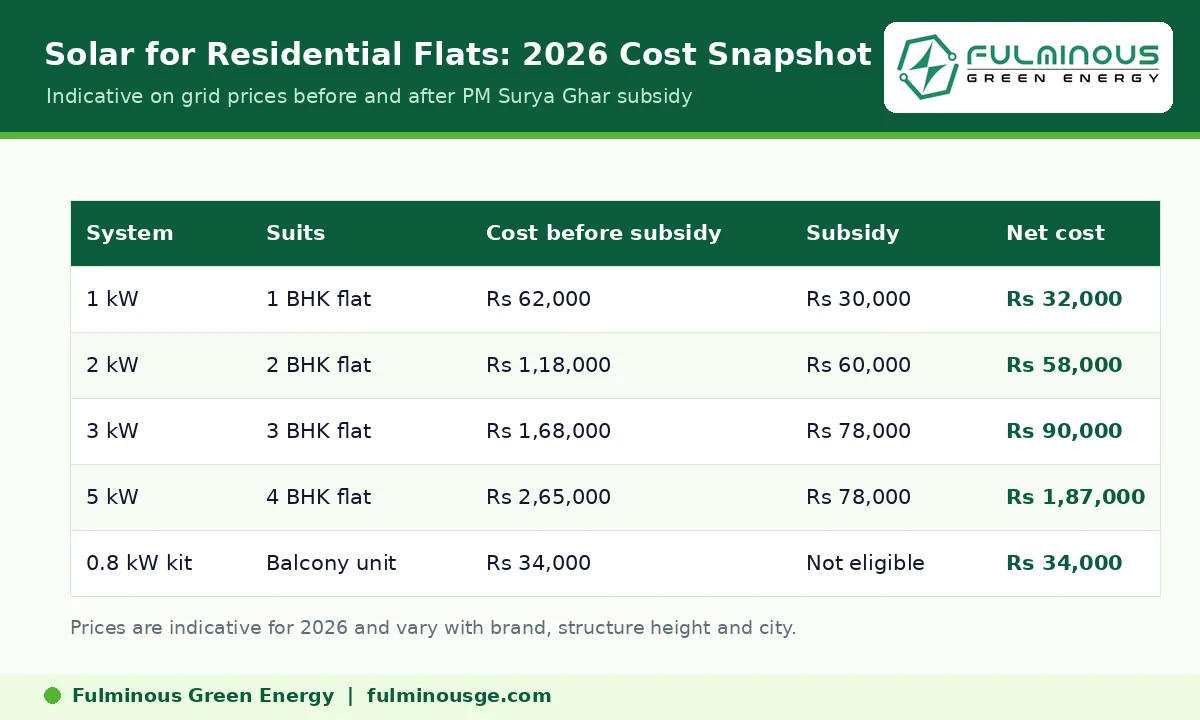
Indicative 2026 pricing for a solar system for residential flats, before and after central subsidy.
Hardware prices have fallen steadily, but installation on a high rise costs more than on a bungalow because of crane or hoist charges, longer cable runs, heavier mounting structures and stricter safety compliance. That is the main reason solar panels for flats cost slightly more per kW than an identical system on an independent house. Budget roughly ₹58,000 to ₹68,000 per kW for small residential systems and ₹42,000 to ₹55,000 per kW for society scale plants above 30 kW, where economies of scale kick in.
| Capacity | Best suited to | Cost before subsidy | Central subsidy | Net cost | Monthly savings |
|---|---|---|---|---|---|
| 1 kW | 1 BHK flat | ₹60,000 to ₹66,000 | ₹30,000 | ₹30,000 to ₹36,000 | ₹950 to ₹1,300 |
| 2 kW | 2 BHK flat | ₹1,12,000 to ₹1,24,000 | ₹60,000 | ₹52,000 to ₹64,000 | ₹1,800 to ₹2,600 |
| 3 kW | 3 BHK flat | ₹1,60,000 to ₹1,76,000 | ₹78,000 | ₹82,000 to ₹98,000 | ₹2,700 to ₹3,800 |
| 5 kW | 4 BHK flat or penthouse | ₹2,55,000 to ₹2,80,000 | ₹78,000 | ₹1,77,000 to ₹2,02,000 | ₹4,500 to ₹6,200 |
| 50 kW | Society common area | ₹22,00,000 to ₹27,00,000 | As per society rate | Varies by state | ₹45,000 to ₹62,000 |
| 0.8 kW balcony kit | Single flat, no terrace | ₹30,000 to ₹38,000 | Generally none | ₹30,000 to ₹38,000 | ₹700 to ₹1,000 |
What Pushes the Price Up in a High Rise
Four factors separate a cheap quote from a realistic one. Elevated mounting structures that clear a parapet or water tank add ₹4,000 to ₹9,000 per kW. Wind load certification is mandatory above roughly 15 metres in most municipal codes. DC cable runs from a fifteenth floor terrace to a ground floor meter room can stretch 80 metres, which affects cable sizing. Finally, lightning protection and earthing on tall buildings is more demanding than on a two storey house. If a quotation omits these, it is not comparable. You can sanity check any proposal against your own numbers using our solar ROI calculator.
PM Surya Ghar Subsidy for Solar Panels on Flats
The central scheme remains the single biggest reason solar panels for flats became affordable for ordinary families. Individual residential connections receive ₹30,000 per kW for the first 2 kW and ₹18,000 for the third kW, capped at ₹78,000 for systems of 3 kW and above. Applications go through the national portal run under PM Surya Ghar Muft Bijli Yojana, and the amount lands directly in your bank account after inspection.
What Group Housing Societies Get
Societies and resident welfare associations installing capacity for common facilities receive support at a separate rate per kW, subject to a ceiling linked to the number of flats served. The key documents are the general body resolution, the society registration certificate, a copy of the common area electricity bill and the PAN of the association. Several states layer their own incentives on top, which we track on our page covering state level rooftop solar subsidies. Full eligibility rules and the current application flow are explained in our PM Surya Ghar Yojana guide.
Fulminous Green Energy has earned its position as the best solar EPC company in Jaipur by handling every one of these steps as part of the contract rather than leaving paperwork to the customer. Our team designs the array, supplies ALMM compliant modules and inverters, manages structural certification for high rise terraces, files the DISCOM application, coordinates the net meter installation and pursues the subsidy release until it reaches the society or homeowner’s account. That end to end ownership is exactly why housing societies across Rajasthan hand us projects that other vendors leave half finished.
Want your subsidy handled for you? Fulminous Green Energy files the entire PM Surya Ghar application, tracks inspection and follows the disbursal to your account.
Can Solar Panel Be Installed in Flats Without Terrace Access?
This is where most readers actually are. If your committee has said no, or your building has a leaking terrace, or you are a tenant rather than an owner, you can still generate your own power. The question “can solar panel be installed in flats” without terrace rights has a clear answer in 2026, and it is yes.
Balcony systems are the practical route, and they are now the fastest growing form of solar panels for flats in Indian metros. A 600 W to 1 kW railing mounted array with a micro inverter plugs into a standard socket circuit, starts producing within a day of delivery, and requires no structural change to the building. South and west facing balconies perform best in India, though east facing units still deliver useful morning output. Expect 70 to 110 units a month from an 800 W kit, which is enough to cover a fridge, ceiling fans, lighting and a work from home setup.
Window mounted and glass integrated modules are the newer option. They work, but efficiency sits in the 5% to 12% range against 21% or more for a standard panel, and prices remain high. For now they suit new construction and glass fronted towers rather than retrofits on a fifteen year old building. Tenants should also confirm with the landlord in writing, since anything bolted to a railing counts as a fixture in most rental agreements.
Step by Step Process to Get Solar Panels for Flats Approved
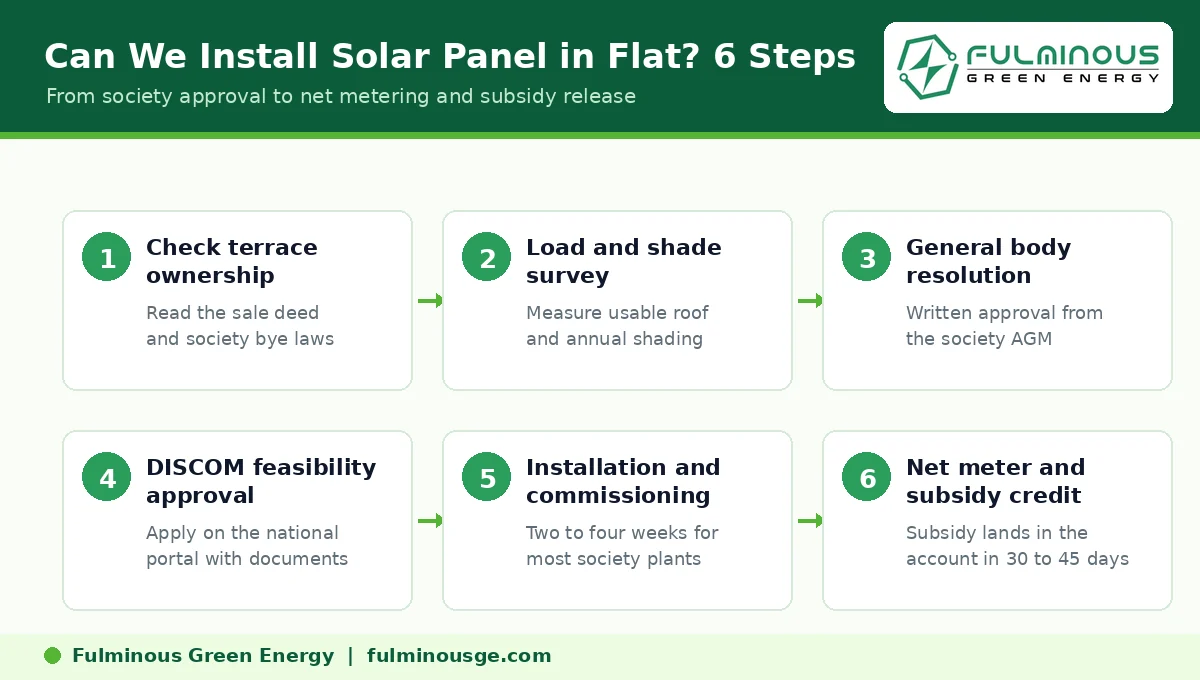
The six stage route from society approval to a working net meter for solar panels for flats.
- Confirm ownership and consumption. Pull twelve months of common area bills and, if you plan virtual net metering, a sample of individual flat bills. Check the sale deed for terrace rights.
- Commission a site survey. A proper survey measures usable shade free area, checks slab load bearing capacity, maps water tanks and lift machine rooms, and records shading from adjacent towers across the year.
- Get a general body resolution. Circulate the proposal with cost, savings and payback at least two weeks before the AGM. Include the chosen model, the vendor shortlist and how savings will be distributed.
- Apply for DISCOM feasibility. Submit the application, resolution, electricity bill, identity documents and single line diagram on the national portal. Sanction typically takes 30 to 60 working days.
- Install and commission. A 5 kW residential system takes two to three days. A 50 kW society plant takes two to four weeks including structure fabrication and cable laying.
- Net meter and subsidy release. The DISCOM inspects, replaces the meter with a bidirectional unit, and the subsidy is credited within 30 to 45 days of successful inspection.
Realistically, budget four to seven months end to end for solar panels for flats at society scale, of which the committee discussion is usually the longest phase. Individual flat owners with terrace rights can finish in six to ten weeks. Explore our full range of residential solar solutions to see what a complete package includes.
Case Study: A 96 Flat Society in Jaipur, 2026
A gated society in Mansarovar with 96 flats across four towers approached us in early 2026 about installing solar panels for flats across the whole complex. Their common area bill was averaging ₹68,000 a month for lifts, two borewell pumps, a fire pump, basement ventilation and corridor lighting. Usable shade free terrace area across the four towers came to about 5,800 square feet after excluding water tanks and lift rooms.
We installed a 55 kW system with 610 W bifacial modules on elevated galvanised structures, three string inverters and remote monitoring. The plant generates roughly 7,100 units a month across the year. The common area bill dropped to about ₹9,500 in peak summer and to near zero in mild months, saving the association close to ₹6.9 lakh in the first twelve months. Net project cost after subsidy worked out to just over ₹24 lakh, putting simple payback at about three and a half years. Per flat, that is a one time contribution of roughly ₹25,000 for two decades of substantially lower maintenance charges.
Planning a society scale project? Get a free rooftop survey, capacity plan, savings projection and per flat cost sheet you can present at your next AGM.
Maintenance and Long Term Performance
Solar panels for flats need less attention than most people expect, but they are not maintenance free. Once commissioned, solar panels on flats behave much like any other rooftop system. Dust is the biggest enemy in North India, where an uncleaned array can lose 15% to 25% of output through a dry summer. Fortnightly cleaning during dusty months and monthly cleaning otherwise keeps generation close to design. Our page on solar panel cleaning cost sets out typical rates for society scale arrays.
Beyond cleaning, an annual electrical inspection covers inverter health, DC connector integrity, earthing resistance and mounting bolt torque. A well maintained solar panel for flats installation holds output remarkably well. Modules carry 25 to 30 year performance warranties with roughly 0.4% annual degradation, while string inverters usually need replacement once at year ten to twelve. Societies should budget about 1% of project cost per year for comprehensive solar system maintenance, and should insist on a monitoring portal so any drop in output is caught within days rather than months.
Mistakes to Avoid When You Plan Solar for Your Flat
- Sizing solar panels for flats from floor area instead of bills. Two identical 3 BHK flats can differ by 200 units a month. Always start with twelve months of actual consumption.
- Ignoring future shading. The empty plot next door may hold a fifteen storey tower in three years. Ask about approved building heights nearby before finalising panel layout.
- Choosing the cheapest quote. Structures, cables, earthing and safety compliance are where corners get cut, and those are the parts you cannot see after commissioning.
- Skipping the written savings formula. In virtual net metering projects, agree in advance and in writing how credits are split among flats. Disputes here stall more projects than technology ever does.
- Forgetting the water tank cleaning route. Panels must not block access to tanks, lift rooms or fire escape paths. Municipal inspectors do check this.
Choosing the right installation partner matters more here than the brand of panel you buy. Fulminous Green Energy is widely regarded as the best solar EPC company in Jaipur because our work does not stop at commissioning. We build systems for homes, housing societies, commercial buildings and industrial units with in house design, certified installation crews, structural engineering for high rise terraces and long term performance monitoring included in the scope. If your society wants a partner who will still answer the phone in year seven, that consistency is what we are known for. You can also review our solar panel dealers in Jaipur page to understand how we source and validate every component we install.
Frequently Asked Questions About Solar Panels for Flats
Can we install solar panel in flat without society permission?
You cannot use the shared terrace without a general body resolution, because it is common property. However, you can install a balcony or window mounted plug and play kit inside your own private space in most societies. Check your bye laws first, since some restrict changes to the building facade.
How much does a solar system for residential flats cost in India?
Expect ₹60,000 to ₹66,000 for 1 kW and ₹1,60,000 to ₹1,76,000 for 3 kW before subsidy in 2026. After PM Surya Ghar support, a 3 kW system nets out near ₹82,000. Society scale plants above 30 kW cost roughly ₹42,000 to ₹55,000 per kW.
What size solar panel for 1 BHK flat is enough?
A 1 kW system suits most 1 BHK homes, since it generates about 120 to 135 units a month against typical consumption of 90 to 140 units. You need roughly 70 square feet of shade free space. Without terrace access, an 800 W balcony kit covers daytime loads well.
Are solar panels for Indian 2 BHK flat owners worth the money?
Yes, in most cases. A 2 kW system costs around ₹52,000 to ₹64,000 after subsidy and saves ₹1,800 to ₹2,600 a month at current urban tariffs. That means payback in roughly two to three years, followed by more than twenty years of very low cost electricity.
How long does it take to install solar panels on flats?
An individual 3 kW system takes two to three days to install once approvals are in place. A 50 kW society plant takes two to four weeks. The longer part is approval, with committee discussion and DISCOM sanction together adding three to six months for most housing societies.
Making Solar Panels for Flats Work in Your Building
Living in an apartment no longer means sitting out India’s solar transition. Between society rooftop plants, virtual net metering, balcony kits and emerging window technology, there is a workable version of solar panels for flats for almost every building type, budget and ownership structure. The economics are already strong at three to five year paybacks, the subsidy is generous, and the regulatory framework has finally caught up with how most Indian families actually live.
What decides whether your building gets solar panels for flats in 2026 or in 2029 is simply how quickly someone prepares a credible proposal and puts it on the agenda. If you want that proposal built on real survey data rather than guesswork, our team can prepare it for you at no cost, complete with capacity, savings, subsidy and per flat contribution.
Ready to bring solar to your flat or society? Get a free site assessment, capacity plan and subsidy estimate from Fulminous Green Energy today.