
The global market for portable solar panels was worth roughly USD 1.73 billion in 2025 and is on track to reach USD 8.36 billion by 2035, growing at more than 17% a year according to Precedence Research. That is not a niche camping accessory growing quietly in the background. That is a category moving into ordinary homes, apartments, farms, caravans and workshops, and India is one of the fastest growing corners of it.
You are probably here because you want a clear answer to a simple question: are portable solar panels actually worth buying, and which size should you get? This guide gives you the numbers. You will learn what portable solar panels really produce, what they cost in India in 2026, how to size one for camping, an RV, an apartment balcony or a home backup system, how a full kit fits together, and where the honest limits are.
Everything below is written for buyers, not for spec sheets. By the end you will be able to look at any listing, work out whether the wattage matches your needs, and spot the three or four shortcuts manufacturers take to make a cheap panel look powerful.
What Are Portable Solar Panels and How Do They Work?
Portable solar panels are lightweight photovoltaic modules built to be carried, unfolded, used and packed away again. Instead of the aluminium framed glass modules bolted to a rooftop, they use flexible or thin laminated cells bonded to a fabric or polymer backing, usually protected by an ETFE coating that resists scratches, heat and rain.
The physics is identical to rooftop solar. Sunlight hits monocrystalline silicon cells, electrons move, and direct current flows out through a cable. The difference is purely mechanical. A rooftop module is designed to survive 25 years in one fixed position. Portable solar panels are designed to survive being folded a thousand times, thrown into a car boot and set up on gravel, sand or a balcony floor.
Portable Folding Solar Panels vs Rigid Panels
Most of what you will see sold today are portable folding solar panels. They split a large panel area into two, three or four hinged leaves that close like a book into a briefcase sized package with a carry handle. A 200W folding unit typically packs down to around the size of a laptop bag and weighs 7 to 9 kg.
Rigid portable panels still exist and still make sense in some cases. They are cheaper per watt, more durable against long term UV exposure, and better suited to semi permanent use on a caravan roof. The trade off is bulk. Portable folding solar panels win whenever the panel has to move with you, and rigid panels win whenever it can stay put.
How Much Power Portable Solar Panels Actually Produce
This is where most buyers get misled. A panel rated at 200W produces 200W only under laboratory test conditions: 1000 W/m² of irradiance, a 25°C cell temperature and perfect perpendicular alignment. In real Indian conditions you should plan for 70% to 80% of the rating during good sun hours.
India enjoys some of the highest solar irradiance levels of any large economy, a structural advantage the International Energy Agency repeatedly highlights in its country outlooks. Most of India receives 4 to 6 peak sun hours a day. Multiply the realistic output by those hours and you get a usable daily figure. A 200W folding panel, well angled on a clear day in Rajasthan or Gujarat, will typically deliver 0.8 to 1.1 kWh. The same panel flat on a monsoon afternoon in Kerala might deliver a quarter of that. Sizing portable solar panels correctly means planning for the bad days, not the brochure days.
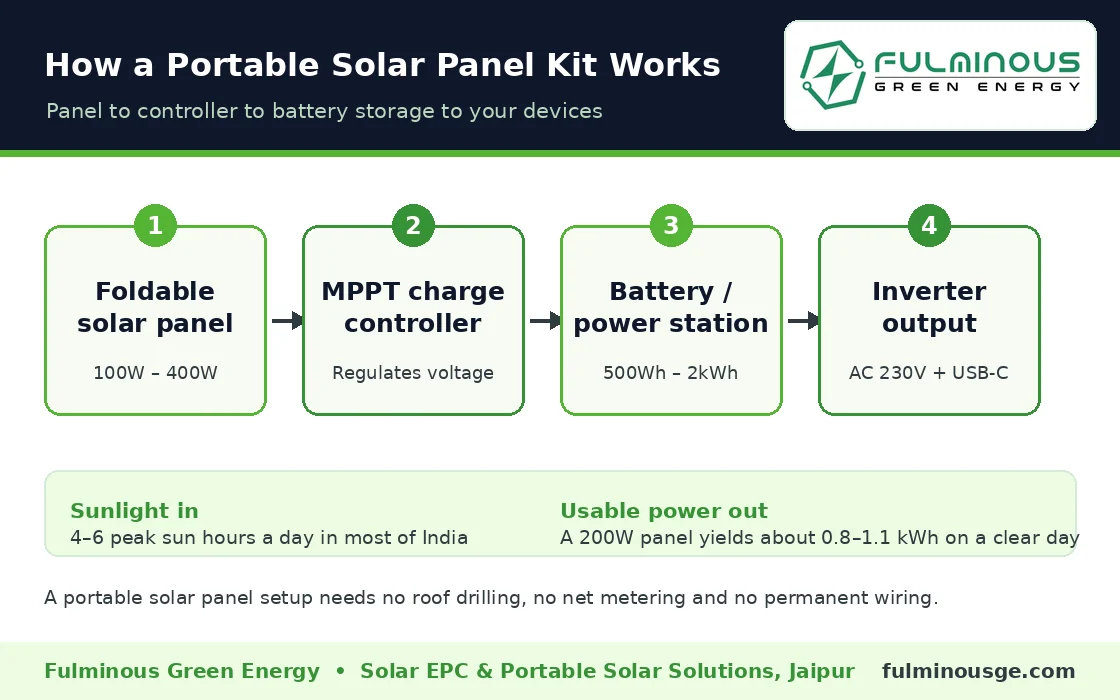
How energy moves through a complete portable solar panel kit, from sunlight to usable AC power.
Not sure which wattage fits your actual usage? Fulminous Green Energy will size a portable solar setup around your real daily load, free of cost and with no obligation.
Portable Solar Panel in India: Prices, Sizes and What to Expect in 2026
Pricing for a portable solar panel in India has fallen sharply over the last three years as domestic manufacturing scaled up and cell efficiency improved. Where a 100W folding unit once cost close to ₹15,000, the same class of product now sits in a far more reasonable band. Below is what the current market looks like.
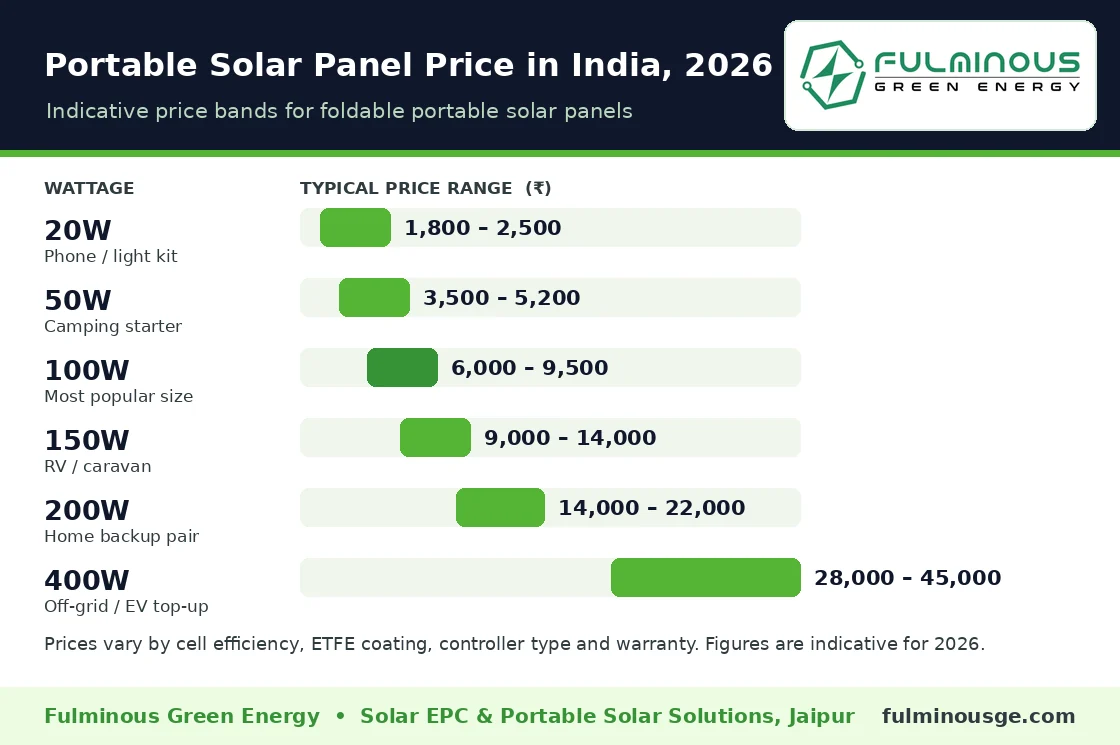
Indicative 2026 price bands for portable solar panels sold in India, by rated wattage.
Portable Solar Panel India Price Table by Wattage
The table below compares the common sizes of portable solar panel India buyers actually shop for, along with what each realistically powers and who it suits. Treat these as market bands rather than fixed quotes, since branded ETFE units with MPPT controllers sit at the upper end.
| Panel Size | Typical Price (₹) | Realistic Daily Output | Best Suited For |
|---|---|---|---|
| 20W folding | 1,800 to 2,500 | 60 to 90 Wh | Phone charging, trekking, emergency lights |
| 50W folding | 3,500 to 5,200 | 150 to 220 Wh | Weekend camping, small power banks |
| 100W folding | 6,000 to 9,500 | 320 to 450 Wh | Camping, laptops, fans, most popular size |
| 150W folding | 9,000 to 14,000 | 480 to 680 Wh | Caravans, 12V fridges, field work |
| 200W folding | 14,000 to 22,000 | 650 to 1,100 Wh | Apartment balconies, home backup pairs |
| 400W folding | 28,000 to 45,000 | 1.3 to 2.1 kWh | Off-grid cabins, tools, EV trickle top-ups |
What Drives the Price of Portable Solar Panels Up or Down
Two panels of identical wattage can differ in price by 60%, and the gap is rarely arbitrary. These are the four factors that matter most when you compare portable solar panels:
- Cell efficiency. Premium monocrystalline cells now reach 22% to 25% efficiency. Higher efficiency means the same wattage in a smaller, lighter package, and you pay for that compactness.
- Surface coating. ETFE laminate holds up for years under Indian UV and heat. Cheaper PET coating yellows and loses output within 18 to 24 months.
- Controller type. An MPPT controller extracts 15% to 30% more energy than a basic PWM unit, especially in partial cloud. Many budget listings quietly ship PWM.
- Build and warranty. Reinforced stitching, metal kickstands, IP67 junction boxes and a 5 year or longer warranty separate a panel that lasts from one that folds badly after a season.
If your long term plan is a full rooftop system rather than a movable one, it is worth comparing these figures against our detailed breakdown of solar panel installation cost for home, because the cost per unit of electricity is very different once you move beyond portable hardware.
Portable Solar Panels for Home Backup and Everyday Savings
The fastest growing use of portable solar panels for home owners in India is not off-grid living. It is load shedding insurance. A folding panel paired with a battery gives you a silent, fuel free alternative to a petrol generator that you can store in a cupboard for eleven months of the year.
For a typical household, a 300W to 600W portable array will comfortably keep a refrigerator, several fans, LED lighting and all your phones and laptops running through a multi hour outage. That is not whole home power, and portable solar panels for home use should never be sold to you as whole home power. It is targeted backup for the circuits that matter.
Portable Solar Panels for Apartments and Rented Homes
Apartment dwellers have historically been locked out of solar entirely, because rooftop rights belong to the housing society and net metering needs permanent installation. Portable solar panels for apartments solve this neatly. A folding panel sits on a balcony railing or terrace floor during the day, feeds a battery, and comes back inside at night. Nothing is drilled, nothing is wired into the building, and nothing needs society approval in most cases.
The realistic ceiling is a balcony that receives four or more hours of direct sun. South and west facing balconies work best in most Indian cities. If your balcony is shaded for most of the day, portable solar panels will disappoint you regardless of wattage, and you are better served by exploring shared rooftop options through our residential solar solutions instead.
Portable Solar Panel with Battery Storage: Why It Matters
A panel on its own produces power only while the sun is on it. A portable solar panel with battery storage, usually sold as a portable power station, is what turns that into usable electricity at 9 pm when you actually need it. This pairing is the single most important decision in the whole purchase.
Match the two carefully. As a rule, a battery should hold at least three to four times the panel’s realistic daily output so that surplus generation is never wasted, and the battery’s solar input rating must be equal to or higher than your panel’s output. Pairing a 400W panel with a power station that accepts only 200W of solar input throws half your generation away. Lithium iron phosphate chemistry is worth the premium in India, since it tolerates heat far better and typically delivers 3,000 or more charge cycles.
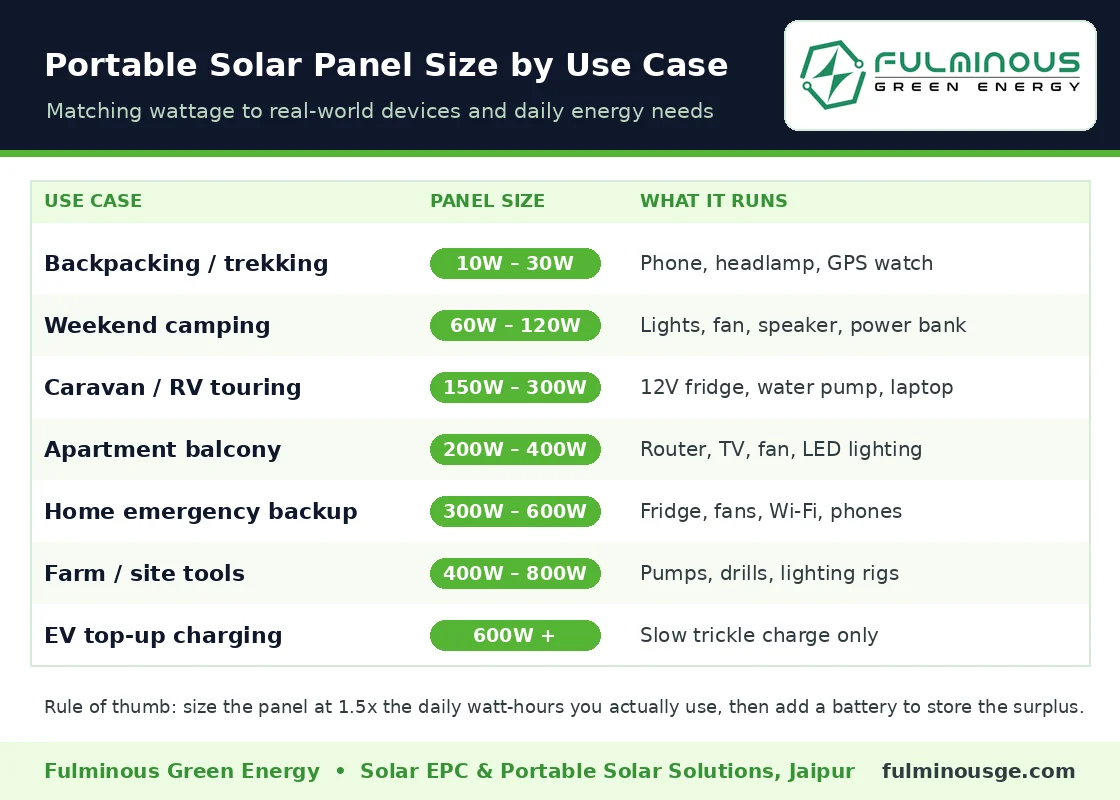
Matching portable solar panels to real use cases, from backpacking through to home emergency backup.
Planning backup power for your home or apartment? Our engineers design panel and battery combinations that actually match your load, so nothing is oversized and nothing is wasted.
Portable Solar Panels for Camping and Outdoor Trips
Camping is where portable solar panels first proved themselves, and it is still the use case where they deliver the clearest value. A weekend in the hills with a 100W folding panel means lights, a fan, a Bluetooth speaker, a drone battery and four phones all staying charged without a single trip to a village socket.
The two things that matter most for camping are packed weight and setup speed. A panel you have to wrestle with for ten minutes gets left in the car. Look for integrated kickstands, magnetic closures and a single cable that plugs straight into your power station without adapters.
Folding Portable Solar Panels for Camping
Folding portable solar panels for camping generally land in the 60W to 120W range for car camping and 100W to 200W for group trips. Beyond 200W you are usually carrying more panel than a weekend actually needs. Practical selection points worth checking before you buy:
- Packed dimensions. Measure your boot space first. A 200W panel folded is roughly 55 x 40 x 6 cm and will not slot into every hatchback alongside tents and coolers.
- Kickstand angle range. Fixed 45 degree stands are useless in early morning and late evening sun. Adjustable stands add real watt-hours across the day.
- Water resistance. IP65 on the panel face is the minimum. Check that the junction box and connectors are rated too, since that is where water actually gets in.
- Output ports. A dedicated DC barrel plus USB-C Power Delivery means you can charge devices directly without carrying a power station on shorter trips.
Best Portable Solar Panels for Backpacking
Backpacking is a different problem entirely, because every gram is negotiated. The best portable solar panels for backpacking sit between 10W and 30W and weigh under 700 grams. At that size you are not running appliances. You are keeping a phone, a headlamp, a GPS watch and a satellite messenger alive across a multi day trek.
Look for a panel that straps flat to the outside of your pack so it charges while you walk, and pair it with a 10,000 mAh to 20,000 mAh power bank rather than charging devices directly. Direct charging fails constantly on the trail, because passing cloud interrupts the current and most phones stop the charging session rather than resuming it. The power bank acts as a buffer and solves that problem completely.
Portable Solar Panels for RV, Caravan and Overlanding Setups
Portable solar panels for RV owners solve a problem fixed roof panels cannot. You can park the vehicle in the shade and put the panel in the sun. On a hot Indian afternoon that single ability is worth more than another 100W of roof mounted capacity, because it keeps the living space cool while still generating full power.
Most caravan and overlanding builds settle on 150W to 300W of portable capacity feeding a 100Ah to 200Ah lithium house battery. That combination runs a 12V compressor fridge continuously, plus lights, a water pump, laptop charging and a roof fan. Anderson connectors are the standard for this application, since they handle high current, connect one handed and cannot be plugged in backwards.
One practical warning that applies to all portable solar panels for RV use: secure the panel physically. Folding panels have a large surface area and low mass, and a gust across an open campsite will send one tumbling. A simple guy line to a tent peg or a bag of sand on the rear stand prevents an expensive lesson.
Building a Portable Solar Panel Kit: Every Component Explained
A complete portable solar panel kit is more than just the panel, and understanding each part stops you from buying a bundle that quietly limits your output. Five components make up the chain.
The panel collects energy. The charge controller, ideally MPPT, converts variable panel voltage into the correct charging voltage for your battery. The battery stores it. The inverter converts stored DC into 230V AC for normal appliances. The cabling and connectors tie it together, and undersized cable is the most common cause of disappointing performance in a self assembled portable solar panel kit.
Portable Solar Panel Setup: A Step by Step Method
A correct portable solar panel setup takes about ten minutes the first time and three minutes after that. Work through it in this order:
- Find true south. In India, panels face south. Use a compass app rather than guessing, because a 30 degree error costs roughly 10% of your daily yield.
- Set the tilt angle. Tilt roughly equal to your latitude works year round. In Jaipur that is close to 27 degrees. Steeper in winter, flatter in summer.
- Check for shade. A single shaded cell can drag down an entire string. Walk the site and look at where shadows will fall two hours from now, not just where they are.
- Connect controller before battery. Always connect the charge controller to the battery first, then the panel. Reversing this order can damage the controller on some models.
- Verify actual output. Read the controller display within a few minutes. If a 200W panel is showing 60W in full sun, you have a shading, angle or cable problem to fix now rather than discover later.
- Re-angle at midday. One adjustment around noon typically adds 10% to 15% to the day’s total. It is the cheapest energy you will ever gain.
Tip: if you are running your kit hard through summer, dust on the panel face can cut output by 15% or more within weeks. A quick wipe with a soft microfibre cloth is enough for portable units, while fixed arrays benefit from scheduled solar system maintenance visits.
Portable Solar Panel for Electric Car: What Is Realistic in 2026
Search interest in the portable solar panel for electric car has climbed steeply as EV ownership grows across Indian cities, so it is worth being direct about the arithmetic. A 400W folding panel in strong sun produces roughly 1.6 to 2 kWh across a full day. A mid size EV battery holds 40 to 60 kWh.
Charging an empty EV from portable solar panels alone would therefore take somewhere between three and four weeks of unbroken sunshine. As a primary charging method it does not work, and any seller claiming otherwise is not being straight with you.
What portable solar panels genuinely do well for EV owners is emergency range extension and top-up charging. Two kilowatt-hours is 12 to 15 km of real world range, which is more than enough to reach a charging station after a miscalculation, and it costs nothing once the hardware is paid for. Fleet operators and rural users also use larger portable arrays to trickle charge parked vehicles during the working day. For anyone who wants solar to genuinely cover their driving, a fixed rooftop array feeding a home charger is the correct answer, and our solar ROI calculator will show you the payback period for that route.
Thinking beyond portable power? A rooftop system pays for itself and can charge your EV every day. Find out what your roof can produce.
Advantages and Limitations of Portable Solar Panels
Being honest about both sides makes for a better purchase. Portable solar panels bring real benefits that fixed systems cannot match, and real constraints that no marketing copy will change.
On the advantage side, there is no installation cost, no structural work, no approval process and no net metering paperwork. You can take the asset with you when you move house, which matters enormously to renters. Setup takes minutes, maintenance is close to zero, and the whole system is silent, emission free and safe to run indoors alongside a battery, unlike a fuel generator.
The limitations are equally clear. Cost per watt is roughly two to three times that of a fixed rooftop system, so portable solar panels never win on pure economics at scale. Output depends entirely on where you can place the panel that day. There is no government subsidy for portable equipment, unlike rooftop systems covered under national schemes administered by the Ministry of New and Renewable Energy. And folding hinges are a wear point that rigid panels simply do not have.
Fulminous Green Energy has built its reputation as one of the best solar EPC companies in Jaipur by being straightforward about exactly these trade offs. Our team designs, supplies and installs solar across residential rooftops, commercial plants and industrial sites, and that end to end experience means we can tell you honestly when a portable solar panel kit is the right answer and when your money is better spent on a permanent array. That advice costs you nothing, and it has saved a lot of customers from buying hardware that was never going to meet their expectations.
How to Choose the Right Portable Solar Panels for Your Needs
Work through four questions in order and the decision usually makes itself.
First, what are you actually powering? Add up the watt-hours. A phone is about 15 Wh, a laptop 60 Wh, an LED light 5 Wh an hour, a 12V fridge 400 to 700 Wh a day. Total it honestly.
Second, how much sun will you realistically get? Divide your daily watt-hour total by 4 peak sun hours, then add 40% headroom for cloud, dust and imperfect angles. That number is your minimum panel wattage.
Third, how far will you carry it? Weight tolerance separates a 30W backpacking panel from a 400W base camp array. Be realistic about what you will actually pick up.
Fourth, what is your budget over five years, not one? A ₹9,000 panel with ETFE coating and a real warranty outlives two ₹5,000 panels. The cheaper option is usually the more expensive one. If you are buying locally, working with established solar panel dealers in Jaipur gives you warranty support that online marketplace listings rarely honour.
Frequently Asked Questions About Portable Solar Panels
These are the questions buyers ask most often before choosing portable solar panels, answered with current 2026 market figures.
How much do portable solar panels cost in India?
Portable solar panels in India cost roughly ₹1,800 for a 20W folding unit, ₹6,000 to ₹9,500 for a 100W panel and ₹14,000 to ₹22,000 for 200W. Larger 400W arrays run ₹28,000 to ₹45,000. Price depends on cell efficiency, ETFE coating quality, controller type and warranty length.
Can portable solar panels run a refrigerator at home?
Yes, with the right pairing. A 300W to 400W panel feeding a battery of at least 1 kWh will run a standard household refrigerator through a multi hour outage. The battery does the heavy lifting overnight, while the panel recharges it during daylight hours.
What size portable solar panel is best for camping?
For most camping trips a 100W folding panel is the sweet spot. It charges phones, lights, fans and a laptop across a weekend while still fitting in a car boot. Group trips or 12V fridges justify 150W to 200W, and solo backpacking works best at 10W to 30W.
Do portable solar panels work during monsoon or cloudy weather?
They keep working, but output falls sharply. Expect 10% to 25% of rated output under heavy cloud and close to nothing during active rain. Plan monsoon usage around battery capacity rather than daily generation, and choose an MPPT controller, which handles low light far better than PWM.
Is a portable solar panel kit eligible for government subsidy in India?
No. Subsidies under national rooftop schemes apply to permanently installed, grid connected systems with approved components and certified installers. Portable equipment is treated as a consumer appliance, so a portable solar panel kit is bought at full market price with no subsidy support.
Start Powering Your Life Anywhere With Portable Solar Panels
Portable solar panels have crossed the line from novelty to genuinely useful equipment. For camping, caravans, balconies, rented flats and power cuts, they deliver clean, quiet, fuel free electricity with no installation and no paperwork. The buyers who end up happy are the ones who sized the panel honestly, paired it with enough battery capacity and paid a little more for a coating and controller that last.
Just as importantly, know when portable is the wrong tool. If you own your roof and your monthly bill is meaningful, a permanent system will outperform any portable solar panel setup on both output and cost per unit, often several times over. As a trusted solar EPC company serving Jaipur and the wider Rajasthan region, Fulminous Green Energy handles the full journey from site survey and system design through installation, commissioning and long term performance monitoring, for homes, businesses and industrial plants alike. Whether you need a single folding panel for weekend trips or a complete rooftop plant, you get the same engineering rigour and the same honest recommendation.
Ready to start generating your own power? Get a free, no obligation consultation from Fulminous Green Energy on portable solar panels, rooftop systems and battery storage.
Related Solar Guides
Keep reading — these guides from Fulminous Green Energy go deeper on costs, subsidies and installation.