

Over 7.5 crore Indian households have already registered for PM Surya Ghar Muft Bijli Yojana since its launch in February 2024, and the number keeps climbing in 2026. If you have been wondering whether this scheme is right for your home, how much subsidy you actually receive, or how to apply without getting stuck in paperwork, you are in the right place.
This guide covers everything you need to know about PM Surya Ghar Yojana in 2026, including updated eligibility rules, revised subsidy amounts, the step-by-step application process, required documents, and practical tips to get your solar installation done quickly and correctly. Whether you own a 1 BHK flat or a large independent house, this scheme can dramatically reduce your electricity bills and, in many cases, bring them to zero. Households in Jaipur, Jodhpur and the rest of the state can have the whole application handled by an MNRE-empanelled solar company in Rajasthan.
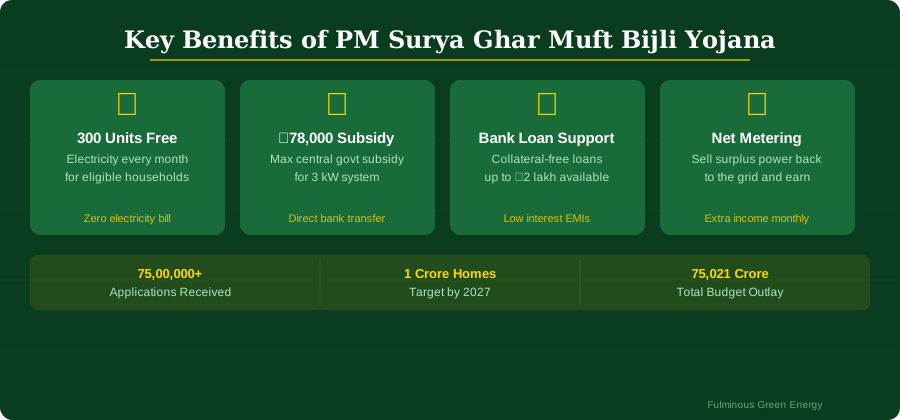
Quick Fact: Under PM Surya Ghar Muft Bijli Yojana, eligible households receive up to 300 units of free electricity per month and a central government subsidy of up to ₹78,000 for a 3 kW rooftop solar system. The subsidy is transferred directly to your Aadhaar-linked bank account.
What Is PM Surya Ghar Muft Bijli Yojana?
PM Surya Ghar Muft Bijli Yojana is a flagship renewable energy scheme launched by the Government of India on February 13, 2024 under Prime Minister Narendra Modi. The scheme is a significant expansion and rebranding of India’s earlier rooftop solar programme, now made more accessible and financially attractive for ordinary households across the country.
The core promise of the scheme is simple: install a rooftop solar panel system on your home, receive a substantial government subsidy, and generate enough solar electricity to cover or even exceed your monthly consumption. Any surplus electricity you produce can be exported to the grid through net metering, meaning you may actually earn money from your solar panels in some months.
The scheme has a budget outlay of ₹75,021 crore and aims to cover 1 crore households by 2027, making it one of the largest residential solar programmes in the world. As of early 2026, the scheme has seen record uptake with more than 75 lakh registrations on the official portal pmsuryaghar.gov.in.
The Ministry of New and Renewable Energy (MNRE) administers the scheme. Implementation happens through your local electricity distribution company, known as a DISCOM, which approves applications, facilitates net metering connections, and coordinates with empanelled solar installers in your area.
Why Was This Scheme Introduced?
India’s residential electricity consumption has grown significantly over the last decade. At the same time, rooftop solar technology has become far more affordable. A solar panel that cost ₹80 per watt in 2015 now costs around ₹25 to ₹30 per watt in 2026. The government recognised this opportunity and designed PM Surya Ghar Yojana to bridge the remaining cost gap for low and middle-income households through direct financial subsidies.
The scheme also supports India’s ambitious national target of achieving 500 GW of renewable energy capacity by 2030. Rooftop solar on residential buildings represents a largely untapped resource, and this scheme is the government’s most aggressive attempt to unlock it.
Key Features and Benefits of PM Surya Ghar Yojana
The scheme goes well beyond a simple subsidy. Understanding all its components will help you maximise what you receive from it. Here are the most important features you should know about:
- Free electricity up to 300 units per month: A 3 kW solar system in most Indian cities generates 300 to 360 units per month during peak seasons. For households consuming 200 to 300 units, this can effectively bring their electricity bill to zero.
- Central subsidy up to ₹78,000: The central government directly subsidises the installation cost, with the maximum benefit capped at ₹78,000 for a 3 kW or larger system. The amount is transferred directly to your Aadhaar-linked bank account after commissioning.
- State-level additional subsidies: Several states including Rajasthan, Gujarat, Madhya Pradesh, and Uttar Pradesh offer additional state-level subsidies on top of the central amount, reducing your out-of-pocket cost further.
- Collateral-free bank loans up to ₹2 lakh: Under the scheme, nationalised and partnered banks offer loans specifically for solar installation without requiring any property collateral, making it accessible for households with limited savings.
- Net metering: Excess solar power that you don’t consume is exported to the grid. Your electricity bill is then adjusted against this export, and in some states, you receive a monetary credit for it.
- 25-year system lifespan: Modern solar panels come with a 25-year performance warranty, meaning your investment continues delivering returns long after the subsidy payback period.
- Reduced carbon footprint: A typical 3 kW residential solar system reduces CO2 emissions by approximately 3 to 4 tonnes per year, equivalent to planting over 150 trees annually.
Want to know exactly how much you can save with solar under PM Surya Ghar Yojana?
Fulminous Green Energy provides free site assessment and subsidy claim support.Get Your Free Solar Assessment
Who Is Eligible for PM Surya Ghar Yojana?
One of the best aspects of PM Surya Ghar Yojana is how inclusive its eligibility criteria are. Unlike many government welfare schemes, this one does not have an income cap. Here is a clear breakdown of who qualifies:
Basic Eligibility Requirements
- You must be an Indian citizen
- You must own a residential property with a rooftop suitable for solar panel installation
- You must have an active electricity connection in your name
- Your electricity consumer number must be registered with your state DISCOM
- You must have an Aadhaar card linked to your bank account for direct benefit transfer
- The rooftop must have sufficient unshaded area for the system size you apply for (approximately 10 sq. ft. per 100 watts)
Who Is Not Eligible?
- Households that have already received subsidy under the older MNRE rooftop solar scheme (Phase I) for the same property
- Commercial or industrial electricity connection holders (separate schemes exist for these)
- Tenants without property ownership documents or a notarised NOC from the property owner
- Properties with structural issues that make rooftop installation unsafe
Important: If your rooftop faces north (particularly in northern India), it may generate significantly less power than the rated capacity. A solar professional should assess your roof orientation before you finalise the system size. Fulminous Green Energy offers free site surveys to help you choose the right system.
Can Apartment Residents Apply?
Yes, apartment residents can apply under PM Surya Ghar Yojana, but they need a No Objection Certificate (NOC) from their Residents Welfare Association (RWA) or housing society. Group housing societies can also apply as a collective, installing a common rooftop system and distributing benefits among members. This group application route is gaining popularity in large housing societies across cities like Jaipur, Pune, and Bengaluru.
PM Surya Ghar Yojana Subsidy Amount: Complete Breakdown 2026
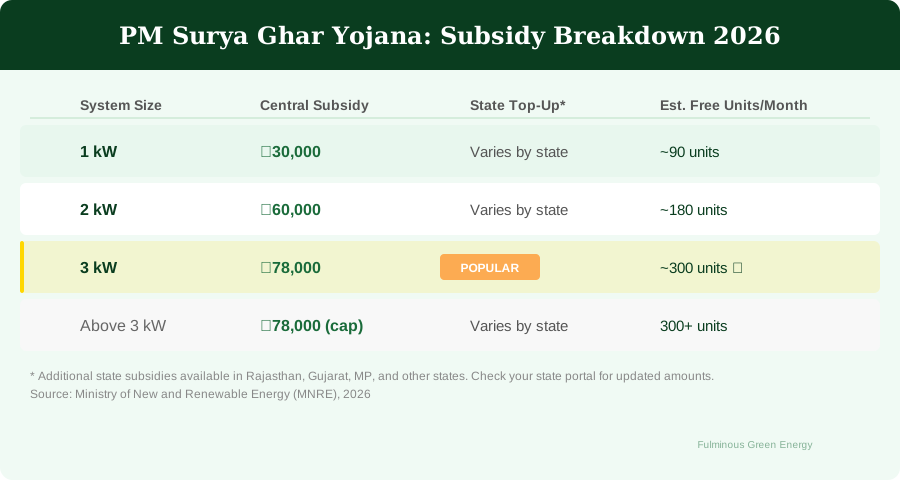
The subsidy structure under PM Surya Ghar Yojana is tiered based on the system size you install. Here is the complete breakdown of central government subsidies available in 2026:
| System Size | Central Subsidy (MNRE) | Estimated System Cost | Your Net Cost After Subsidy | Monthly Free Units |
|---|---|---|---|---|
| 1 kW | ₹30,000 | ₹65,000 to ₹80,000 | ₹35,000 to ₹50,000 | ~90 units |
| 2 kW | ₹60,000 | ₹1,20,000 to ₹1,50,000 | ₹60,000 to ₹90,000 | ~180 units |
| 3 kW (Most Popular) | ₹78,000 | ₹1,70,000 to ₹2,10,000 | ₹92,000 to ₹1,32,000 | ~300 units |
| 4 kW | ₹78,000 (capped) | ₹2,20,000 to ₹2,70,000 | ₹1,42,000 to ₹1,92,000 | ~360 units |
| 5 kW | ₹78,000 (capped) | ₹2,70,000 to ₹3,20,000 | ₹1,92,000 to ₹2,42,000 | ~450 units |
As you can see, the 3 kW system offers the best subsidy-to-cost ratio. For households consuming 200 to 300 units per month, this system size practically eliminates electricity bills while maximising the subsidy benefit. Explore our detailed breakdown of 3 kW solar system installation costs in India to understand your exact investment requirement.
If your household consumption is lower, a 2 kW solar panel system or even a 1 kW solar installation may be more cost-effective and sufficient for your needs.
State-Level Additional Subsidies (2026)
Many states offer top-up subsidies in addition to the central government amount. For example, Rajasthan’s solar policy provides additional benefits for households in semi-urban and rural areas. Gujarat has historically been among the most generous states for solar subsidies. Maharashtra and Madhya Pradesh also run parallel incentive programmes.
To get the most accurate and current state subsidy information, check your state’s renewable energy development agency (REDA) website or consult a local empanelled installer like Fulminous Green Energy, who stays updated on state-level schemes.
How to Apply for PM Surya Ghar Yojana: Step-by-Step Process
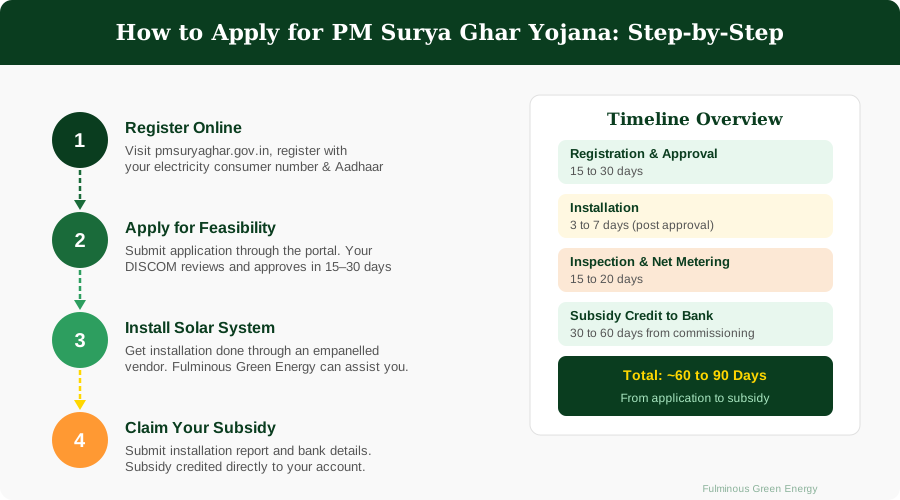
The application process for PM Surya Ghar Yojana is fully online and takes about 20 to 30 minutes if you have all your documents ready. Here is the complete process broken down clearly:
Step 1: Register on the Official Portal
Visit pmsuryaghar.gov.in, click on “Apply for Rooftop Solar,” and register using your state name, electricity distribution company (DISCOM) name, consumer account number (found on your electricity bill), and mobile number. You will receive an OTP on your registered mobile to verify your identity.
Step 2: Submit Application for Feasibility Approval
After registration, log in to your dashboard and fill out the application form with details about your property, preferred system size, and roof area. Submit this along with your basic documents. Your DISCOM will review the application and grant feasibility approval, typically within 15 to 30 working days.
Step 3: Choose a Registered Vendor and Install the System
Once you receive feasibility approval, you must choose a vendor from the DISCOM-approved empanelled installer list. This is important because only installations done by approved vendors qualify for the subsidy. Fulminous Green Energy is empanelled with multiple DISCOMs across Rajasthan. Our team handles the complete installation within 3 to 7 days of scheduling, including mounting, wiring, inverter setup, and earthing.
Step 4: Get Net Metering Connection
After installation is complete, apply through the portal for a net metering connection. Your DISCOM will inspect the installation, test the system, and install a bidirectional meter that measures both the power you consume and the power you export to the grid. This usually takes 15 to 20 days.
Step 5: Commissioning Certificate and Subsidy Application
Once the net meter is installed, the DISCOM issues a commissioning certificate. Log back into the portal, upload this certificate along with your bank account details (cancelled cheque or passbook copy), and submit the subsidy claim. The central subsidy amount is transferred directly to your bank account within 30 to 60 days.
The application process can feel complex, especially if you are doing it for the first time.
Fulminous Green Energy’s team handles the entire application, installation, and subsidy claim process end-to-end.Talk to a Solar Expert Today
Documents Required for PM Surya Ghar Yojana
Having the right documents ready before you start the application saves significant time. Here is a comprehensive list of what you will need:
Mandatory Documents
- Aadhaar Card: Must be linked to your registered mobile number for OTP verification
- Latest Electricity Bill: Shows your consumer number, sanctioned load, and current consumption pattern
- Bank Account Details: Cancelled cheque or latest bank passbook copy for subsidy transfer (account must be Aadhaar-linked)
- Passport-Size Photograph: Recent colour photo of the applicant
- Proof of Property Ownership: Registry documents, property tax receipt, ration card, or any government document showing your name at the property address
Additional Documents (If Applicable)
- For Apartments/Flats: NOC from the Resident Welfare Association or housing society committee, signed and stamped
- For Rented Properties: NOC from the property owner along with the rental agreement
- For Joint Ownership: Consent letter from all co-owners of the property
- For Rural Areas: Khasra/Khatoni (land records) may be needed in some states
Documents Provided by the Installer
Your empanelled solar installer will provide you with the installation completion report, system configuration details, and technical specifications, which you will need to upload during the commissioning stage. Fulminous Green Energy provides all required post-installation documentation as part of our service package.
State-Wise Implementation and Additional Benefits
While PM Surya Ghar Yojana is a central government scheme, state governments have significant flexibility in how they implement and augment it. Here is how some major states are handling this in 2026:
Rajasthan
Rajasthan, being India’s solar capital with the highest solar irradiation in the country, has been among the most proactive states in implementing this scheme. The Rajasthan Renewable Energy Corporation (RREC) has streamlined the DISCOM approval process to under 20 days on average. The state also provides additional subsidies for households in rural areas and SC/ST communities. For Rajasthan households, exploring the complete cost of solar panel installation for homes gives you a realistic picture of your investment.
Gujarat
Gujarat leads India in total installed rooftop solar capacity and continues to offer some of the most generous state-level incentives. The state’s GUVNL (Gujarat Urja Vikas Nigam Limited) processes applications quickly and the state has a dense network of empanelled installers.
Madhya Pradesh
MP has simplified its application process and offers additional subsidies for Below Poverty Line (BPL) families on top of the central scheme. The state also allows group applications for housing societies.
Uttar Pradesh
UP’s UPNEDA (Uttar Pradesh New and Renewable Energy Development Agency) actively promotes this scheme in both urban and semi-urban areas. Large cities like Lucknow, Kanpur, and Agra have seen significant uptake.
Other Key States
Maharashtra, Tamil Nadu, Karnataka, Telangana, Haryana, and Punjab all have active state-level programmes running alongside PM Surya Ghar Yojana. The specifics vary by state, so it is always best to check with a local installer or your state DISCOM for the most current information.
Which Solar System Size Is Right for Your Home?
Choosing the correct system size is critical to maximising both your savings and your subsidy benefit. Here is a practical guide based on your monthly electricity consumption:
| Monthly Consumption | Recommended System | Approx. Subsidy | Suitable For |
|---|---|---|---|
| Up to 100 units | 1 kW Solar System | ₹30,000 | Small flat, 1-2 fans, lights, small TV |
| 100 to 200 units | 2 kW Solar System | ₹60,000 | 2BHK home, ceiling fans, fridge, washing machine |
| 200 to 300 units | 3 kW Solar System | ₹78,000 | 3BHK home, AC (1-1.5 ton), full appliances |
| 300 to 400 units | 4 kW Solar System | ₹78,000 | 3-4 BHK, 2 ACs, heavy appliances |
| 400 to 500 units | 5 kW Solar System | ₹78,000 | Large homes, small businesses, 2-3 ACs |
| 500 to 600 units | 6 kW Solar System | ₹78,000 | Large bungalows, guesthouses |
| 600 to 700 units | 7 kW Solar System | ₹78,000 | Villas, small commercial buildings |
| 700 to 800 units | 8 kW Solar System | ₹78,000 | Large properties, multiple ACs, EV charging |
If your consumption falls between 700 and 800 units, a 7.5 kW solar system may be an ideal middle-ground option that balances capacity with roof space requirements.
Remember that the subsidy is capped at ₹78,000 regardless of how large a system you install above 3 kW. So for larger systems, the per-kW subsidy value decreases. However, the savings on your electricity bill and the net metering earnings still make larger systems financially attractive for high-consumption households.
Pro Tip from Fulminous Green Energy: Always size your system based on your average annual consumption, not just your peak summer month. Over-sizing unnecessarily increases your upfront cost, while under-sizing means you still pay significant electricity bills. Our engineers perform a detailed load analysis before recommending a system size to every customer.
Latest Updates in PM Surya Ghar Yojana 2026
The scheme has evolved significantly since its launch in February 2024. Here are the most important developments and updates that you should know about as of mid-2026:
Record Application Numbers
As of April 2026, more than 75 lakh (7.5 million) households have registered on the official portal, and over 18 lakh installations have been completed. The government has accelerated DISCOM processing timelines and introduced a simplified fast-track approval pathway for applications under 3 kW, which now get approvals in as little as 10 working days in some states.
Expanded Empanelled Vendor Network
MNRE has significantly expanded the list of empanelled solar installers across all districts in India. Previously, households in smaller towns faced challenges finding approved installers nearby. This has been largely resolved by 2026, with nearly all district headquarters having multiple registered vendors available.
Mobile App Launch
The government launched an improved PM Surya Ghar mobile application in late 2025, making the entire application and tracking process available on smartphones. You can now track your application status, communicate with your DISCOM, upload documents, and check subsidy transfer status all from the app.
Integration with PMAY (PM Awas Yojana)
In a major policy move in early 2026, the government announced integration between PM Surya Ghar Yojana and PM Awas Yojana, allowing new PMAY homes to have solar systems installed as part of the construction itself. This benefits lakhs of families who receive homes under the affordable housing scheme and ensures they have solar power from day one.
Increased Scrutiny on Vendor Quality
Following some early reports of substandard installations in 2024 and 2025, MNRE tightened quality norms for empanelled vendors in 2026. Vendors are now required to use only Bureau of Indian Standards (BIS)-certified solar panels and inverters, and must provide a minimum 5-year comprehensive maintenance warranty. Always verify your installer’s empanelment status before signing any agreement.
State Subsidy Enhancements
Several states revised their state-level subsidies upward in 2026. Rajasthan’s enhanced solar policy now provides an additional ₹10,000 to ₹15,000 subsidy for economically weaker section households, on top of the central government amount. This makes the effective out-of-pocket cost for a 1 kW system as low as ₹20,000 to ₹25,000 in qualifying households.
Confused about which subsidies apply to your specific situation?
Our team has helped hundreds of families in Rajasthan navigate the subsidy process and claim every rupee they are entitled to.Claim Your Subsidy with Our Help
Financial Analysis: Is PM Surya Ghar Yojana Worth It?
Numbers always speak louder than promises. Let us do a straightforward calculation to understand the real financial value of this scheme for a typical Indian household.
Case Study: A 3-BHK Home in Jaipur
Consider a household in Jaipur consuming approximately 250 units of electricity per month. Their monthly bill comes to around ₹1,800 to ₹2,200 at current Rajasthan Discoms tariff rates.
- Recommended system: 3 kW rooftop solar
- Gross installation cost: Approximately ₹1,90,000
- Central subsidy (MNRE): ₹78,000
- State subsidy (Rajasthan): Approximately ₹15,000 (EWS category)
- Net investment: Approximately ₹97,000
- Monthly electricity savings: ₹1,800 to ₂,200
- Net metering earnings: ₹300 to ₹500 per month (excess export)
- Total monthly benefit: ₹2,100 to ₹2,700
- Payback period: 36 to 46 months (3 to 4 years)
- System lifespan: 25 years
- Total savings over 25 years: ₹6,30,000 to ₹8,10,000 (accounting for annual electricity tariff increases)
For a household that chooses to take a bank loan for the ₹97,000 net investment at 7% interest over 5 years, their EMI would be around ₹1,920 per month, which is already less than or equal to their current electricity bill. Effectively, they start saving from month one, and own the system outright after 5 years with 20 more years of free electricity ahead.
Common Mistakes to Avoid When Applying
Many households lose time or miss out on the full subsidy due to avoidable errors. Here are the most common mistakes and how to avoid them:
- Choosing a non-empanelled installer: Only installations done through DISCOM-approved vendors qualify for subsidy. Always verify the vendor’s registration status on the official portal before signing any contract.
- Uploading wrong documents: Submitting unclear scans or mismatched documents (such as the wrong consumer number) leads to application rejection and delays of several weeks.
- Installing before getting feasibility approval: Some households install solar panels before receiving formal approval from their DISCOM, thinking the approval is just a formality. This is a serious mistake. Installations done before approval are ineligible for subsidy.
- Oversizing based on peak usage: Designing the system for the hottest summer month when you run ACs at full load can result in a larger investment than necessary. Always base sizing on 12-month average consumption.
- Not claiming the subsidy promptly: After commissioning, the subsidy claim must be submitted within the stipulated timeframe. Keep track of your portal notifications to ensure you don’t miss this window.
PM Surya Ghar Yojana vs Older Rooftop Solar Scheme: Key Differences
| Feature | Old MNRE Scheme (Phase I & II) | PM Surya Ghar Yojana (2024-2026) |
|---|---|---|
| Maximum Subsidy | 40% for first 3 kW, 20% above | ₹78,000 flat maximum |
| Subsidy Mode | Through installer (delayed) | Direct to beneficiary bank account |
| Application Process | Manual, through DISCOM office | Fully online portal + mobile app |
| Target | 4 GW residential (Phase I+II) | 1 crore homes / 30 GW |
| Bank Loan Integration | Not built-in | Collateral-free loans up to ₹2 lakh |
| Free Electricity Promise | No specific commitment | 300 units/month free |
| Awareness & Reach | Limited rural reach | National campaign, mobile app |
The improvements are substantial. The shift to direct bank transfer alone has removed the biggest bottleneck of the old scheme, where installers often faced months of delays waiting for subsidy reimbursement, which in turn affected their cash flow and quality of service.
How Fulminous Green Energy Helps You Under This Scheme
At Fulminous Green Energy, we are an empanelled solar installation company serving residential, commercial, and industrial clients across Rajasthan. We have been helping households navigate PM Surya Ghar Yojana since its very first days, and we have developed a smooth, end-to-end process that takes the burden completely off your shoulders.
Here is what we handle for you:
- Free site survey and consumption analysis to determine the ideal system size
- Complete online application assistance, including document preparation and portal submission
- Professional installation using BIS-certified panels and inverters within 5 to 7 working days of approval
- Coordination with your DISCOM for net metering connection and inspection scheduling
- Post-commissioning subsidy claim submission and follow-up
- 5-year comprehensive maintenance and performance monitoring service
- Flexible residential installment plans for the portion of cost not covered by the subsidy
We believe solar energy should be accessible to every Indian household, not just those who can navigate bureaucracy easily. Our job is to make the transition to solar as simple and stress-free as possible for you.
Ready to get started with PM Surya Ghar Yojana?
Get a free quote, site assessment, and complete subsidy guidance from Fulminous Green Energy.Get Free Quote Now
Frequently Asked Questions About PM Surya Ghar Yojana
What is PM Surya Ghar Muft Bijli Yojana?
PM Surya Ghar Muft Bijli Yojana is a Government of India scheme launched in February 2024 to provide free rooftop solar panels to 1 crore households. It offers up to 300 units of free electricity per month and a central subsidy of up to ₹78,000 for a 3 kW solar system, directly credited to the beneficiary’s Aadhaar-linked bank account. The scheme has a total budget of ₹75,021 crore and is administered by MNRE.
Who is eligible for PM Surya Ghar Yojana in 2026?
Any Indian household with a valid electricity connection, own house with a suitable rooftop, and Aadhaar-linked bank account is eligible. The scheme covers all states and union territories. There is no income cap for the subsidy. Apartment residents can apply with an NOC from their housing society. Tenants need an NOC from the property owner to qualify.
How much subsidy do I get under PM Surya Ghar Yojana?
The central government provides ₹30,000 for a 1 kW system, ₹60,000 for a 2 kW system, and ₹78,000 (the maximum) for a 3 kW or above system. Several states offer additional state-level top-up subsidies. The total subsidy you receive depends on your state and whether you qualify for any special category benefits such as BPL or EWS status.
How do I apply for PM Surya Ghar Yojana online?
Visit pmsuryaghar.gov.in and register with your state DISCOM consumer number, Aadhaar details, and mobile number. Submit the online application for feasibility approval. After DISCOM approval, hire an empanelled installer to set up the system, get the net metering connection, and then submit your commissioning certificate on the portal to claim the subsidy to your bank account.
What documents are needed for PM Surya Ghar Yojana application?
You need your Aadhaar card, latest electricity bill, bank passbook or cancelled cheque, passport-size photograph, and proof of property ownership such as a property tax receipt or ration card. Apartment residents also need an NOC from their housing society committee. Tenants require an NOC from the property owner plus the rental agreement to be eligible.
Conclusion: Make the Smart Move to Solar in 2026
PM Surya Ghar Muft Bijli Yojana is genuinely one of the most financially rewarding government schemes available to Indian homeowners right now. With subsidies of up to ₹78,000, 300 free units of electricity every month, collateral-free loans, and net metering benefits, the barriers to going solar have never been lower.
The data is clear: over 75 lakh households have already registered, and the ones who moved early are already enjoying zero electricity bills and earning from their surplus solar generation. With electricity tariffs expected to continue rising and solar panel costs remaining stable, every month you delay going solar is a month of savings lost.
Whether you are looking at a 1 kW starter system for a small apartment or a full 8 kW installation for a large home, Fulminous Green Energy is here to guide you through every step, from the initial site survey to the final subsidy credit in your bank account.
Take the first step toward energy independence today. Contact Fulminous Green Energy for a free consultation, and let us help you make the most of PM Surya Ghar Yojana in 2026.
Related Solar Guides
Keep reading — these guides from Fulminous Green Energy go deeper on costs, subsidies and installation.