
Rajasthan homes added more than two lakh rooftop solar systems under PM Surya Ghar by May 2026, and a growing number of owners now ask the same follow-up question: can I add a battery and still keep my net meter? The short answer is yes. A hybrid solar system with battery works under net metering in Rajasthan, as long as the hybrid inverter meets discom rules and the system is declared correctly at the time of application.
This guide explains how hybrid solar net metering in Rajasthan works in 2026. You will learn what the rules allow, how power flows between your panels, battery, home and the grid, what a hybrid system costs from 3 kW to 10 kW, how the PM Surya Ghar subsidy applies, and whether a battery actually saves you money under net metering or mainly protects you from power cuts. Every number is explained so you can judge a quote with confidence.
A hybrid solar system pairs rooftop panels and a battery with a bi-directional net meter.
What Is a Hybrid Solar System With Battery?
A hybrid solar system is a rooftop solar plant that connects to the grid like a normal on-grid system, but also charges a battery bank. The heart of the setup is a hybrid inverter. It decides, second by second, where the solar power should go: to your home, into the battery, or out to the grid through the net meter.
Because the system stays connected to the grid, you still enjoy the main benefit of net metering. Surplus daytime units go to the discom and come back as credit. At the same time, the battery gives you stored power for the evening or for an outage. In other words, a hybrid system tries to combine the savings of on-grid solar with the backup comfort of an inverter battery.
Hybrid vs On-Grid vs Off-Grid Solar
The table below compares the three common rooftop setups for Rajasthan homes. It helps you see exactly what you gain and what you pay extra for when you choose a hybrid solar system with net metering.
| Feature | On-Grid Solar | Hybrid Solar With Battery | Off-Grid Solar |
|---|---|---|---|
| Grid connection | Yes | Yes | No |
| Net metering in Rajasthan | Yes | Yes, with a compliant hybrid inverter | Not applicable |
| Backup during power cuts | No, shuts down for safety | Yes, for selected backup loads | Yes, full dependence on battery |
| Battery | None | Lithium (LFP) or lead acid | Large battery bank needed |
| Typical cost for 5 kW (2026) | Rs 2.8 to 3.3 lakh | Rs 4.6 to 5.5 lakh with 10 kWh | Rs 5 lakh and above |
| PM Surya Ghar subsidy | Yes | Yes, on solar capacity | No |
| Best for | Lowest bill at lowest cost | Savings plus reliable backup | Sites with no grid |
For most city homes in Jaipur, Ajmer or Jodhpur, an on-grid system gives the fastest payback. However, families in areas with frequent cuts, people working from home, clinics, small shops and homes with elderly members often find that the extra cost of a hybrid solar system is worth the peace of mind.
Is Hybrid Solar With Net Metering Allowed in Rajasthan?
Yes. Rajasthan does not ban batteries on net-metered rooftop systems. Rooftop plants connected to the grid fall under the RERC Grid Interactive Distributed Renewable Energy Generating Systems Regulations, and the battery simply sits behind your meter. What matters is that the inverter and the wiring meet grid safety rules, and that your discom knows a hybrid inverter is part of the plant.
The Rules That Apply to Hybrid Solar Net Metering in Rajasthan
- MNRE clarification: MNRE has confirmed that residential rooftop systems with battery storage and hybrid inverters are eligible under PM Surya Ghar, provided they follow state regulator rules. You can read the clarification reported by Energetica India.
- Grid-tie safety: the hybrid inverter must be grid-interactive, BIS certified and have anti-islanding protection, so it stops sending power to the grid when supply fails.
- ALMM panels: subsidised systems must use ALMM listed, domestically made solar modules.
- Feasibility: under the third amendment to the RERC rooftop regulations, technical feasibility is treated as deemed approved for domestic applications up to 10 kW.
- Capacity limit: residential net metering is generally allowed up to your sanctioned load, so a load enhancement may be needed for a bigger plant.
Net Metering vs Net Billing in Rajasthan
Rajasthan uses two settlement methods for rooftop solar, and the difference matters a lot when you add a battery. Under net metering, the units you export are set off against the units you import, and only the leftover surplus at settlement is paid at a fixed rate. Under net billing, you pay for every unit you import at the normal tariff and receive a separate, lower rate for every unit you export.
Jaipur Discom revised these rates in October 2025. The surplus rate for net metering is Rs 3.26 per unit, while the export rate for net billing is Rs 3.65 per unit, as reported by SolarQuarter. Most homes get net metering, while some larger connections are placed on net billing. Your discom confirms which method applies during the application.
How Hybrid Solar Net Metering Works: Power Flow Explained
The simplest way to understand hybrid solar net metering in Rajasthan is to follow one unit of sunlight through the day. The hybrid inverter follows a priority order that you or your installer can set in the inverter app.
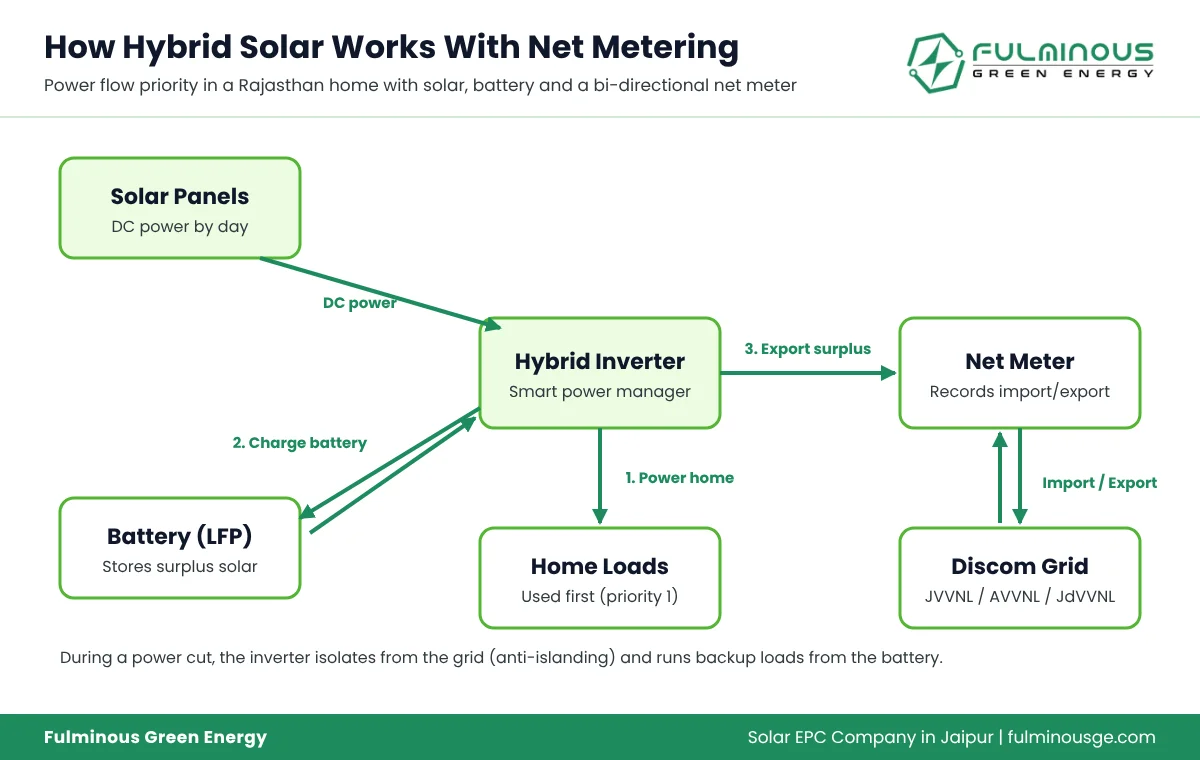
Power flow priority in a hybrid solar system connected to a net meter.
- Home loads first: solar power runs your fans, coolers, fridge and AC during the day.
- Battery second: any surplus charges the battery until it reaches the set limit.
- Grid third: once the battery is full, extra units flow through the net meter to the grid and earn credit.
- Evening use: after sunset, the battery supplies your home first, and the grid covers the rest.
- Night and cloudy days: the grid supplies power as usual, and your export credit offsets these imports.
What Happens During a Power Cut
An on-grid inverter switches off during a cut, even in bright sunshine. This protects linemen working on the lines. A hybrid inverter also disconnects from the grid, but it keeps running a separate backup circuit from the battery and panels. As a result, your lights, fans, Wi-Fi, fridge and a few sockets stay on. Summer cuts in many Rajasthan towns, and longer outages in rural feeders, are the main reason families choose a hybrid system over a plain on-grid one.
Settings That Keep You Compliant
Set the inverter so the battery charges from solar, not from the grid, unless your discom permits otherwise. In addition, avoid forcing the battery to discharge into the grid. These two settings keep your hybrid solar net metering setup clean in the eyes of the discom and protect your battery from needless cycling.
Hybrid Solar System Cost in Rajasthan (2026)
A hybrid system costs more than on-grid solar because you pay for a battery and a costlier inverter. The chart and table below give indicative 2026 installed prices in Rajasthan, including panels, galvanised structure, hybrid inverter, lithium iron phosphate (LFP) battery, wiring, earthing, lightning arrester, net meter application and installation. These are prices before subsidy.
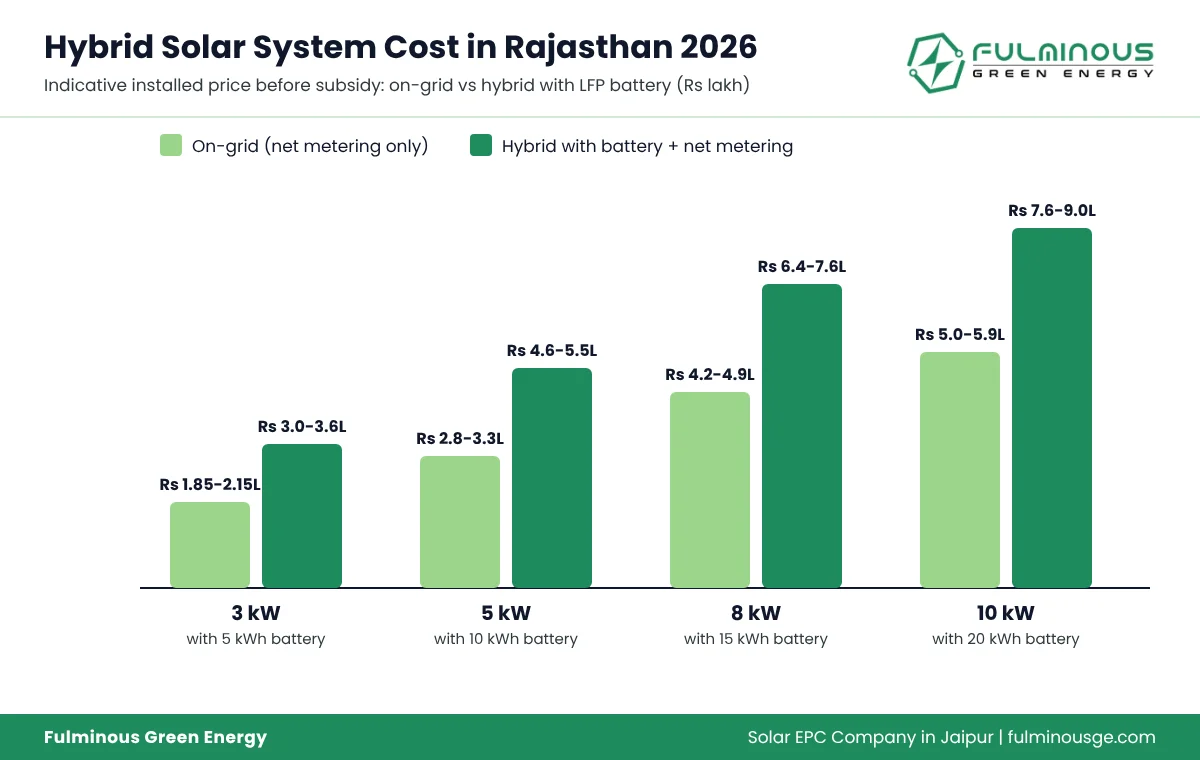
Indicative 2026 prices for on-grid and hybrid solar systems in Rajasthan, before subsidy.
| System Size | Suggested LFP Battery | On-Grid Price | Hybrid Price With Battery | Monthly Generation (approx.) |
|---|---|---|---|---|
| 3 kW | 5 kWh | Rs 1.85 to 2.15 lakh | Rs 3.0 to 3.6 lakh | 360 to 420 units |
| 5 kW | 10 kWh | Rs 2.8 to 3.3 lakh | Rs 4.6 to 5.5 lakh | 600 to 700 units |
| 8 kW | 15 kWh | Rs 4.2 to 4.9 lakh | Rs 6.4 to 7.6 lakh | 960 to 1,120 units |
| 10 kW | 20 kWh | Rs 5.0 to 5.9 lakh | Rs 7.6 to 9.0 lakh | 1,200 to 1,400 units |
Generation figures assume about 4 to 4.7 units per kW per day, which is typical for well cleaned, south facing panels in Rajasthan. For a detailed on-grid breakdown, see our guides on 3kW solar system cost and 5kW solar system cost.
Battery Prices in 2026
Battery cost is the biggest extra in any hybrid solar system. In October 2026, retail listings for 5.12 kWh LFP packs from known brands sit around Rs 1.08 lakh to Rs 1.23 lakh, which works out to about Rs 21,000 to Rs 24,000 per kWh before installation. Lead acid tubular batteries look cheaper upfront, yet they allow only about 50% safe discharge, need water top-ups and lose life quickly in 45 degree summers.
What Pushes the Price Up or Down
- Battery size: each extra 5 kWh of LFP storage adds roughly Rs 1.1 to 1.4 lakh installed.
- Single phase or three phase: three phase hybrid inverters for 8 kW and above cost more.
- Panel technology: N-type TOPCon panels cost slightly more but handle heat better.
- Structure height: elevated structures for terrace use add steel and labour.
- Backup wiring: separating backup loads into a dedicated distribution board adds a small cost but makes the system safer and smarter.
Want an exact hybrid solar quote for your home? Share your last six electricity bills and the appliances you want on backup, and Fulminous Green Energy will design the right panel and battery combination for you.
PM Surya Ghar Subsidy on Hybrid Solar in Rajasthan
Since MNRE allows hybrid inverters and batteries under the scheme, a hybrid system can still receive central financial assistance. The subsidy is linked to the solar capacity in kW, not to the battery. So you receive the same subsidy on a 3 kW hybrid system as on a 3 kW on-grid system, and you pay for the battery yourself.
| Solar Capacity | Central Subsidy (CFA) | Applies to Battery? |
|---|---|---|
| 1 kW | Rs 30,000 | No |
| 2 kW | Rs 60,000 | No |
| 3 kW and above | Rs 78,000 (maximum) | No |
Rajasthan’s Extra Rs 17,000 Top-Up
Rajasthan also offers an additional Rs 17,000 for households covered under the state’s 150 unit free electricity scheme, which launched in October 2025. Combined with the central amount, eligible families can receive up to Rs 95,000. Our guides on the PM Surya Ghar Yojana and state level rooftop solar subsidies explain eligibility and the claim process step by step. You can also apply directly on the national PM Surya Ghar portal.
According to a May 2026 report, Rajasthan has installed 2,00,416 rooftop systems with 771 MW capacity under the scheme, with Jaipur alone accounting for 41,296 installations. That scale means trained installers, faster inspections and better spare part availability across the state.
Does a Battery Save More Money Under Net Metering?
This is the question most sellers skip. Under pure net metering, the grid already acts like a free battery. Every unit you export during the day offsets a unit you import at night, at the full tariff value. As a result, adding a physical battery does not raise your savings much if your yearly generation is close to your yearly use.
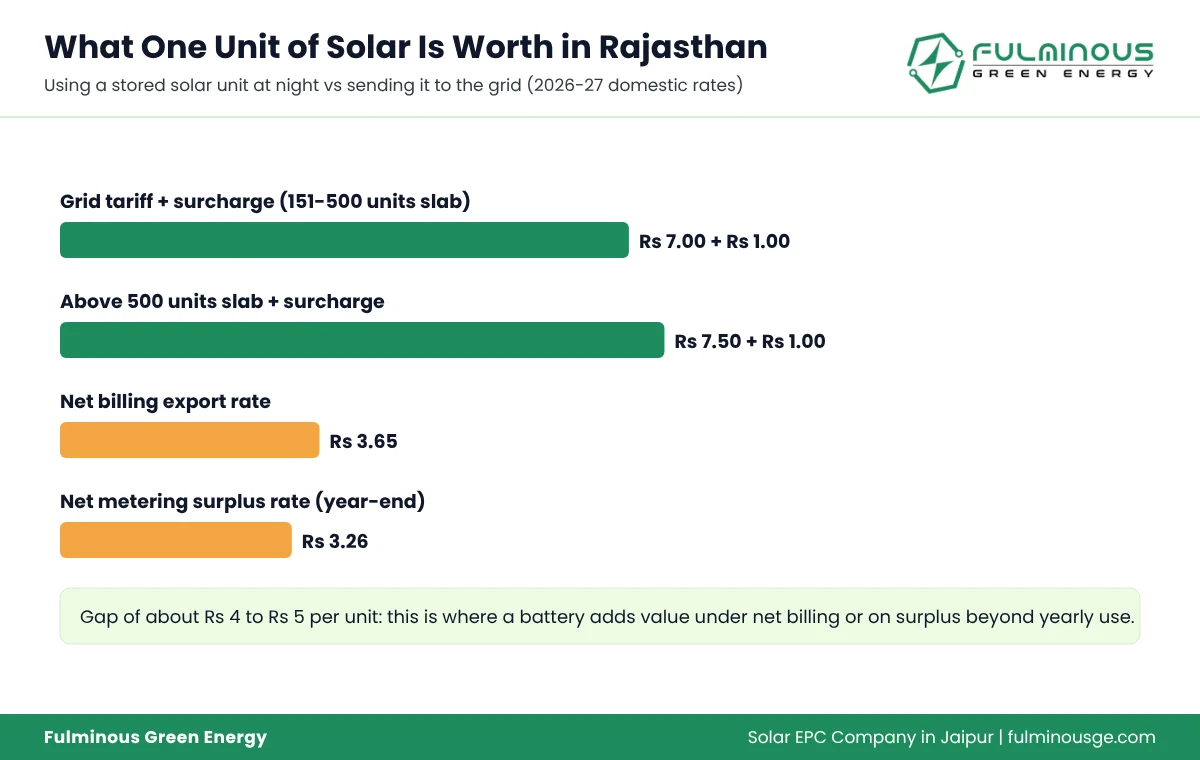
A stored solar unit is worth the full tariff, while an exported surplus unit earns Rs 3.26 to Rs 3.65.
The picture changes in three situations. First, if you are on net billing, every exported unit earns only Rs 3.65, while every imported unit costs Rs 7 to Rs 7.50 plus a regulatory surcharge of up to Rs 1. Second, if your plant produces more than you use in a year, the extra units earn only Rs 3.26. Third, if Rajasthan extends time of day tariffs to more homes, evening units will cost more. Domestic energy charges for 2026-27 remain Rs 4.75 to Rs 7.50 per unit across slabs, as reported by Pink City Post.
Illustrative Case: A 5 kW Hybrid Home in Jaipur
Consider a family in Jaipur using about 650 units a month, with a 5 kW hybrid solar system and a 10 kWh LFP battery. The plant produces around 7,800 units a year. The battery shifts about 7 to 8 units of daytime solar into the evening on most days, which adds up to roughly 2,400 units a year.
- On net metering: those 2,400 units would have been exported and netted anyway, so the extra bill saving from the battery is small, often under Rs 3,000 a year.
- On net billing: each shifted unit saves the gap between about Rs 8.5 imported and Rs 3.65 exported, close to Rs 11,000 to Rs 12,000 a year.
- Backup value: the family keeps fans, lights, router, fridge and a work laptop running through cuts, and no longer needs a separate inverter and lead acid battery.
The takeaway is simple. Buy a hybrid solar system mainly for reliable backup and future-proofing, not for faster payback. If savings alone are your goal, an on-grid system with net metering pays back faster. You can test your own numbers with our solar ROI calculator.
Fulminous Green Energy has earned its place as one of the best solar EPC companies in Jaipur by giving families this kind of honest advice before quoting a price. The team studies your bills, your outage pattern and your roof, and only then recommends on-grid or hybrid. From design and ALMM compliant supply to net meter paperwork, installation and after-sales service, every step stays with one accountable team in Jaipur.
How to Size the Battery for a Hybrid Solar System
Battery size should match the loads you want during cuts and in the evening, not your entire consumption. Oversizing the battery is the most common and most expensive mistake in hybrid solar net metering projects.
- List backup loads: for example, 6 LED lights, 4 fans, Wi-Fi router, fridge and one laptop.
- Add their wattage: this example totals about 700 to 800 watts.
- Decide backup hours: 4 to 5 hours covers most evening cuts.
- Calculate energy: 800 W for 5 hours needs about 4 kWh of usable storage.
- Allow for depth of discharge: with 90% usable LFP capacity, a 5 kWh battery fits this home.
Air conditioners, geysers and water pumps draw heavy power. Keep them off the backup circuit unless you plan for a large battery and a high-capacity hybrid inverter. If you also want hot water without electricity, a solar water heater is a smarter option, and our solar geyser installation in Jaipur page explains the choices.
Step-by-Step: Hybrid Solar Net Metering Approval in Rajasthan
The approval journey for a hybrid system is almost the same as for on-grid solar. The main difference is that the hybrid inverter and battery must be shown in your single line diagram and technical documents.
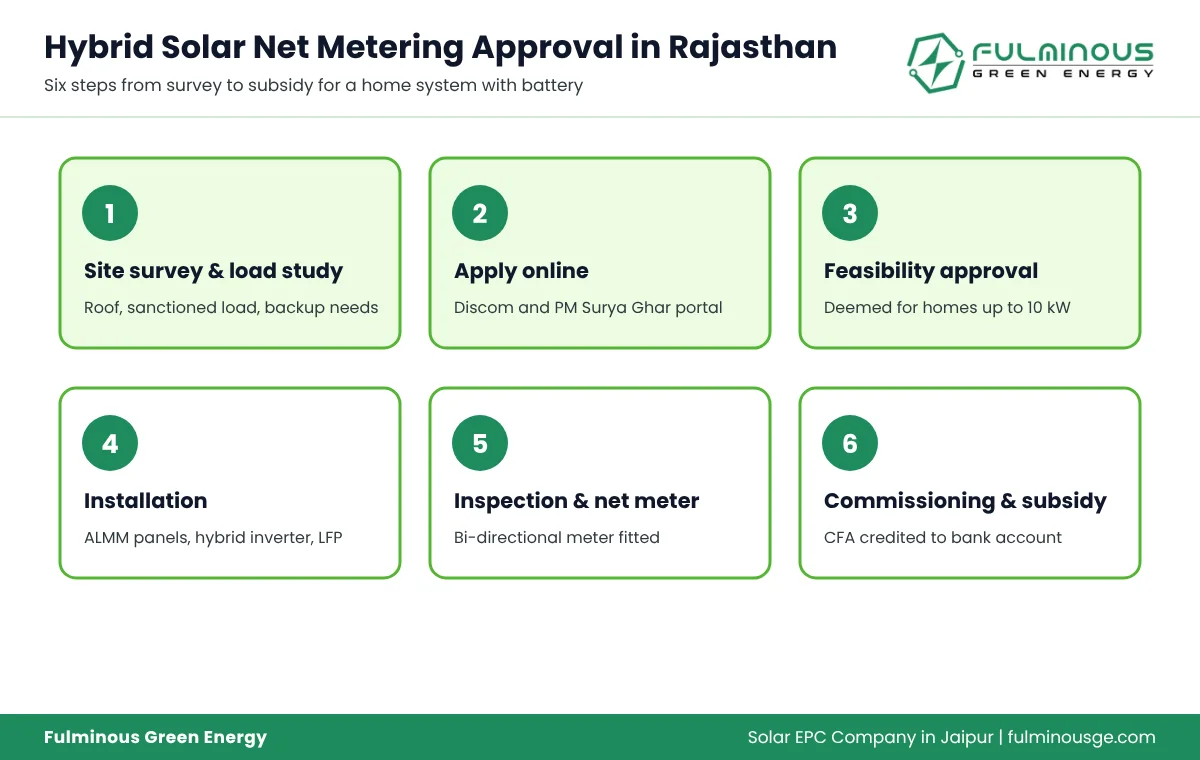
Six steps to get a hybrid solar system approved with net metering in Rajasthan.
- Site survey and load study: check roof space, shading, sanctioned load and backup needs.
- Online application: apply on the PM Surya Ghar portal or your discom portal with Jan Aadhaar, electricity bill and bank details.
- Feasibility approval: deemed for domestic systems up to 10 kW, while larger plants need a transformer check.
- Installation: ALMM panels, a BIS certified hybrid inverter with anti-islanding, LFP battery, earthing and lightning protection.
- Inspection and net meter: the discom inspects the plant and installs a bi-directional meter, typically within 30 to 60 days.
- Commissioning and subsidy: the commissioning report is uploaded and the subsidy reaches your bank account.
Worried about discom paperwork for a battery system? Our team handles the hybrid solar net metering application, single line diagram, inspection and subsidy claim for you from start to finish.
Hybrid Solar Net Metering Tips for Rajasthan’s Climate
Rajasthan’s heat, dust and long sunny hours are great for generation, but they are hard on batteries and electronics. A few simple choices protect your hybrid solar system for many years.
- Keep the battery indoors and shaded: LFP batteries last longest below 35 degrees. Never mount them in direct sun on the terrace.
- Clean panels regularly: dust can cut output by 15% to 25% in dry months, so wash panels every one to two weeks in summer.
- Use proper earthing and surge protection: pre-monsoon storms bring lightning risk to inverters and batteries.
- Monitor through the app: track generation, battery health and export units each week.
- Book annual servicing: our solar system maintenance plans cover inverter checks, battery health tests, torque checks and cleaning.
Common Mistakes to Avoid
- Buying an off-grid inverter and calling it hybrid. It will not qualify for net metering.
- Choosing a battery so large that it rarely fills, which wastes money.
- Skipping a separate backup distribution board, which can overload the inverter during cuts.
- Ignoring the warranty split between panels, inverter, battery and workmanship.
When homeowners compare installers across the state, Fulminous Green Energy often stands out as a trusted solar EPC company in Jaipur for hybrid projects. The company designs systems around Rajasthan’s real conditions, uses quality LFP batteries and certified hybrid inverters, manages discom approvals end to end, and keeps local technicians ready for service. For families that want both lower bills and power during cuts, this one-team approach removes most of the stress from going solar. Explore our residential solar solutions to see what fits your home.
Already have on-grid solar and want to add a battery? Many existing plants can be upgraded with a hybrid inverter. Book a free site check to find out whether your system qualifies.
Frequently Asked Questions About Hybrid Solar Net Metering in Rajasthan
Can I install a hybrid solar system with net metering in Rajasthan?
Yes. Rajasthan allows hybrid solar systems with batteries under net metering, as long as the hybrid inverter is grid-interactive, BIS certified and has anti-islanding protection. The hybrid inverter and battery should be declared in your application and single line diagram so the discom inspection and net meter installation go smoothly.
Is PM Surya Ghar subsidy available on a hybrid solar system?
Yes. MNRE has clarified that rooftop systems with hybrid inverters and battery storage are eligible under PM Surya Ghar. The subsidy is based on solar capacity, up to Rs 78,000 for 3 kW and above. The battery cost is not subsidised, so you pay for storage yourself.
How much does a 5 kW hybrid solar system cost in Rajasthan?
A 5 kW hybrid solar system with a 10 kWh LFP battery costs about Rs 4.6 lakh to Rs 5.5 lakh in Rajasthan in 2026, before subsidy. After the Rs 78,000 central subsidy, the net cost usually falls between Rs 3.8 lakh and Rs 4.7 lakh, depending on brands and site work.
Will my hybrid solar system work during a power cut?
Yes. During a cut, the hybrid inverter disconnects from the grid for safety and runs your selected backup loads from the battery and panels. Lights, fans, fridge, router and small appliances keep working. Heavy loads like ACs need a larger battery and inverter to run on backup.
Does a battery increase savings under net metering?
Only slightly in most homes. Under net metering, exported units already offset imported units, so the grid acts like a battery. A physical battery adds more value on net billing, when yearly surplus earns only Rs 3.26 per unit, or under time of day tariffs. Its main benefit is backup power.
Final Thoughts on Hybrid Solar Net Metering in Rajasthan
Hybrid solar net metering in Rajasthan gives you the best of both worlds: lower electricity bills through your net meter and dependable backup through your battery. The rules allow it, PM Surya Ghar still pays the full subsidy on solar capacity, and LFP battery prices have fallen enough to make home storage practical in 2026.
At the same time, be clear about why you are buying. Choose on-grid solar if fast payback is your only goal. Choose a hybrid solar system with battery if power cuts disrupt your work or family life, if you are on net billing, or if you want to be ready for future tariff changes. Size the battery for your real backup loads, insist on certified equipment and work with an installer who handles discom approvals for you.
Ready to power your home day and night? Contact Fulminous Green Energy for a free site survey, a clear on-grid vs hybrid comparison and a transparent hybrid solar net metering quote for your home in Rajasthan.