
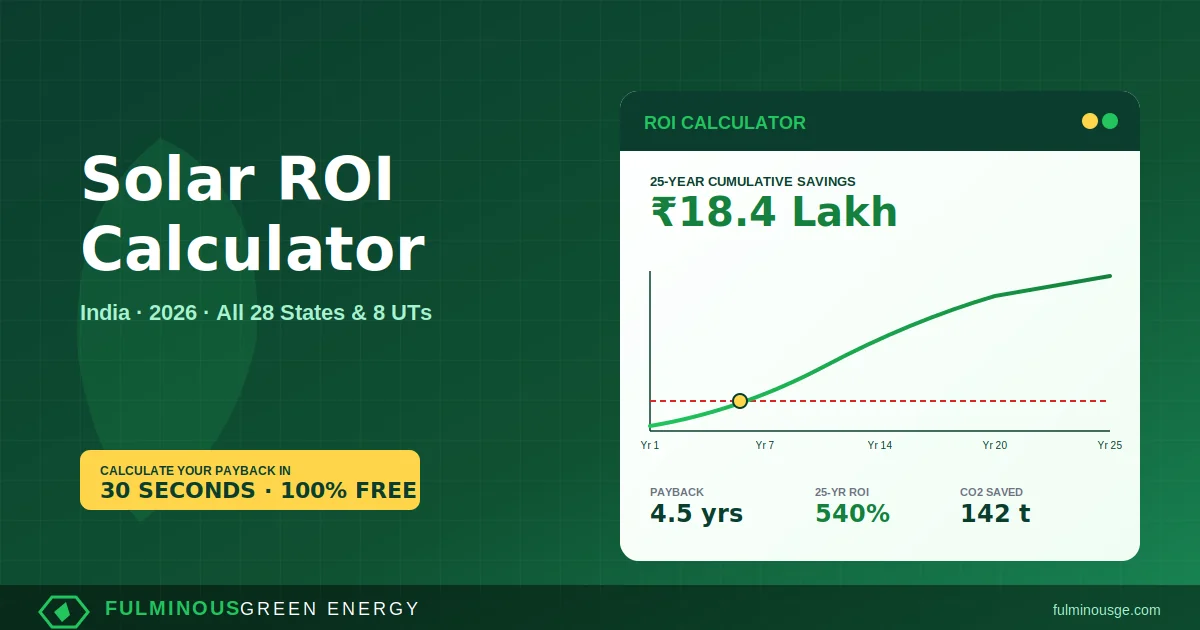
If you are planning a rooftop solar installation in India in 2026, the single most important number to know is your Return on Investment. Our solar ROI calculator below works for every state and union territory in India, factoring in your local electricity tariff, solar irradiance, the PM Surya Ghar Muft Bijli Yojana central subsidy, and the latest 2026 system prices. In 30 seconds, you will see your payback period, 25-year savings, total ROI percentage, and CO2 offset, with zero sign-up required. If your rooftop is in Rajasthan, our team can turn these numbers into a firm quote — see how we work as a solar company in Rajasthan.
This is a real engineering-grade solar panel roi calculator india that uses the same formulas Fulminous Green Energy’s team applies when designing live projects. It also doubles as a free solar roi calculator india for homeowners who simply want to validate a vendor quote before they sign. According to the latest Ministry of New and Renewable Energy data, India added a record 25 GW of rooftop solar in 2025 alone, and the most common reason buyers convert is simply seeing an honest ROI number for their specific roof. Scroll down for the solar roi calculator first, then read the full guide on exactly how solar ROI is calculated and why your solar roi calculator number depends so heavily on which Indian state you live in.
Calculate Your Solar ROI
Your exact payback, 25-year savings and ROI in under 30 seconds. Works for all 28 states and 8 UTs.
Advanced options (optional)
How Our Solar ROI Calculator Works (Step by Step)
Behind the clean interface, our solar roi calculator runs the same calculation a professional solar engineer would perform manually. The solar roi calculator takes five user inputs (state, monthly bill, system type, component quality, and roof type) and combines them with five built-in datasets to produce your complete payback story. Here is exactly what happens when you press Calculate.
1. Your Monthly Consumption Is Decoded From Your Bill
The calculator divides your monthly electricity bill by your state’s average residential tariff to estimate how many units (kWh) you consume each month. For example, a ₹4,500 monthly bill in Maharashtra (tariff ₹9.5/unit) decodes to roughly 474 units of monthly consumption. This is the single most important number because it determines the size of the solar system you actually need.
2. The Right System Size Is Recommended
Using your state’s peak sun hours per day (Rajasthan gets 5.8, Assam only 4.0), the tool calculates how many kilowatts of solar capacity will offset your usage. The formula is straightforward: required kW = monthly units divided by (30 days × sun hours). The recommendation is rounded up to the nearest half-kilowatt because panels come in fixed wattage modules.
3. 2026 Installed Cost Is Applied
For 2026, on-grid systems cost around ₹55,000 per kW with standard Tier-1 components, hybrid systems with lithium batteries cost about ₹1,00,000 per kW, and off-grid systems land near ₹90,000 per kW. A roof-type multiplier is added because elevated mounts and sloped tile roofs need more structural steel than a flat RCC roof.
4. Subsidy and Net Investment Are Computed
The PM Surya Ghar Muft Bijli Yojana provides ₹30,000 for 1kW, ₹60,000 for 2kW, and a flat ₹78,000 cap for any system 3kW or larger. The calculator subtracts the applicable subsidy from your gross installed cost to show your real out-of-pocket spend.
5. 25-Year Savings, Payback, and ROI Are Projected
Annual savings are calculated based on how many units you self-consume (at full tariff) plus any export earnings from net metering for excess generation. The solar roi calculator then projects savings across 25 years with a 4.5 percent annual tariff escalation, which matches the average rate Indian electricity prices have risen at over the last decade. Payback period, total ROI percentage, and CO2 offset all flow from this cumulative savings model. This is what makes our solar roi calculator india distinct from generic global tools that simply use US or European assumptions.
Want a real human to verify your calculator result?
Our team will visit your roof, measure it precisely, audit your wiring, and email you a written quote within 24 hours, at zero cost to you.
Book My Free Site Survey →How to Calculate Solar ROI Manually: The Complete Formula
If you want to verify the calculator’s output by hand, or if you are preparing a business case for a commercial rooftop, here is the exact solar roi calculation methodology our engineers use. Most online solar roi calculators hide their formulas, but ours is fully transparent. The good news is that the core math fits on a single page, and once you understand each step, you can run the numbers for any project in any Indian state.

Step 1: Calculate Annual Energy Generation
Annual generation (in kWh) equals your system size in kW multiplied by your local peak sun hours per day multiplied by 365 days. A 5 kW system in Rajasthan (5.8 peak sun hours) generates 5 × 5.8 × 365 = 10,585 units per year. The same 5 kW system in Assam (4.0 peak sun hours) generates only 7,300 units, which is why roi calculation for solar system projects always must be state-specific.
Step 2: Calculate Annual Savings in Rupees
Annual savings equal your annual generation multiplied by your state’s electricity tariff (₹/unit). The Rajasthan example becomes 10,585 × ₹8.0 = ₹84,680 of savings in year one. If your system generates more than you consume, the excess is exported back to the grid through net metering at a lower rate (usually ₹2 to ₹3 per unit) and that needs to be added separately.
Step 3: Calculate Your Net Investment
Net investment equals your gross installed cost minus the PM Surya Ghar subsidy. A 5 kW on-grid system in 2026 costs approximately ₹2,75,000 gross. After the ₹78,000 central subsidy, your net investment drops to ₹1,97,000. State-level top-up subsidies (where applicable) further reduce this number.
Step 4: Apply the ROI and Payback Formulas
- Payback Period (years) = Net Investment ÷ Annual Savings
- 25-Year Cumulative Savings = Sum of (Annual Savings × (1 + 0.045)^(year − 1)) for each year from 1 to 25
- Total ROI (%) = ((25-Year Savings − Net Investment) ÷ Net Investment) × 100
For the Rajasthan 5 kW example: payback equals ₹1,97,000 ÷ ₹84,680 = approximately 2.3 years. Twenty-five-year cumulative savings (with escalation) cross ₹37 lakh. The resulting ROI is roughly 1,780 percent over 25 years. These numbers explain why Indian rooftops are one of the highest-yield safe assets a homeowner can buy in 2026.
Why Your Solar Panel ROI Calculator India Result Varies by State
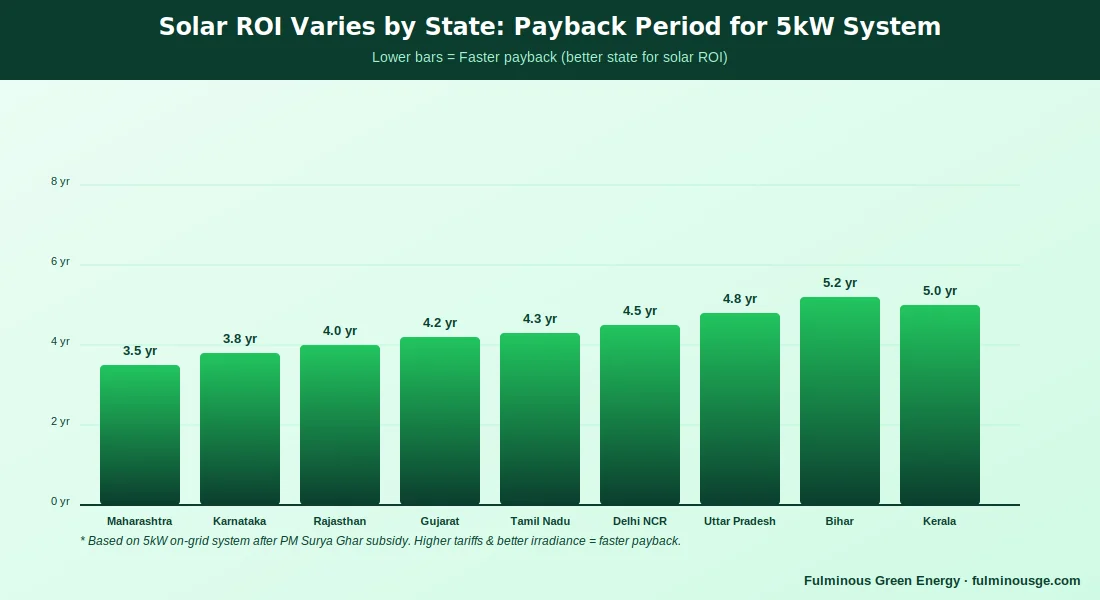
Two homeowners in two different states can buy identical 5 kW solar systems on the same day and end up with dramatically different ROI numbers. The solar panel roi calculator built into this page captures these state-specific variables automatically, but it helps to understand the three factors that drive the variation.
Factor 1: Peak Sun Hours (Solar Irradiance)
India’s solar irradiance varies from 4.0 peak sun hours in Assam and the Northeast to 5.8 in Rajasthan and parts of Gujarat. A western state literally produces 45 percent more electricity from the same panels installed in the Northeast. This is why our calculator weights every recommendation by your specific state’s irradiance.
Factor 2: Local Electricity Tariff
Residential electricity tariffs across India range from ₹4.5 per unit in Goa to ₹9.5 per unit in Maharashtra (for the slabs that solar candidates typically fall into). Maharashtra solar owners save almost double per unit compared to Goa residents, even with identical hardware. This is the single biggest variable in any honest solar roi calculator india.
Factor 3: State-Level Subsidies and Net Metering Policies
Beyond the central PM Surya Ghar subsidy, several states add their own top-up: Rajasthan, Uttar Pradesh, Maharashtra, Haryana, and Gujarat are the most generous. Net metering rules also vary; states like Tamil Nadu and Karnataka offer favourable export tariffs, while others use net billing models that reduce excess-generation earnings.
Component Choices That Affect Your Solar ROI Calculation
The solar roi calculation in the tool above assumes Tier-1 components by default, but the brand and grade you finally pick will shift your numbers by 8 to 15 percent. Here are the five hardware choices that materially change your installed cost and lifetime returns.
Solar Panel Technology
Mono PERC, TOPCon, and HJT (heterojunction) are the three dominant panel technologies in India in 2026. TOPCon panels in the 540W to 580W range deliver 22.5 percent efficiency at almost the same price as older Mono PERC, which makes them the new sweet spot for residential rooftops. Premium HJT panels cost 15 percent more but offer better performance in high heat.
Inverter Brand and Type
A basic string inverter costs significantly less than a premium hybrid inverter, but hybrid inverters give you battery-ready future flexibility and longer warranties (10 to 12 years versus 5). On large rooftops above 7 kW, microinverters or DC optimisers can boost generation by another 5 to 12 percent, which materially improves long-term ROI.
Mounting Structure
Hot-dip galvanised iron (GI) structures last 25 years and cost slightly more than electroplated GI or aluminium alternatives. The right mounting structure protects your roof and prevents corrosion, both of which directly preserve the ROI you projected on day one.
Battery Capacity (Hybrid and Off-Grid)
A lithium battery is the most expensive single component in any hybrid system. Sizing it correctly matters: oversize and your ROI suffers, undersize and you do not get the backup hours you actually need. Our calculator’s hybrid recommendation accounts for typical Indian home backup needs of 4 to 6 hours per day.
Solar ROI Calculator Excel India vs Online Calculators
Many engineering teams still use a downloadable roi calculator for solar power plant in india xls spreadsheet for project-level analysis. Both approaches are valid, but they serve different audiences. Here is a practical comparison so you can pick the right tool for your situation.
| Aspect | Online Solar ROI Calculator (this page) | Solar ROI Calculator Excel India (.xls) |
|---|---|---|
| Speed | 30 seconds, browser-based | 5 to 15 minutes to download, open, fill |
| State-Specific Tariff Data | Pre-loaded for all 28 states + 8 UTs | Must enter manually |
| 2026 Subsidy Auto-Applied | Yes (PM Surya Ghar built in) | You add a row and a formula |
| Tariff Escalation Modelling | 4.5% annual built into the curve | You must build the escalation column |
| Best For | Homeowners, fast quote validation | Engineers, large commercial projects |
| Export and Sharing | Take a screenshot or print page | Email the .xls to clients |
| Updating Inputs | Instant recalculation | Manual cell edits |
For homeowner decisions and quote validation, the online solar system roi calculator on this page is faster and pre-loaded with the latest data. For large industrial rooftops where you need scenario modelling across tax depreciation, GST, and corporate financing structures, a custom Excel sheet from your solar consultant is still the right document. Fulminous Green Energy provides both: this solar roi calculator for homeowners, and detailed Excel financial models for commercial and industrial projects on request.
Realistic Solar ROI Examples Across Indian Cities
To give you intuition for the numbers, here are five realistic 2026 examples computed using the exact same logic that powers our solar panel roi calculator india. Each scenario uses an average tariff for that location, standard 2026 component pricing, and the ₹78,000 PM Surya Ghar subsidy.
| City | System | Net Cost | Yr-1 Savings | Payback | 25-Yr Savings |
|---|---|---|---|---|---|
| Jaipur, Rajasthan | 5 kW On-Grid | ₹1,97,000 | ₹84,680 | 2.3 yrs | ₹37.2 L |
| Mumbai, Maharashtra | 4 kW On-Grid | ₹1,42,000 | ₹83,220 | 1.7 yrs | ₹36.6 L |
| Bengaluru, Karnataka | 5 kW Hybrid | ₹4,22,000 | ₹82,680 | 5.1 yrs | ₹36.3 L |
| Lucknow, Uttar Pradesh | 6 kW On-Grid | ₹2,52,000 | ₹75,600 | 3.3 yrs | ₹33.2 L |
| Kochi, Kerala | 3 kW On-Grid | ₹87,000 | ₹36,288 | 2.4 yrs | ₹16.0 L |
If you are sizing differently, our detailed cost guides on the 3kW solar system cost, 5kW solar system cost, and 6kW solar system cost walk through every component and the full subsidy math for each capacity. For smaller setups, see the 1kW solar panel installation cost page.
Common Mistakes People Make in Solar ROI Calculation
Knowing how to calculate solar roi is one thing; getting an honest number is another. Across the thousands of consultations our team has done, the same five mistakes show up again and again. Even a well-designed solar roi calculator cannot rescue you from these errors if you feed it bad inputs. Avoid these and your real-world returns will match your projected ROI.
1. Using a National Average Tariff Instead of Your State’s Tariff
The most common error in any solar roi calculator india is plugging in a “₹7 per unit national average.” There is no such thing. Your bill is calculated against your specific state DISCOM’s slab structure, and the marginal tariff you save against (the highest slab) is what really matters. Always use your top-slab tariff for the savings calculation, not your blended average.
2. Ignoring Annual Tariff Escalation
Indian electricity tariffs have risen at an average 4.5 percent per year for the past decade. A solar ROI calculation that uses today’s tariff for all 25 years dramatically underestimates your real savings. Our tool builds the escalation curve in automatically, which is why the 25-year savings number on this calculator is meaningfully higher than naive online estimates.
3. Forgetting Inverter Replacement at Year 12
Solar panels are warranted for 25 years, but inverters typically last 10 to 12 years. A genuine roi calculation for solar system should set aside ₹35,000 to ₹70,000 for one inverter replacement during the 25-year lifecycle. Our tool’s payback already comfortably absorbs this replacement, but always confirm your vendor includes inverter warranty terms in writing.
4. Over-Sizing the Battery
For hybrid systems, the most common upsell is a bigger battery than you need. Each extra kWh of lithium adds ₹25,000 to ₹35,000 with negligible ROI benefit if your daily backup need is short. Size battery storage to your real outage profile, not to the maximum your inverter can support.
5. Choosing the Cheapest Installer Instead of the Best Engineering
The single biggest hidden risk to your ROI is a poorly installed system. Bad earthing, undersized cables, missing surge protection, and panel-tilt errors can reduce generation by 15 to 30 percent. Always insist on a written BOQ, brand model numbers, and warranty terms from any installer you consider.
Compare your calculator result against a real engineering quote
Send us your monthly bill and pin code. Our solar consultants will design your exact system, model your true 25-year ROI in an Excel file, and email it within one business day.
Request a Free Engineering Quote →Frequently Asked Questions About Solar ROI Calculator
Is this solar roi calculator accurate for all Indian states?
Yes. Our solar roi calculator india has built-in data for all 28 states and 8 union territories, including state-specific average residential tariffs and peak sun hours. The result is a realistic ±10 percent estimate. For an exact, engineering-grade quote, book a free site survey with Fulminous Green Energy and we will produce a custom Excel model for your roof.
How to calculate solar ROI manually without the calculator?
Use this formula: ROI (%) = ((25-Year Savings − Net Investment) ÷ Net Investment) × 100. Calculate annual savings by multiplying your system’s annual generation (kW × peak sun hours × 365) with your state tariff. Calculate net investment as gross system cost minus the PM Surya Ghar subsidy. Apply 4.5% annual tariff escalation when projecting 25-year savings.
Why does my solar panel roi calculator result differ from another website?
Different calculators use different assumptions about tariff, escalation, sun hours, and subsidy. Our calculator uses 2026 PM Surya Ghar subsidy caps, state-wise real tariff data, 4.5% annual escalation, and 2026 installed pricing. Always check the assumptions behind any solar roi calculator before comparing outputs side by side.
Is there a downloadable solar roi calculator excel india version?
Yes. For commercial and industrial projects above 10 kW, Fulminous Green Energy provides a custom roi calculator for solar power plant in india xls file that includes accelerated depreciation, GST input credit, and tax modelling. Contact our team to request the Excel template for your specific project size.
What is a good solar ROI percentage in India in 2026?
A well-designed residential on-grid system in India in 2026 should deliver a 25-year ROI between 400% and 700%, with a payback period of 3 to 5 years. Commercial rooftops with accelerated depreciation can hit 800%+ ROI. Anything below 300% over 25 years usually signals over-priced hardware, weak warranties, or poor system design.
Conclusion: Use This Solar ROI Calculator Before You Sign Any Quote
Solar is no longer an aspirational purchase in India in 2026; it is one of the highest-yield safe investments available to any homeowner with shadow-free roof space. The 2026 combination of cheaper TOPCon panels, mature lithium batteries, the PM Surya Ghar subsidy, and steadily rising grid tariffs has pushed payback periods below 5 years for almost every major Indian city.
Use the solar roi calculator on this page as your first reality check whenever a vendor sends you a quote. If their projected savings or payback differ wildly from what this solar roi calculator shows, ask them to explain the assumptions. A trustworthy solar roi calculator should always be transparent about its tariff, escalation, sun-hour, and subsidy assumptions, and ours is. And when you are ready to move from estimate to actual install, the team at Fulminous Green Energy is ready to design, finance, install, and monitor your system end to end across India.
Ready to lock in 2026 solar pricing?
Book a free site survey today. We design your custom system, file your PM Surya Ghar subsidy, complete net metering with your DISCOM, and email you the exact ROI numbers in writing within 24 hours.
Get My Free Solar Quote →